By Marlon Dale Ferreira
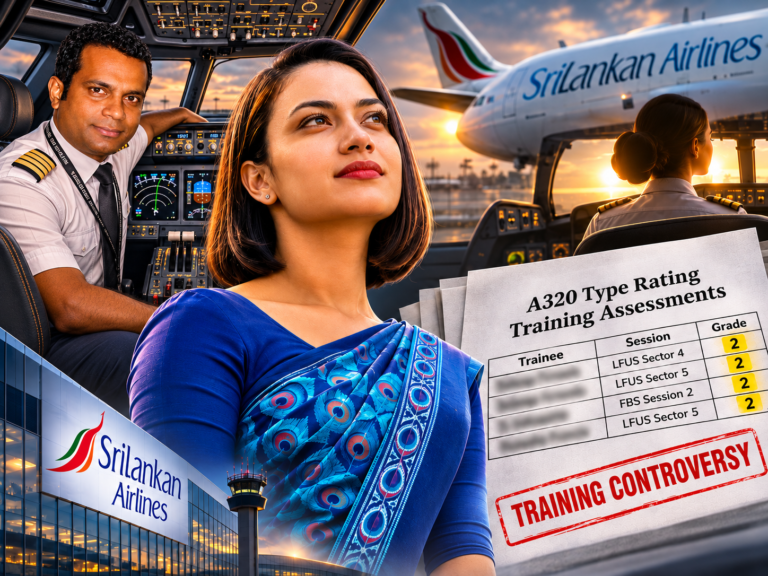
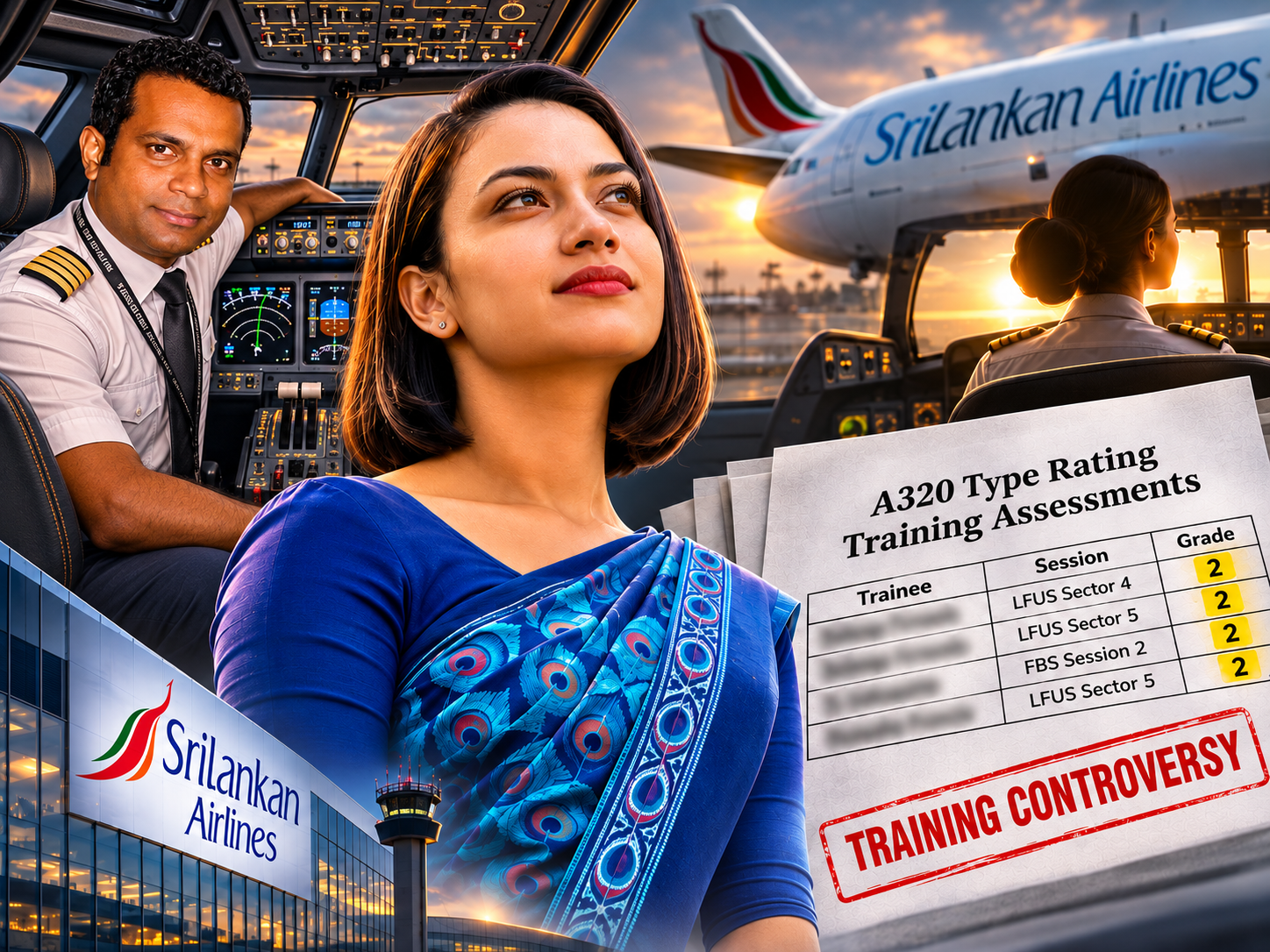
Newly examined grading records and earlier findings of management lapses raise concerns over whether an aspiring female pilot was denied the same opportunities afforded to other cadets.
COLOMBO, Sri Lanka – For former SriLankan Airlines flight stewardess ST, becoming a commercial pilot was more than a career ambition. It was a dream she had worked towards, saved for and sacrificed to achieve.
Having spent years serving passengers aboard aircraft, she longed for the day she could exchange the cabin for the cockpit.
But that dream came to an abrupt end when SriLankan Airlines terminated her pilot training after instructors determined that she had failed to meet the required standards.
Her opportunity to become a pilot was gone.

Now, against the backdrop of a controversial Airbus A320 training dispute involving the country’s current Director General of Civil Aviation, Captain Daminda Rambukwella, previously reported inconsistencies in SriLankan Airlines’ grading system have raised fresh questions about the fairness of ST’s termination.
Details of training records supplied to The Morning Telegraph identify several cadet pilots who reportedly received repeated low-grade assessments during individual training sessions, yet whose records warrant further examination to establish how decisions about their progression were made.
The information does not, by itself, demonstrate that those cadets were improperly advanced or that ST was wrongly terminated.
However, when considered alongside correspondence from a former Director General of Civil Aviation and findings attributed to SriLankan Airlines’ own Board Sub-Committee, the records raise a question the airline can no longer afford to overlook.
If SriLankan Airlines recognised that inconsistencies in its training system could adversely affect one aspiring pilot, did it examine whether those same shortcomings had already cost another trainee her career?
The Morning Telegraph is withholding ST’s full name to protect her privacy.
The Woman Left Behind in SriLankan Airlines’ Training Controversy
Much of the publicity surrounding SriLankan Airlines’ pilot-training controversy has centred on Captain Daminda Rambukwella, whose A320 Type Rating and subsequent training progression became the subject of a dispute involving several senior Type Rating Instructors and Type Rating Examiners, commonly known as TRIs/TREs.
As previously reported by The Morning Telegraph, six instructors questioned whether Rambukwella’s training assessments complied with the airline’s approved grading requirements.
Although his A320 Type Rating had been endorsed by the Civil Aviation Authority of Sri Lanka (CAASL), the instructors subsequently declined to conduct further training, including stages required before he could enter the airline’s operational flying cadre.
The dispute escalated to senior management and eventually reached the airline’s Board Sub-Committee.
What followed exposed significant concerns over the administration of SriLankan Airlines’ training assessment system.
At a meeting held on May 21, 2024, the Board Sub-Committee Human Resources and Remuneration Committee examined a proposal concerning Rambukwella’s training and surety bond.
According to the committee minutes described in The Morning Telegraph’s earlier investigation, confusion had arisen over grading criteria and the communication of revised training requirements.
The committee attributed shortcomings to Flight Operations Management and concluded that Rambukwella should not be held responsible for matters over which he had little control.
The airline consequently approved a waiver of approximately Rs. 8.7 million in training expenditure associated with his partly completed programme.
The Board’s findings did not establish that all disputed training assessments were satisfactory, nor did the waiver automatically entitle Rambukwella to complete the remaining operational training.
Nevertheless, the decision established an important point.
SriLankan Airlines had recognised that failures within its own training administration could adversely affect the professional future of a trainee.
That recognition now brings ST’s termination into sharper focus.
If management errors and inconsistent grading procedures were sufficiently serious to justify Board-level consideration in Rambukwella’s case, should the airline not also examine whether other trainees were disadvantaged by similar shortcomings?
Former Civil Aviation Chief Identified Inconsistent Grading
The concerns over SriLankan Airlines’ training standards were not confined to the objections raised by instructors in the Rambukwella dispute.
On February 16, 2024, former Director General of Civil Aviation P. A. Jayakantha wrote to the airline’s Head of Flight Operations, Captain Patrick Fernando, concerning the continuation of pilot training.
The correspondence, previously reported by The Morning Telegraph, followed Jayakantha’s examination of relevant training documentation and provisions of the airline’s Flight Operations Manual.
He reportedly identified instances in which instructors had not followed the approved marking system.
More significantly, he observed that some trainees had received more Grade 2 markings than permitted under the applicable criteria but had nevertheless been allowed to continue training and subsequently been cleared as Junior First Officers.
That observation raised concerns about the consistency of the assessment process.
If some trainees were permitted to progress despite markings that appeared to exceed prescribed thresholds, the airline needed to establish whether such decisions were authorised under the applicable training rules.
Equally important was whether those same provisions and opportunities were available to other trainees whose training had been terminated.
That includes ST.
Jayakantha’s intervention did not establish that every trainee receiving multiple Grade 2 markings had failed an assessment. But it provided an important basis for examining the consistency of the airline’s grading practices.
The Grading System That Could Determine a Pilot’s Future
SriLankan Airlines’ pilot-training programme employed a grading system ranging from 1 to 5:
- Grade 1 — Unsatisfactory
- Grade 2 — Minimum Acceptable Standard
- Grade 3 — Satisfactory
- Grade 4 — Good
- Grade 5 — Very Good
According to training provisions referred to during the earlier controversy, a single Grade 1 or three Grade 2 assessments could produce an unsatisfactory overall result during certain prescribed checks.
However, the rules governing individual instructional sessions and formal assessments must be distinguished.
A Grade 2 represents the minimum acceptable level for an individual graded item. Multiple Grade 2 markings may have different consequences depending on the type of assessment, the applicable manual and the overall performance criteria.
The Flight Operations Manual also reportedly contained provisions permitting instructors to exercise discretion when trainees had not achieved particular training objectives.
Such discretion could involve allowing a trainee to continue under prescribed conditions or requiring additional training before progression.
This distinction is central to ST’s case.
An instructor’s decision that a trainee requires additional training is not necessarily the same as a formal finding that the trainee has failed an entire training programme.
Similarly, a trainee permitted to progress after receiving low grades has not necessarily been improperly passed.
What matters is whether SriLankan Airlines applied the correct rules consistently to trainees undergoing comparable assessments.
If one cadet received remedial instruction, further assessment or an opportunity to continue under an authorised procedure, the airline must be able to explain whether similarly placed cadets were entitled to the same consideration.
Training Records Reveal Repeated Grade 2 Assessments
The Morning Telegraph has been supplied with details of training records identifying several cadets who reportedly received three or more Grade 2 markings during individual sessions or sectors.
The records identify the instructors associated with those assessments and provide a starting point for examining how the airline’s grading and progression requirements were interpreted.
Flight Training Grading Records
| Instructor | Trainee | Date | Training session | Grade 2 entries |
|---|---|---|---|---|
| Capt. Chaminda De Soysa | Dulanga Fernando | 12 Dec 2022 | LFUS Sector 4 | 4 |
| Capt. Chaminda De Soysa | Dulanga Fernando | 12 Dec 2022 | LFUS Sector 5 | 5 |
| Capt. Chaminda De Soysa | Dulanga Fernando | 15 Jan 2023 | LFUS Sector 39 | 3 |
| Capt. Nuwan Gunaratne | Dulanga Fernando | 16 Dec 2022 | LFUS Sector 7 | 3 |
| Capt. Nuwan Gunaratne | Dulanga Fernando | 16 Dec 2022 | LFUS Sector 8 | 3 |
| Capt. Nuwan Gunaratne | Dulanga Fernando | 16 Dec 2022 | LFUS Sector 9 | 4 |
| Capt. Rajind Ranatunga | S. Udugama | 24 Jan 2023 | LFUS Sector 5 | 3 |
| Capt. Pujitha Jayakody | S. Udugama | 6 Dec 2022 | FBS Session 2 | 3 |
| Capt. Anushka Jeewandara | Natasha Francis | 7 Mar 2023 | LFUS Sector 5 | 3 |
| Capt. V. K. Ekanayake* | Natasha Francis | Not provided | LFUS Sector 11 | 3 |
| Capt. Kamal Gunewardena | Natasha Francis | 19 Apr 2023 | LFUS Sector 51 | 5 |
What makes these records significant is not simply the number of Grade 2 markings.
It is the need to establish what happened after those markings were recorded.
Were the trainees required to undergo additional training?
Were the sessions repeated?
Did instructors exercise discretion under the Flight Operations Manual?
Were the overall assessments satisfactory under the rules applicable to those particular training stages?
And were comparable opportunities available to ST?
These are not questions that can be answered by examining the grades alone.
They require the original training sheets, the applicable manuals, the progression records and the documented reasons for the decisions made.
Nevertheless, the reported entries provide specific cases against which the consistency of SriLankan Airlines’ training procedures can be examined.
One Airline, Two Very Different Outcomes
The contrast between the Rambukwella controversy and ST’s experience deserves particular attention.
In Rambukwella’s case, the dispute resulted in senior management involvement, regulatory correspondence and a formal Board-level review.
The committee reportedly recognised shortcomings in the grading process and concluded that the trainee should not bear responsibility for identified management lapses.
In ST’s case, the information presently available establishes that her training was terminated following an adverse assessment.
What has not been established is whether she received a comparable review of the procedures used to determine her future.
The two cases cannot automatically be treated as equivalent.
They may have involved different stages of training, different assessment requirements and different performance records.
However, those distinctions need to be examined rather than assumed.
The essential issue is whether ST’s training was terminated under a grading process that SriLankan Airlines subsequently recognised as inconsistent or inadequately administered.
If the same procedural shortcomings affected her assessments, the airline would have a compelling reason to reconsider the decision.
If her termination occurred under different, correctly administered requirements, the records should make that distinction clear.
What should not happen is for an unresolved procedural question to remain unanswered simply because the trainee concerned lacked the prominence of another individual whose case reached the Board.
The Responsibility of Instructors and Management
Pilot instructors and examiners exercise considerable authority over the careers of aspiring aviators.
Their assessments determine whether trainees progress, receive remedial instruction, repeat exercises or face termination.
That authority carries an obligation to apply approved standards impartially and consistently.
The training records supplied to The Morning Telegraph identify several instructors associated with repeated Grade 2 markings.
Their inclusion does not imply that they acted improperly.
There may have been legitimate training reasons for allowing a particular cadet to continue, just as there may have been valid reasons for terminating another trainee’s programme.
But those decisions must be capable of explanation by reference to the applicable rules.
Where instructor discretion existed, the airline should be able to demonstrate how that discretion was exercised.
Where remedial training was authorised, there should be a clear record of the circumstances in which it was offered or withheld.
And where management intervened in disputed assessments, the reasons for those interventions should be documented.
The earlier Board-level findings concerning Rambukwella have already demonstrated the consequences of uncertainty surrounding training procedures.
An airline responsible for preparing commercial pilots cannot afford ambiguity over the standards by which their competence is measured.
Nor can it afford a system in which trainees are left uncertain about whether their professional futures are determined by consistently applied requirements.
Was ST Denied an Opportunity to Continue?
For ST, the consequences of the airline’s decision were profound.
Having previously worked as a flight stewardess, she had reportedly saved money from her employment to pursue the ambition of becoming a pilot.
The termination of her training therefore represented more than an unsuccessful professional assessment.
It brought an end to years of preparation, sacrifice and expectation.
That personal loss does not exempt her from the competency requirements imposed on every aspiring commercial pilot.
But neither should it prevent the airline from examining whether the process that ended her training was properly administered.
Several matters now require clarification.
The first is the precise grading criteria applied when ST underwent training.
The second is whether the assessments recorded against her constituted failures under the manual provisions effective at the time.
The third is whether she was offered the additional training, reassessment or review opportunities available under those provisions.
The fourth is whether trainees with genuinely comparable assessments were allowed to continue under instructor discretion or management intervention.
Finally, the airline must establish whether its subsequent recognition of grading discrepancies should have prompted a review of training terminations that might have been affected.
At present, the available information does not establish that ST was deliberately failed, nor does it prove that her instructors acted with improper motives.
But the documented concerns surrounding the wider training system make a careful review of her case a reasonable and necessary step.
SriLankan Airlines Must Examine Whether It Made a Mistake
The most significant development in this controversy remains the airline’s reported recognition that deficiencies in its own procedures could adversely affect a trainee.
That recognition carries consequences beyond the individual case considered by the Board.
When an organisation acknowledges that errors in training administration have occurred, the appropriate response is not merely to resolve the most prominent dispute.
It is also to determine whether the same errors affected other decisions.
ST’s case deserves consideration within that wider responsibility.
An independent review should examine her original assessment records, the applicable grading requirements and the reasons for terminating her training.
It should compare her circumstances with those of trainees assessed under genuinely equivalent conditions, rather than simply comparing the numbers of low-grade markings.
The review should also allow the relevant instructors, management officials and ST herself to explain the decisions and evidence.
Where the assessment process was correctly administered, that conclusion should be recorded.
But where a procedural mistake materially affected the decision to terminate a trainee, the airline should be prepared to provide an appropriate remedy.
For ST, that could include consideration of an opportunity to resume the appropriate stage of pilot training and undergo an independent reassessment, subject to current licensing, medical and competency requirements.
Such an opportunity would not mean overlooking poor performance or weakening aviation safety standards.
It would mean ensuring that an aspiring pilot was not permanently deprived of her career because of a mistake made by the institution responsible for training her.
And if SriLankan Airlines was prepared to acknowledge management shortcomings and provide relief in one disputed training case, it should be equally prepared to investigate whether another trainee suffered consequences from comparable failures.
The Dream That Never Took Flight
For years, ST walked through aircraft cabins carrying a dream that few of the passengers she served would ever have known.
She wanted to become a pilot.
She worked towards that ambition, saved for it and entrusted her future to a training system responsible for determining whether she possessed the competence to fly a commercial aircraft.
When her training was terminated, that dream came to an end.
Others continued their training. Some progressed into aviation careers.
ST was left behind.
There may have been legitimate reasons for that outcome.
But the controversies surrounding SriLankan Airlines’ training assessments, the concerns raised by a former Director General of Civil Aviation and the airline’s own reported recognition of management failures have created grounds for examining whether the decision that ended her ambition was reached fairly.
The issue is not whether ST should be permitted to fly an aircraft without meeting the required standards.
She should not.
The issue is whether she was given a fair opportunity to demonstrate that she could meet those standards.
If the evidence establishes that her training was terminated correctly, SriLankan Airlines should be able to explain the decision through its original records.
But if those records reveal that she was denied opportunities available to comparable trainees, or that recognised procedural errors contributed to her termination, the airline must confront the consequences.
An apology alone would not restore the years she invested.
A meaningful remedy would require consideration of how she might be given a fair opportunity to complete the training that ended so abruptly.
ST should not have to prove that she was already a qualified pilot to establish that she deserved a fair assessment.
She should only have to demonstrate that the rules governing her training were not correctly or consistently applied.
SriLankan Airlines now has an opportunity to establish the truth.
It can examine the records, explain its decisions and determine whether a woman who once dreamed of occupying an aircraft cockpit deserves another opportunity to prove herself.
Because a dream denied by a genuine failure to meet the required standard is a painful outcome.
But a dream destroyed by an institution’s own mistake is an injustice.
And if that mistake is established, SriLankan Airlines must be prepared not merely to acknowledge it, but to put it right.