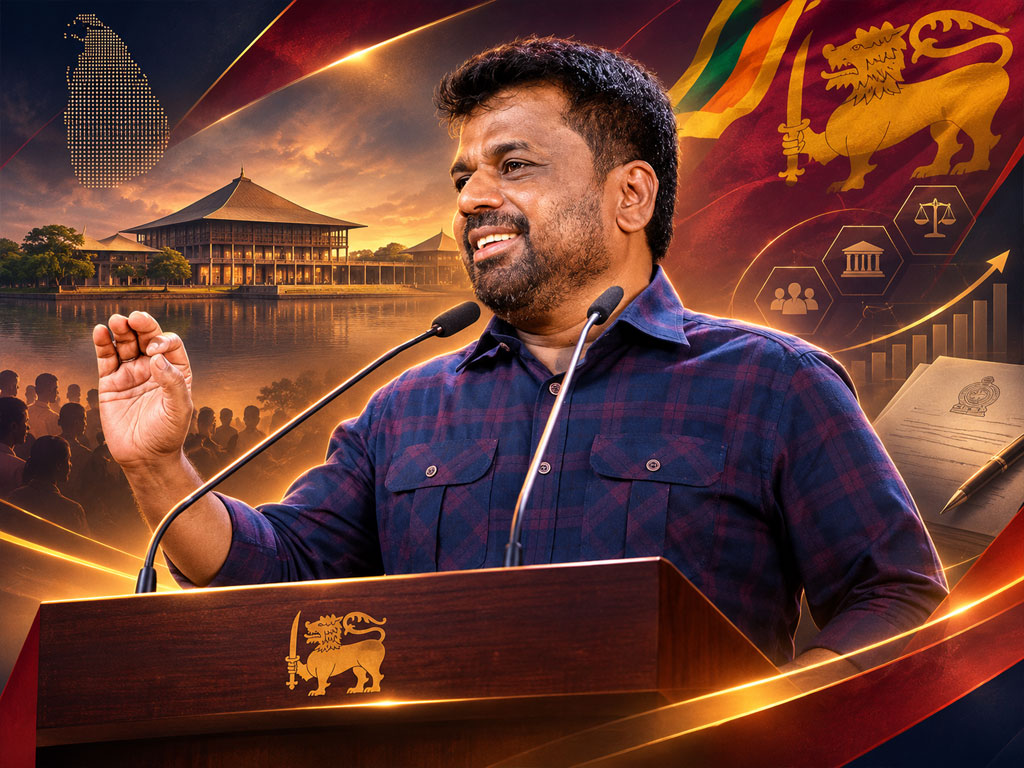
COLOMBO, November 14, 2026 – President Anura Kumara Dissanayake has declared that his government’s first responsibility is no longer to the political party that brought it to power, but to the people of Sri Lanka, insisting that citizens have the right to question, criticise and protest against those who govern them.
Addressing the 37th Il Maha Viru Commemoration on November 13, the President said the Janatha Vimukthi Peramuna (JVP), having spent most of its existence struggling for political power, must now adapt to the responsibilities of governing an entire nation.
He acknowledged that the movement could no longer use the failures of previous administrations to avoid responsibility for present-day problems.
Dissanayake also accused opposition parties of attempting to unite because they could see no immediate prospect of bringing down his government, while drawing sharp distinctions between his administration and the political establishment it replaced.
His address, delivered in remembrance of JVP founder Rohana Wijeweera and others killed during the party’s history, combined reflections on the movement’s political struggles with a call for a new relationship between the government and the public.

Sixty-One Years of Political Struggle and Transformation
The President began by commemorating those who lost their lives during the JVP’s turbulent history, particularly its founder Rohana Wijeweera.
He described the occasion as an opportunity not simply to remember fallen party members, but to reflect on the principles, aspirations and personal qualities that shaped the movement.
Thirty-seven years after Wijeweera’s death, Dissanayake said those principles continued to define the party’s political objectives.
Tracing its history, he recalled the JVP’s formation in 1965, the 1971 insurrection, its return to democratic political activity in 1978, the party’s proscription in 1983, its renewed participation in parliamentary politics from 1994 and its eventual electoral victory in 2024.
He argued that few political movements had experienced such varied conditions, ranging from violent repression and imprisonment to electoral defeat and the responsibilities of government.
During the 1971 uprising, many individuals who helped establish and develop the movement were killed or imprisoned, he said.
The party later returned to electoral politics, contesting by-elections, development council elections and presidential elections before facing another period of repression.
Its prohibition in 1983 and the violence of the late 1980s represented further turning points, culminating in the deaths of Wijeweera and other party leaders.
Dissanayake described the JVP’s emergence from those experiences and its eventual assumption of power in 2024 as evidence of the movement’s resilience.
He maintained that, despite the changing circumstances, its underlying purpose had remained consistent.
The Objective of Building a Just Society
According to the President, the central objective connecting the JVP’s various historical phases has been the creation of a just society for Sri Lanka and its people.
He said the movement had pursued that goal during periods of political repression, imprisonment, electoral participation and opposition activity.
The same objective, he argued, must now guide the administration.
Dissanayake referred to the deaths of party members during the 1988–1989 period, presenting their sacrifices as part of the struggle to achieve what he described as a better society.
In his account, the party’s political journey had been shaped by a continuing commitment that survived organisational setbacks, state repression and electoral defeats.
Before 2024, its central struggle had been to obtain political power in order to pursue that objective.
Since assuming office, the movement’s responsibility had changed from winning power to fulfilling the promises and principles for which it sought power.
That distinction, he said, represented one of the most important transformations in the party’s history.
Endurance, Sacrifice and Collective Responsibility
The President identified perseverance, endurance, sacrifice, collective decision-making and close relationships with ordinary people as qualities inherited from earlier generations of JVP activists.
He recalled the movement’s experience of bans, imprisonment, political attacks and periods of extremely limited public support.
Even when the party’s electoral support had fallen to approximately 3%, he said, its members had continued working towards their political objectives.
Dissanayake contrasted those difficulties with the challenges facing the movement in government, suggesting that the present circumstances were far less severe than the repression experienced by previous generations.
He said endurance remained important, although the nature of the challenges had changed.
Collective action was another principle he believed the movement had preserved.
According to the President, the JVP had built and sustained its organisation through the willingness of members to work together rather than pursue individual interests.
That approach, he argued, remained necessary for maintaining political power and implementing the government’s programme.
He also highlighted the party’s historical relationship with the public.
Listening to people’s concerns, understanding their daily lives and maintaining direct contact with communities were, in his view, essential characteristics of a successful political movement.
Whether operating under repression, participating in elections or exercising governmental authority, he said the party must maintain those connections.
The commemoration was therefore intended to renew the movement’s commitment to sacrifice, perseverance, unity and service.
Dissanayake urged members to demonstrate those qualities continuously rather than treating November 13 as an annual occasion for remembrance alone.
The objective of building a just society, he said, must remain part of the movement’s everyday political conduct.
President Claims Opposition Parties Are Uniting Against His Government
Turning to the current political environment, Dissanayake argued that opposition groups which contested the 2024 Presidential Election separately were increasingly attempting to work together.
He attributed this development to their inability to destabilise his administration.
According to the President, opposition politicians had initially expected the new government to collapse, but had subsequently recognised that there was no immediate prospect of that happening.
He claimed they were also responding to the government’s stated determination to apply the law without protecting individuals accused of fraud and corruption.
Those assessments represented Dissanayake’s interpretation of the opposition’s political motives.
He maintained that rival political groups were attempting to reorganise because his administration had established itself in power.
The President also criticised the political culture that existed before the 2024 elections, describing earlier alliances and parliamentary defections as having blurred the distinction between government and opposition.
Previous Governments Accused of Distorting Electoral Mandates
Dissanayake argued that Sri Lankan politics had previously operated through shifting alliances in which politicians elected on opposing platforms frequently joined the same administration.
He said voters had sometimes witnessed candidates they rejected at elections subsequently obtaining ministerial positions in the government they had opposed.
In his assessment, such arrangements weakened the connection between electoral choices and the composition of government.
The President referred to the circumstances surrounding the country’s previous political transitions, arguing that political alliances had made it difficult for voters to distinguish competing parties and their responsibilities.
He described that system as a form of political hybridity in which the identities of government and opposition were obscured.
The same lack of distinction, he alleged, had extended to governance practices and the treatment of corruption.
Political groups that appeared to oppose one another publicly had, according to Dissanayake, often behaved similarly when exercising power.
He claimed that the parliamentary mandates given by voters were consequently distorted after elections.
By contrast, the President argued that the 2024 Presidential and Parliamentary Elections had established a clearer division between those entrusted with governing and those elected to oppose the administration.
He described the preservation of that distinction as an important change in Sri Lankan political culture.
Two Political Camps With Opposing Principles
Dissanayake presented the current political environment as a contest between two competing approaches to governance.
He characterised one as an established political culture associated, in his view, with corruption, criminality, family-centred power, communal divisions and outdated practices.
The other, he argued, represented his government’s efforts to establish democratic accountability, national unity and development based on scientific knowledge.
The President outlined several distinctions that he believed separated the two camps:
- Corruption and accountability: He accused previous political leaders of engaging in corruption and attempting to protect themselves, while claiming that his administration was working to prevent wrongdoing and hold offenders accountable.
- Crime and the rule of law: He alleged that earlier administrations had contributed to the development of what he called a criminal state, contrasting that with his government’s stated objective of reforming public institutions and strengthening the application of the law.
- Family-centred governance: He criticised political systems dominated by powerful families and maintained that his administration was committed to respecting citizens’ democratic rights.
- Racial and religious divisions: The President accused rival political groups of exploiting ethnic and religious differences for political advantage, while presenting national unity and equal citizenship as principles of his government.
- Science and modern technology: He criticised political dependence on charms, curses and superstition, arguing that Sri Lanka’s development should instead be guided by modern technology, science and knowledge.
These allegations were made as part of the President’s political address and do not, by themselves, establish wrongdoing by the individuals or organisations he criticised.
Dissanayake maintained that the contrast between the competing political approaches was becoming increasingly visible to the electorate.
Media Organisations Also Accused of Taking Political Sides
The President extended his criticism to sections of the media, alleging that certain organisations were aligned with what he described as the destructive political establishment.
He argued that the increasingly sharp distinction between political camps was also becoming apparent among media institutions.
Dissanayake suggested that some outlets continued to represent the interests of established political groups opposed to his government’s programme.
He also referred to divisions among sections of the Buddhist clergy, observing that the broader political separation had become visible beyond Parliament and party organisations.
His comments reflected a wider argument that Sri Lankan society was experiencing a clearer division between competing political outlooks.
The President did not, in the supplied speech, identify specific media institutions or provide evidence establishing misconduct by individual journalists or organisations.
President Warns Against Opposition Frustration
Dissanayake also claimed that opposition forces had become increasingly frustrated because of their weakened political position.
He argued that political helplessness could produce stress, weaken self-restraint and encourage conduct that might otherwise be avoided.
The President described this as a potential source of disorder within movements opposing the government.
He maintained that the JVP’s long experience of political struggles had prepared it to withstand such challenges.
According to Dissanayake, the movement’s endurance through repression, imprisonment and electoral setbacks gave it confidence in confronting present political opposition.
He expressed his belief that the administration would overcome those challenges while continuing to pursue its stated objectives.
At the same time, his comments illustrated the increasingly confrontational language being used in the debate between the government and its political opponents.
Governing Requires a Different Political Mindset
One of the President’s central arguments concerned the transformation required within his own movement following its electoral success.
Dissanayake said the responsibilities facing the JVP had changed repeatedly during its history.
Establishing the party, responding to repression, operating under prohibition, contesting elections and participating in democratic politics had each demanded different approaches.
For most of its existence, however, the movement’s principal objective had been to acquire political power.
Having achieved that goal in 2024, he argued that the party now faced a fundamentally different responsibility.
It was no longer sufficient to organise political activity around the struggle to gain power.
The movement had to change its thinking, behaviour and working methods to meet the expectations of the electorate.
He urged party members and government representatives to develop new approaches capable of addressing the responsibilities of administration.
The President stressed that political experience gained in opposition could not automatically be treated as adequate preparation for governing.
The new circumstances required the movement to become more conscious of its obligations to the country.
Government’s First Responsibility Is to the People
Dissanayake’s most direct message concerned the relationship between party loyalty and public accountability.
He acknowledged that, during the JVP’s years in opposition, members had directed much of their responsibility towards the party and its internal political objectives.
That relationship, he said, had changed following the movement’s assumption of governmental authority.
“In the past, we were more responsible to the party. But in the process of governance, we are primarily responsible to the people.”
He explained that internal party problems could be discussed, examined and resolved through organisational structures.
Government, however, was fundamentally different because decisions affected the entire population rather than party members alone.
The President said ministers, deputy ministers, local government representatives, council chairpersons and public officials had to recognise that their accountability extended to the citizens they served.
This required greater care in their conduct, public statements and official decisions.
He argued that those exercising governmental authority must continually assess whether their actions reflected their obligations to the public.
The responsibilities of office, he said, demanded changes not only in policy but also in political attitudes and behaviour.
Previous Governments Can No Longer Be Blamed for Every Problem
The President acknowledged that his administration could not indefinitely attribute present difficulties to the conduct of earlier governments.
Although the JVP had spent decades criticising previous administrations, the responsibility for addressing the country’s current problems now rested with those exercising authority.
Dissanayake said the government could not escape accountability by arguing that particular issues had originated before it assumed office.
He maintained that the public had given his political movement a mandate to govern and was therefore entitled to expect the administration to take responsibility for matters arising during its tenure.
The President’s remarks marked a distinction between explaining the historical causes of a problem and accepting responsibility for dealing with its consequences.
He said government representatives must recognise that they were accountable to the people presently affected by their decisions.
The administration, he argued, had to confront existing problems rather than use the shortcomings of its predecessors as a justification for inaction.
Citizens Have the Right to Criticise and Protest
Dissanayake also called for a fundamental change in the relationship between rulers and citizens.
He criticised what he described as a long-established culture in which people feared political leaders and treated them as figures who could not be questioned.
According to the President, such attitudes had existed at different levels of government.
He described communities in which residents feared local council members, provincial populations feared ministers and ordinary citizens were reluctant to challenge national leaders.
Dissanayake argued that this relationship of fear and submission was incompatible with the political culture his administration wanted to establish.
He said the government must recognise the public’s right to question decisions, criticise officeholders and organise protests.
The President maintained that citizens were entitled to hold their representatives accountable because those representatives had been entrusted with public responsibilities.
He emphasised that political authority should not place rulers beyond scrutiny.
Instead, the relationship between government and the governed should be based on the public’s ability to challenge decisions and demand explanations.
Dissanayake said the administration did not want citizens to live in fear of political authority.
Its objective, he argued, was to create a society in which questioning the government became a normal part of democratic life.
President Calls for Civility in Political Criticism
While defending the public’s right to criticise the government, Dissanayake also addressed the language and conduct of some political opponents.
He said sections of society remained unfamiliar with the freedom to question political authority because of their experience under earlier systems of governance.
According to the President, some critics had responded to the changing relationship between rulers and citizens by using increasingly offensive language.
He argued that public criticism should be exercised within a framework of civility.
Dissanayake maintained that freedom to criticise did not require the use of abusive or degrading language.
He said some supporters had questioned why the government tolerated such criticism.
His response was that people should be allowed to express their views, even when those views were hostile towards the administration.
The President expressed confidence that society would ultimately reject criticism that failed to meet acceptable standards of public conduct.
He insisted that his government would not become agitated by offensive remarks and that political leaders must develop the capacity to withstand public disapproval.
The distinction he sought to draw was between protecting the right to criticise and encouraging responsible public debate.
A New Relationship Between Government and Citizens
Dissanayake concluded by linking his call for public accountability with the wider economic and political transformation promised by his administration.
He said the government had begun a process intended to change both the country’s political culture and its economic direction.
That transformation, he argued, could not be achieved without changing the relationship between political leaders and ordinary citizens.
The JVP’s history of collective struggle, sacrifice and perseverance had brought it to a position of governmental authority.
Its next challenge was to demonstrate that the principles it defended while seeking power could guide its conduct in office.
The President called on party members and representatives to remain united, adapt to new responsibilities and continue working towards the movement’s long-standing objective of building a just society.
His speech ended with an invitation to members to confront the challenges of government through renewed commitment and collective action.
The political significance of the address lies in the standard Dissanayake has now publicly established for his own administration.
Having declared that citizens must be free to criticise, question and protest against their rulers, and that the government must take responsibility for present problems, the President has placed public accountability at the centre of his stated governing principles.
The extent to which those commitments are reflected in government decisions, the treatment of criticism and the conduct of public officials will ultimately determine whether the political transformation he described becomes a lasting change in Sri Lanka’s democratic culture.