COLOMBO, November 19, 2026 — Fitch Ratings says Sri Lanka’s 2027 Budget keeps public debt on a downward path despite higher infrastructure and cyclone-reconstruction spending. However, the agency warns that the country’s debt burden and interest payments remain exceptionally high.
Sri Lanka’s 2027 Budget demonstrates the Government’s continued commitment to fiscal discipline and debt reduction, although higher public investment and reconstruction expenditure are expected to widen the fiscal deficit, according to international credit rating agency Fitch Ratings.
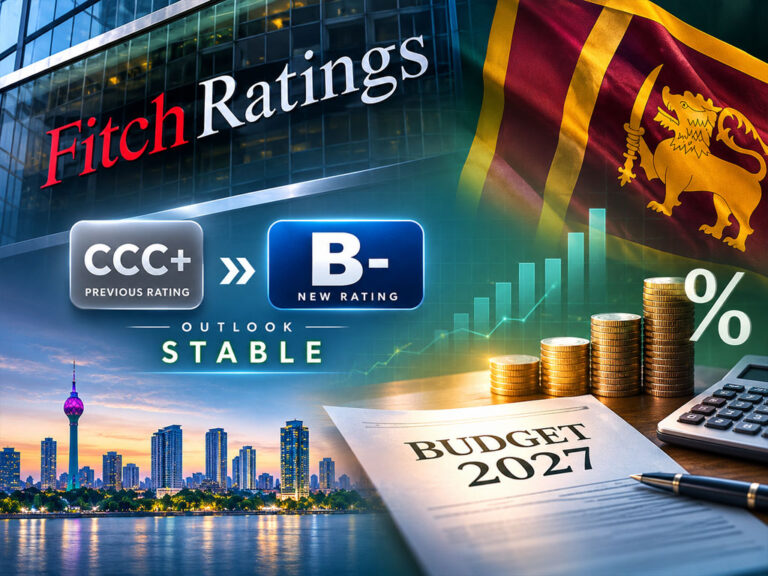
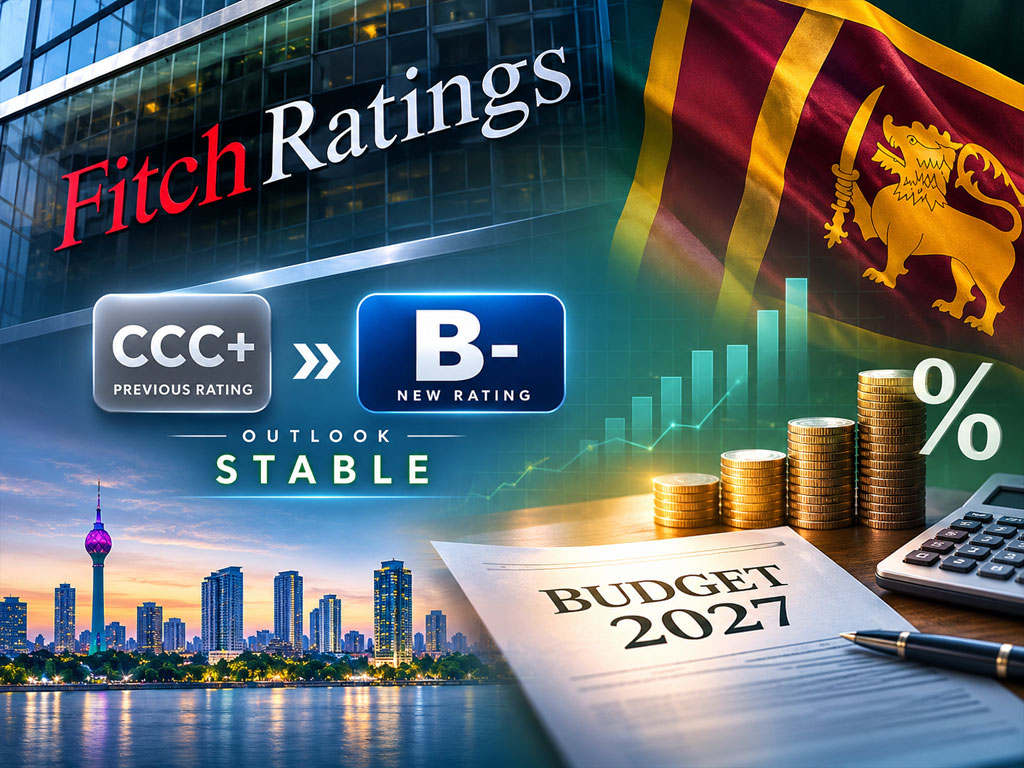
In an assessment issued from Hong Kong on November 18, Fitch said the Budget remained broadly consistent with the economic assumptions underpinning its September decision to upgrade Sri Lanka’s sovereign credit rating from CCC+ to B-, with a Stable Outlook.
The agency attributed the improvement to stronger fiscal performance, sustained primary budget surpluses and the Government’s commitment to reducing debt following the country’s economic crisis.
Nevertheless, Fitch warned that Sri Lanka’s public debt and debt-servicing obligations remain significantly higher than those of other countries with comparable credit ratings.

Primary Surplus Target Falls to 2.3% of GDP
The 2027 Budget targets a primary surplus of 2.3% of gross domestic product (GDP), compared with Fitch’s estimate of 3.6% for 2026.
The estimated 2026 performance exceeds both the 2.5% target in the previous Budget and Fitch’s earlier forecast of 2.6%, reflecting stronger-than-expected Government revenue.
A primary surplus arises when Government revenue exceeds expenditure before interest payments on public debt are included.
Although the targeted surplus is lower in 2027, Fitch considers it sufficient to support continued debt reduction.
The overall fiscal deficit is projected to widen from 3.7% of GDP in 2026 to 4.5% in 2027, reflecting weaker revenue growth and increased capital expenditure.
Fitch described the Budget’s underlying assumptions as credible and broadly consistent with its September sovereign review.
The agency had previously forecast a 2027 primary surplus of 2.8% of GDP, slightly above the Government’s new target because it had anticipated lower expenditure.
It also noted that delays in implementing capital projects could result in actual expenditure falling below budgeted levels, potentially producing a higher primary surplus.
Spending Exceeds Legal Ceiling to Fund Cyclone Reconstruction
One of the most significant features of the Budget is the planned increase in primary Government expenditure to 13.6% of GDP.
This exceeds the 13% ceiling established under the Public Finance Management Act of 2024.
Fitch attributed the temporary deviation principally to reconstruction following Cyclone Ditwah and the Government’s broader public investment programme.
The spending plans include Rs. 260 billion carried forward from reconstruction funding approved through a supplementary budget in December 2025.
Although Parliament approved the original allocations, a substantial portion remained unspent during 2026 because of delays in implementation.
The Government intends to utilise the outstanding funds during 2027 to support reconstruction and rehabilitation.
This marks the second consecutive year in which the Government has sought a temporary deviation from the expenditure ceiling.
However, Fitch noted that actual spending remained below the statutory limit in 2026 because allocated capital expenditure was not fully utilised.
The central challenge in 2027 will be delivering reconstruction projects while maintaining sufficient financial discipline to satisfy the country’s medium-term fiscal objectives.
Government Revenue Expected to Decline
Fitch expects Government revenue to moderate after two years of relatively strong collections.
Revenue is budgeted at 15.8% of GDP in 2027, down from 16.6% in 2026 and 16.7% in 2025.
The decline partly reflects the expected normalisation of vehicle imports.
Sri Lanka’s reopening of the vehicle import market generated substantial customs revenue as previously suppressed demand was released.
That temporary boost is expected to diminish as vehicle imports return to more normal levels.
However, Fitch believes efforts to broaden the tax base and improve compliance are creating more sustainable sources of Government revenue.
Maintaining those improvements will be essential if Sri Lanka is to continue generating the primary surpluses required for debt reduction.
Budget Remains Aligned With IMF Programme
Fitch said the 2027 Budget remains broadly aligned with the parameters of Sri Lanka’s International Monetary Fund programme.
The assessment is important as the country approaches the seventh review of its Extended Fund Facility.
The existing programme is scheduled to conclude in March 2027.
The Government has announced the establishment of a committee to consider whether a follow-on arrangement with the IMF would be appropriate.
Fitch believes another programme could provide an additional policy framework supporting fiscal discipline and economic stability.
No decision to enter a new programme has been finalised.
For Sri Lanka, maintaining investor confidence and policy continuity will become increasingly important as debt repayments resume and the country seeks to strengthen its access to international financial markets.
Public Debt Projected to Fall to 92% of GDP
Despite Sri Lanka’s substantial fiscal adjustment, Fitch warned that debt vulnerabilities remain considerable.
The agency forecasts Government debt will decline to approximately 92% of GDP in 2026, compared with 115% in 2022.
That represents a marked improvement following debt restructuring and stronger fiscal management.
However, Sri Lanka’s projected debt ratio remains far above the 55% median for sovereigns rated in Fitch’s B category.
The gap illustrates the continuing financial challenges facing the country.
Even with progress in debt reduction, the Government must sustain healthy fiscal balances over several years to strengthen its capacity to service outstanding obligations.
Interest Payments Continue to Consume Government Revenue
Fitch also highlighted the heavy cost of servicing Sri Lanka’s public debt.
Interest payments are forecast to absorb approximately 41% of Government revenue in 2026, compared with nearly 80% in 2023.
Although the reduction is substantial, the projected figure remains more than three times the 12.7% median for B-rated sovereigns.
This limits the Government’s flexibility to allocate resources towards infrastructure, healthcare, education and other development priorities.
Fitch considers a sustained record of fiscal discipline and strong primary surpluses essential to improving debt sustainability.
The Government’s medium-term objective is to maintain a primary surplus of 3% of GDP.
Achieving that target while complying with the statutory expenditure ceiling could require difficult decisions over spending priorities and revenue collection.
Economic Growth Depends on Investment and Reform
Fitch forecasts Sri Lanka’s medium-term potential economic growth at approximately 4.2%.
The agency believes higher public investment could strengthen the country’s growth prospects, provided expenditure is effectively targeted and projects are implemented as planned.
However, increased budget allocations alone will not guarantee stronger economic performance.
The outcome will depend on capital expenditure execution, the quality of investment decisions and progress in structural reforms.
Poorly implemented projects could increase expenditure without delivering the productivity improvements needed to support long-term growth.
Fitch said continued fiscal credibility, revenue mobilisation and expenditure restraint would remain central to future improvements in Sri Lanka’s sovereign credit rating.
Debt Reduction Remains the Decisive Test
Fitch’s assessment offers qualified support for the Government’s economic strategy.
The 2027 Budget preserves a framework for debt reduction while allowing additional spending on reconstruction and investment.
Yet the country’s fiscal recovery remains vulnerable to implementation delays, weaker revenue, external economic shocks and the substantial burden of interest payments.
The Government must balance the immediate need to rebuild damaged infrastructure and stimulate growth against the longer-term requirement to reduce public debt.
The success of the Budget will ultimately depend not only on maintaining fiscal targets, but also on whether public investment generates sustainable growth and strengthens the country’s capacity to meet future debt obligations.
For Fitch, the prospect of further rating improvements rests on that continuing record of credible fiscal management, rather than on the Budget’s commitments alone.
SOURCE:- FITCH RATINGS