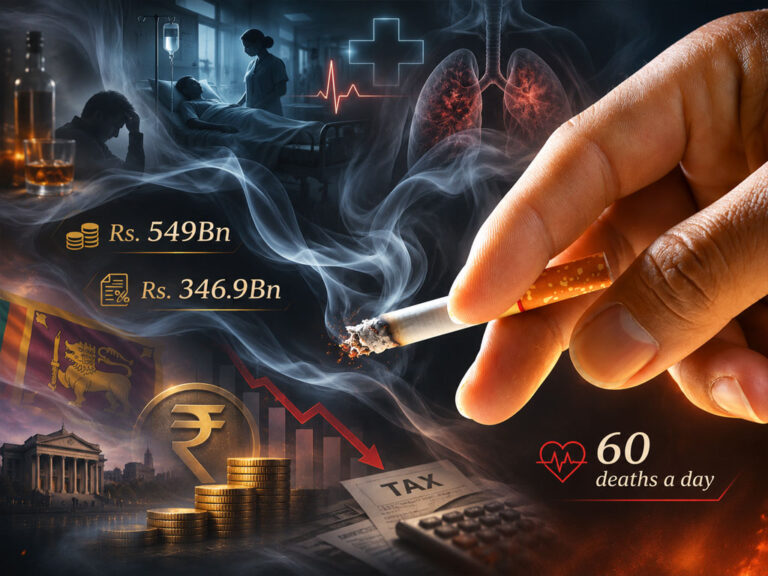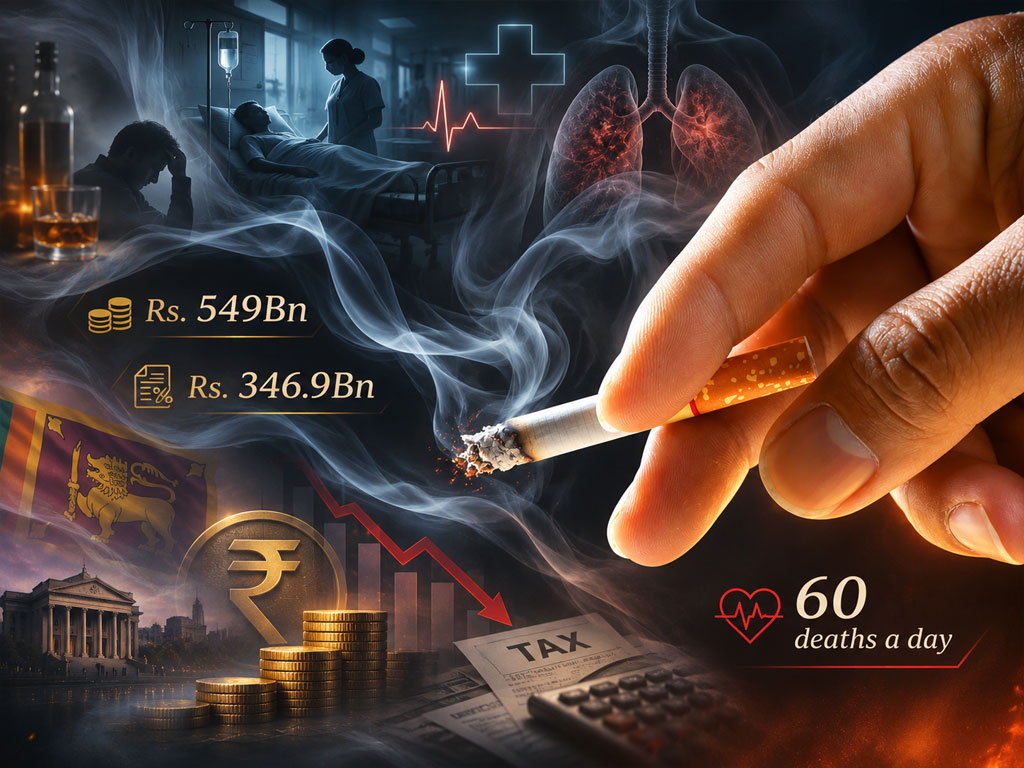
COLOMBO, November 28, 2026 — Sri Lanka faces an estimated Rs. 549 billion in health and economic losses linked to tobacco and alcohol, compared with Rs. 346.9 billion in reported tax revenue. Figures presented to Parliament have exposed the scale of the burden and renewed calls for stronger taxation and public health policies.
Sri Lanka’s tobacco and alcohol consumption imposes an estimated combined health and economic burden of Rs. 549 billion, exceeding the Rs. 346.9 billion in tax revenue reported from the two sectors by Rs. 202.1 billion, according to figures presented to a parliamentary subcommittee.
National Authority on Tobacco and Alcohol (NATA) Chairman Ananda Rathnayake disclosed the findings during proceedings of a subcommittee of the Committee on Public Enterprises (COPE), drawing attention to the substantial economic consequences of alcohol consumption and smoking.
The figures challenge the widely held perception that alcohol and tobacco taxation represents an unqualified financial benefit to the Government. Although both industries generate considerable public revenue, their associated health consequences, productivity losses and wider economic effects impose substantial costs on society.
An important distinction is that the figures combine estimates from different reference years. The alcohol estimates relate to 2025, while the reported cigarette tax revenue is based on 2019 data. The Rs. 202.1 billion difference is therefore an illustrative comparison of reported economic costs and tax collections, rather than a verified annual net loss to the Treasury for a single financial year.

The Rs. 202 Billion Gap Between Revenue and Economic Costs
Figures presented to the parliamentary committee show that the estimated economic burden associated with both alcohol and cigarettes substantially exceeds their reported tax contributions.
| Sector | Tax revenue (Rs. bn) | Health and economic costs (Rs. bn) | Difference (Rs. bn) |
|---|---|---|---|
| Alcohol | 254.0 | 335.0 | 81.0 |
| Cigarettes | 92.9 | 214.0 | 121.1 |
| Total | 346.9 | 549.0 | 202.1 |
Source: Figures presented by NATA to a COPE subcommittee. Alcohol figures relate to 2025; cigarette revenue is based on 2019 data. The differences are arithmetic comparisons, not audited fiscal deficits.
Alcohol consumption accounts for an estimated Rs. 335 billion in health and economic costs, compared with Rs. 254 billion collected in tax revenue. That represents a difference of Rs. 81 billion.
For cigarettes, the estimated health and economic burden stands at Rs. 214 billion, against Rs. 92.9 billion in tax collections, producing a difference of Rs. 121.1 billion.
These costs extend beyond government healthcare expenditure. They can include lost productivity, illness, premature mortality and other economic consequences affecting individuals, families and businesses.
Consequently, the difference between tax revenue and economic harm should not be interpreted as an equivalent amount spent directly by the Government. Nevertheless, the figures indicate that the wider economic damage associated with consumption is substantially greater than the revenue collected through taxation.
REPORTED ECONOMIC COSTS VS TAX REVENUE
Alcohol and Tobacco: Cost vs Tax Revenue
Source: Figures attributed to NATA and Ministry of Health submissions to a COPE subcommittee. Reported figures use different reference years. The difference is not a direct government fiscal loss.
Smoking Claims an Estimated 60 Lives Every Day
Beyond its financial consequences, tobacco consumption continues to impose a heavy burden on Sri Lanka’s public health system and working population.
According to NATA, approximately 22,000 people die prematurely each year from tobacco-related causes, equivalent to around 60 deaths every day.
These deaths represent a significant loss of human life, while the associated illnesses can generate additional expenses for healthcare, reduce household incomes and diminish the country’s productive workforce.
Families may also face prolonged financial pressure when an income earner becomes seriously ill or dies prematurely. Treatment costs, loss of employment and the need for long-term care can affect household financial stability.
Smoking-related illness therefore carries consequences that extend well beyond individual consumers.
The figures also demonstrate why revenue generated through cigarette taxation cannot be assessed separately from the long-term economic effects of tobacco consumption.
Cigarette Tax Structure Faces Criticism
Rathnayake also identified weaknesses in Sri Lanka’s tobacco taxation system, particularly the manner in which excise duties are structured and adjusted.
According to the figures presented, annual cigarette production has fallen from approximately six billion cigarettes two decades ago to around two billion.
Although this decline represents a substantial reduction in reported production, NATA maintains that weaknesses in the existing tax framework continue to limit the effectiveness of tobacco-control measures.
Three principal concerns were highlighted:
– Taxation below the international benchmark: NATA stated that taxes account for approximately 66% of the retail price of cigarettes, below the World Health Organization’s benchmark of at least 75%. The difference indicates scope for reviewing the existing tax structure.
– Failure to adjust taxes adequately for inflation: Rathnayake argued that cigarette duties were not increased sufficiently during periods when the prices of other goods rose sharply. This may have reduced the relative cost of cigarettes and weakened the intended public health effect of taxation.
– Weaknesses in the four-tier excise system: Sri Lanka’s cigarette taxes vary according to cigarette length. NATA alleged that manufacturers can respond to higher duties by reducing cigarette length, including by approximately two millimetres, allowing products to fall into lower tax categories and potentially be sold at cheaper prices.
The third concern is particularly relevant to policymakers because different tax rates for cigarettes of different lengths may create incentives for manufacturers to modify their products rather than absorb higher duties.
A simpler and more consistent excise structure could reduce opportunities for such adjustments, although any reform would require careful consideration of its effects on consumption, revenue collection and enforcement.
Treasury Representation Missing From NATA Board
The parliamentary proceedings also highlighted an institutional weakness in the coordination of tobacco and alcohol taxation policies.
Despite the close relationship between taxation, consumption patterns and public health expenditure, the Ministry of Finance has no representative on NATA’s 14-member Management Board.
This absence creates a potential gap between the authorities responsible for setting tax policy and those tasked with reducing tobacco- and alcohol-related harm.
While the Treasury focuses on revenue collection and fiscal management, the health sector must consider the long-term consequences of consumption, including disease prevention, medical treatment and economic productivity.
Effective policy requires these objectives to be considered together.
Rathnayake informed the committee that proposed amendments to provide Treasury representation on the NATA Board had already been submitted to the Minister of Health.
The COPE subcommittee also emphasised the importance of including a Ministry of Finance representative, recognising that decisions on taxation directly influence public health outcomes and economic costs.
Such coordination could improve the development of policies that protect government revenue while discouraging harmful consumption.
Reforming Taxation Without Ignoring the Economic Burden
The figures presented to Parliament strengthen the case for reviewing Sri Lanka’s approach to alcohol and tobacco taxation.
Higher and better-structured excise duties can serve two purposes: generating revenue for public services and discouraging consumption of products associated with substantial health risks.
Yet taxation alone cannot eliminate the economic and social harm caused by tobacco and alcohol.
Preventive healthcare, public education, treatment services, effective regulation and consistent enforcement remain essential elements of a broader public health strategy.
The findings also underline the importance of evaluating tax policy against its long-term economic consequences rather than revenue collections alone.
For the Government, the immediate priorities identified in the parliamentary proceedings include reviewing the cigarette-length-based tax structure, examining the gap between Sri Lanka’s tobacco tax share and the WHO benchmark, and strengthening coordination between the Treasury and public health authorities.
The proposed amendments to NATA’s governing structure provide an opportunity to improve that coordination.
Ultimately, the question facing policymakers is not simply how much revenue tobacco and alcohol generate, but whether existing fiscal and health policies are effectively reducing the financial and human costs associated with their consumption.
The next test will be whether the concerns presented to Parliament lead to measurable changes in tax policy, public health protection and institutional oversight.