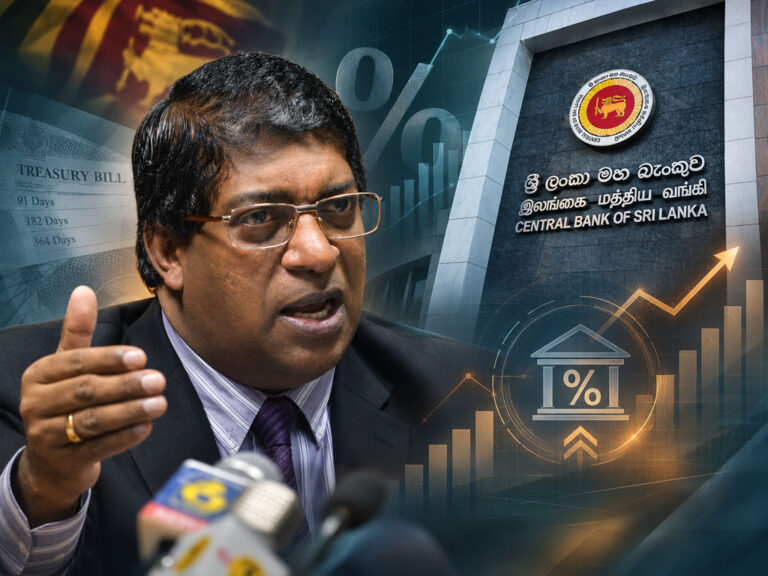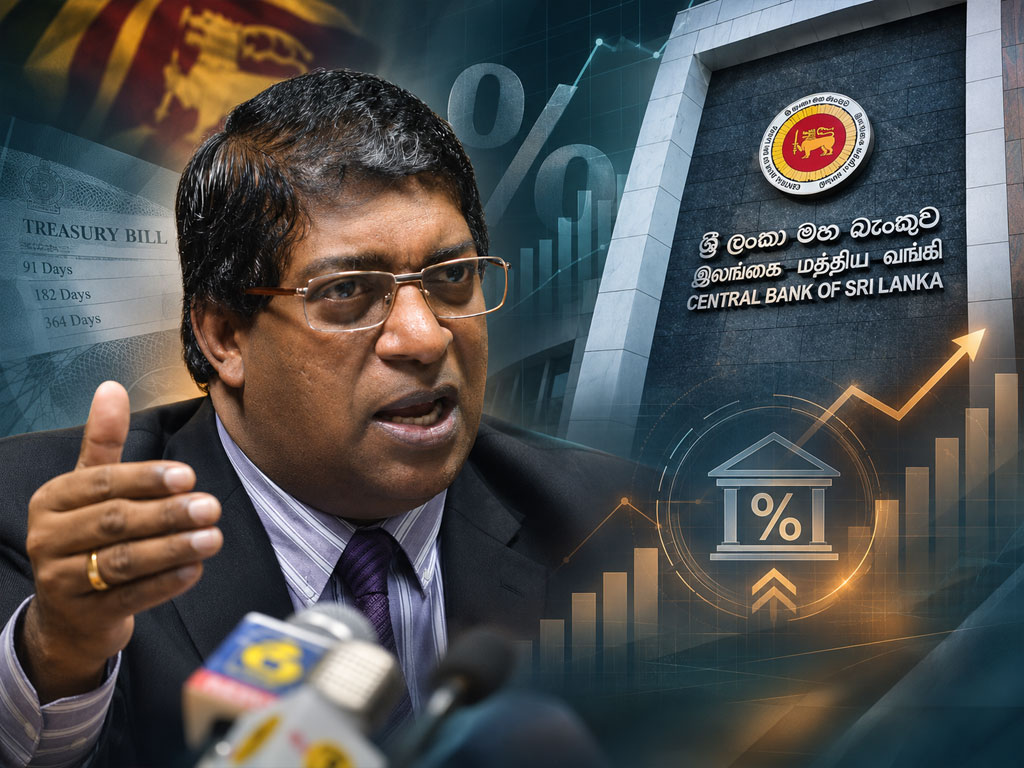
COLOMBO, November 29, 2026 — Former Finance Minister Ravi Karunanayake has challenged Sri Lanka’s latest interest rate hike, demanding explanations for rising inflation, tighter bank lending and potentially higher government borrowing costs. His seven questions place the Central Bank’s monetary decisions under parliamentary scrutiny.
Former Finance Minister and parliamentarian Ravi Karunanayake has called on the Government to explain the economic consequences of the Central Bank’s latest interest rate increase, questioning its impact on businesses, bank lending, economic growth and the cost of servicing Sri Lanka’s public debt.
Raising seven issues in Parliament on November 23, Karunanayake sought clarification from the Minister of Finance, Planning and Economic Development on the monetary policy decisions announced on November 20, particularly their implications for an economy still recovering from a prolonged financial crisis.
His intervention followed the Central Bank’s decision to increase the Overnight Policy Rate (OPR) by 25 basis points, from 8.75% to 9%, after consumer price inflation reached 8.3% in October.
The Monetary Policy Board also decided to raise the Statutory Reserve Ratio (SRR), which determines the proportion of eligible deposit liabilities commercial banks must maintain as reserves with the Central Bank, from 2% to 3%, effective December 9, 2026.
Both decisions followed an earlier increase of 100 basis points in May, bringing the cumulative policy rate increase since then to 1.25 percentage points.
Karunanayake questioned whether the additional monetary tightening was consistent with earlier Central Bank assessments and the economic assumptions underlying the 2027 Budget.

Earlier Inflation Forecasts and the Latest Policy Reversal
One of the principal concerns raised by the former Minister was the difference between the Central Bank’s earlier inflation outlook and its subsequent monetary policy decisions.
Karunanayake recalled that Central Bank Governor Dr. P. Nandalal Weerasinghe had indicated to Reuters in August that inflation was expected to peak near the 7.3% recorded in July and that further interest rate increases during 2026 were unlikely unless additional risks emerged.
Inflation nevertheless continued to accelerate, reaching 8.3% in October.
The Central Bank has attributed the increase principally to higher global energy prices, rising domestic food prices and the wider effects of those cost pressures on the economy.
Its revised projections indicate that inflation could remain elevated in the near term before returning to the 5% target during the second half of 2027.
Karunanayake consequently requested a detailed explanation of the factors that had caused inflation to exceed earlier expectations, together with an assessment of how exchange rate movements, energy costs, food prices and domestic demand contributed to the increase.
He also sought clarification on the Central Bank’s statutory reporting obligations if inflation remains outside the permitted target range.
Seven Questions Submitted to the Finance Minister
The former Finance Minister requested clarification on seven principal matters arising from the latest monetary policy decisions.
1. Inflation forecasts and parliamentary reporting: What were the respective contributions of energy prices, food costs, exchange rate movements and domestic demand to inflation exceeding the August forecast? When would the explanatory report required under Section 26(5) of the Central Bank of Sri Lanka Act be submitted to Parliament if inflation remained above 7% for two consecutive quarters?
2. Banking liquidity and monetary tightening: Why did the Central Bank consider it necessary to increase both the policy interest rate and the Statutory Reserve Ratio while private-sector credit growth was slowing? How much liquidity would be withdrawn from commercial banks, and what additional inflation-control benefits were expected from the reserve requirement increase?
3. Impact on small and medium-sized enterprises: How would higher lending rates affect businesses already struggling with financing costs? Could the Government maintain its proposed concessionary financing arrangements and the Rs. 174 billion lending target for small and medium-sized enterprises?
4. Economic growth and investment: Would the 2027 Budget’s projected economic growth of 4% to 5% remain achievable under tighter monetary conditions? What consequences were expected for private investment, employment creation and government tax revenue?
5. Government borrowing costs: What additional interest expenditure would arise if Treasury bill yields increased by 25, 50 or 100 basis points? How would the Government accommodate any additional costs within the Rs. 2,643 billion provision for interest expenditure?
6. International monetary developments: How would a possible increase in interest rates by the United States Federal Reserve affect the Sri Lankan rupee, domestic borrowing rates and capital flows?
7. International Monetary Fund commitments: To what extent had the International Monetary Fund programme’s requirements, including foreign reserve targets, influenced the Central Bank’s monetary policy decisions?
Together, these questions sought to establish whether the tightening measures were necessary to contain inflation and how the resulting financial pressures would be managed.
Rs. 5.75 Billion in Potential Additional Debt Costs
Karunanayake also drew attention to the implications of higher interest rates for the Government’s domestic borrowing programme.
He calculated that if Rs. 2,300 billion in Treasury bills were refinanced for one year at an interest rate 0.25 percentage points higher, the additional annual interest expenditure would amount to Rs. 5.75 billion.
The calculation illustrates the sensitivity of public borrowing costs to changes in market interest rates.
ILLUSTRATIVE TREASURY BILL REFINANCING COST
Assumed debt refinanced:- Rs. 2,300bn
Additional annual cost at +0.25% : – Rs. 5.75bn
Illustrative calculations assuming the entire Rs. 2,300 billion is refinanced for one year at the indicated higher yield.
View calculation details
Additional annual interest cost is calculated as:
Rs. 2,300bn × interest rate increase
| Rate increase | Annual cost |
|---|---|
| +0.25 pp | Rs. 5.75bn |
| +0.50 pp | Rs. 11.50bn |
| +1.00 pp | Rs. 23.00bn |
These are hypothetical calculations, not actual additional borrowing costs. They assume the full principal is refinanced for one year and that the entire yield increase passes through.
Illustrative calculations assuming the entire Rs. 2,300 billion is refinanced for one year at the indicated higher yield.
The former Minister asked how the Government intended to meet such additional expenditure when its 2027 Budget already provided Rs. 2,643 billion for interest payments.
Actual borrowing costs would depend on the timing of refinancing, the maturity structure of government securities and movements in market yields. A 25-basis-point increase in the policy rate does not necessarily translate into an identical increase across all Treasury securities.
Nevertheless, the questions underscore the importance of accounting for interest rate risks when preparing government expenditure estimates.
Reserve Requirement Increase and Pressure on Bank Lending
Another central issue concerned the Central Bank’s decision to raise the statutory reserve requirement by one percentage point.
The measure is intended to reduce excess liquidity in the domestic banking system and moderate credit expansion.
Central Bank explanations indicated that the increase could absorb approximately Rs. 150 billion in banking system liquidity.
While reducing excess liquidity can support inflation control, higher reserve requirements also restrict the funds commercial banks can deploy for lending and other activities.
Karunanayake therefore sought clarification on the potential consequences for lending rates, particularly those charged to small and medium-sized enterprises.
Many such businesses remain vulnerable to higher financing costs, making access to affordable credit important for maintaining operations, investment and employment.
The former Minister questioned whether the Government could preserve concessionary lending programmes while the monetary authority pursued tighter financial conditions.
Growth Forecasts and International Monetary Pressures
Karunanayake further asked whether the Government’s projected economic expansion of 4% to 5% in 2027 remained realistic following the latest monetary policy tightening.
Higher borrowing costs can discourage business investment and consumer spending, although the scale of their impact depends on broader economic conditions.
At the same time, persistent inflation can weaken household purchasing power and create uncertainty for businesses planning future investment.
The challenge for policymakers is therefore to contain price increases without unnecessarily undermining economic recovery.
Attention was also directed towards international developments, particularly the possibility of further monetary tightening by the US Federal Reserve.
Karunanayake requested an assessment of how changes in American interest rates could affect Sri Lanka’s exchange rate, domestic lending conditions and financial markets.
He additionally sought clarification on whether commitments associated with the International Monetary Fund programme, including foreign reserve objectives, had influenced the Central Bank’s latest decisions.
Government Response and Questions Awaiting Clarification
Responding in Parliament, Deputy Minister of Finance Anil Jayantha Fernando requested additional time to obtain information from the relevant institutions before providing answers to Karunanayake’s questions.
The Central Bank has maintained that its monetary tightening is intended to prevent elevated inflation from becoming entrenched and to preserve confidence in medium-term price stability.
Its assessment is that inflationary pressures, particularly those associated with energy and food prices, require a sufficiently restrictive monetary policy response.
Karunanayake’s intervention nevertheless places three connected issues before the Government: the reliability of economic forecasts, the affordability of credit for businesses and the potential increase in public debt-servicing costs.
The outstanding matter is how the Finance Ministry will reconcile those concerns with the Central Bank’s responsibility to maintain price stability, and whether its forthcoming parliamentary response will provide quantified estimates of the consequences for lending, investment and government finances.