By Roshan Jayasinghe
What Riding Has Taught Me About Thought, Language and Reality
On the road, the motorcycle, the body and the world speak before words arrive. One rider’s reflection on how experience becomes thought, how language carries it, and what happens when reality corrects it.
Before the Road Begins
Before a ride begins on the road, it begins quietly in the house.
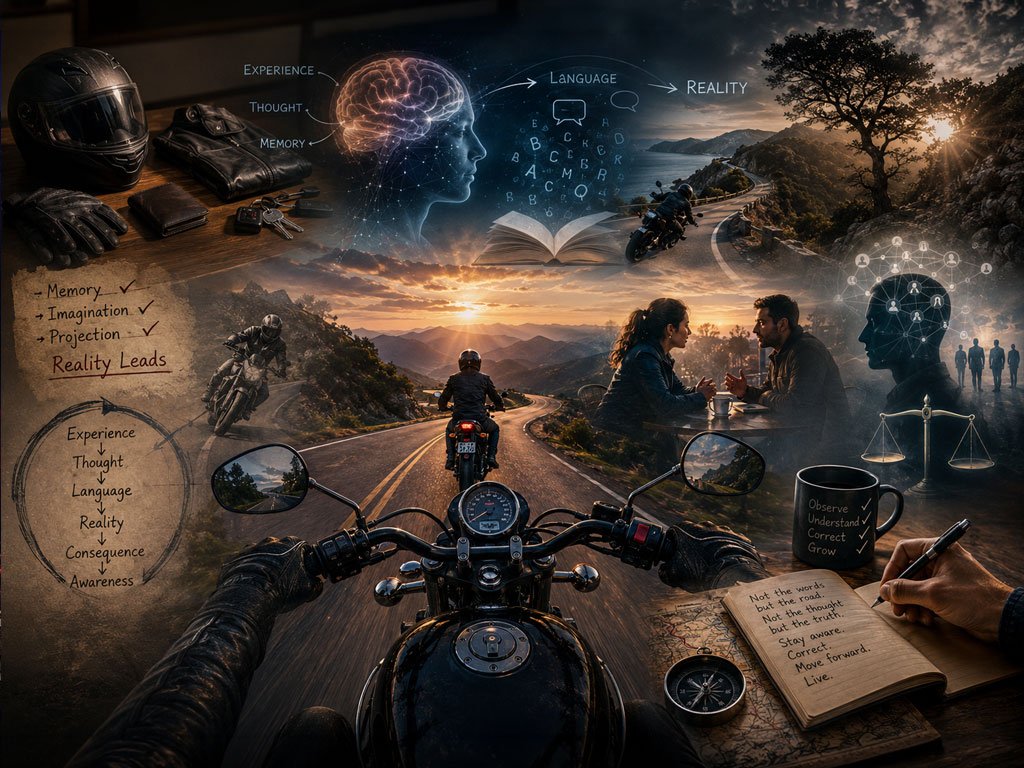
I lay out the jacket, the helmet, the gloves, the keys and the wallet where I can see all five at once. I started doing this after a morning when I stood beside a running motorcycle and could not account for a wallet I had been holding only four minutes earlier.
It would be easy to call that forgetfulness and become irritated with myself, and for a while I was. When I observed it more carefully, however, I saw something deeper than a forgotten wallet. Thought arises according to conditions. What I remember depends upon where my attention rested at the time, what interrupted it, how hurried I felt and what else was already moving through my mind.
So I pause. I look once at the five things, and then I go.
That small ritual does not take freedom from me. It gives me freedom. Once I know that everything I need is in place, my mind no longer has to search behind itself. It can face what is in front of it.
Preparation becomes the first act of awareness.

When Another Language Awakens
When the engine starts, another language awakens.
The engine settles into its rhythm. Vibration rises through the handlebars, through the seat and through the soles of my boots. I feel the weight of the machine beneath me and the response of the throttle through my hand.
Before I form the sentence, “The motorcycle feels right,” some part of me has already received that message and understood it. The road does not speak through grammar. The motorcycle does not arrange words to explain balance, traction, pressure or change. Yet the meaning has already arrived.
Experience has spoken before words.
This has made me consider how thought itself begins.
The Language We Are Born Into
I was not born with Sinhala, English or any other language already written inside me. I was born with the human capacity to feel, recognize, respond, remember and gradually understand. I was born into life, and then gradually into language.
The words of family, culture, school and society began giving names to what I was already experiencing. Language helped me separate one thing from another, identify myself, describe another person, remember yesterday and imagine tomorrow.
Over time, that inherited language became so closely woven into me that thought began using it to examine itself. I could ask myself what I was feeling, whether I was right, what something meant and what I should do next.
Language became an inner mirror through which thought attempted to see itself.
But every mirror has a shape.
The language we inherit carries the understanding, assumptions, divisions, wisdom, fears and history of the people who formed it and handed it to us. It can help thought see clearly, but it can also frame what thought is able to see. In time, we may mistake the name of a thing for the thing itself, a description for reality, a belief for knowledge, or an inherited judgment for our own direct understanding.
Language does not merely carry what we see. It also influences what becomes visible to us.
Every Mile Adds Another Word
Riding shows me this plainly because the language of a motorcycle is learned so visibly through experience. I was born with a capacity for balance and movement. I was not born knowing what a motorcycle was saying. That vocabulary arrived one ride at a time.
I remember the first time the engine note became a word rather than merely a sound. I was climbing in cold air with the sun still behind the ridge. The note flattened, and I had already moved my foot before the phrase “wrong gear” formed anywhere I could hear it.
The knowledge came first. The sentence arrived afterward, only to confirm what the body had already understood.
The body had not reasoned through a sentence, but it had learned.
Throttle response, braking pressure, wind, lean angle, road texture, the movement of traffic and the tension in my own shoulders all became parts of a living vocabulary in the same way.
Every mile added another word that was never spoken.
A Morning in the Canyons
On a morning ride, before I have left the driveway, the journey already exists within thought in three different forms.
Memory brings back the road as I last rode it. Imagination offers the ride I would love to have, with clear air and every curve flowing beautifully into the next. Projection looks ahead and considers what traffic, weather and distance may ask of me.
All three have value, but not one of them is the road.
Within ten minutes of beginning my last ride through Latigo Canyon, the present had begun correcting all three. The road was not the road I remembered. A winter had moved through it and the shoulder had shifted. My tires were a season older than the ones within my memory of that surface, and the temperature was lower than the morning I had imagined while putting on my gloves.
Memory can advise me, but it cannot see for me. Imagination can inspire the ride, but it cannot decide what is safe. Projection can prepare me, but it cannot know a road it has not yet reached.
Memory, imagination and projection may all ride with me, but none of them can be allowed to hold the handlebars.
Reality must lead.
Reality Must Lead
Farther up, a curve I had ridden many times tightened at its exit, where the wet season had lifted the asphalt into a ridge I had never crossed before. I entered it at the speed my memory of that road allowed.
My hands began correcting before I had a word for what was wrong. The word, when it came, arrived late and only to name what my body had already done.
There was no crisis. There was simply a small and complete lesson delivered in less than a second, and delivered by the road rather than by any thought of mine.
The road is not interested in how intelligent my first expectation sounded inside my mind. It responds to what I actually do. If my understanding is wrong, I have to correct it. I correct it through speed, line, attention and the position of my body. I improve nothing by defending the original thought simply because it was mine.
This is the most truthful lesson riding has given me:
Correction is not humiliation.
Correction is intelligence responding to reality while there is still time to act.
Human beings often protect a thought long after reality has exposed its weakness. We defend the words we used, the position we took or the identity that became attached to it. On a motorcycle, that kind of pride has almost no value because the road brings thought, action and consequence too close together for it to survive.
The road is not cruel.
It is simply exact.
When the Ride Becomes a Story
At a rest stop, over coffee, the ride becomes a spoken story for the first time.
But the story is not the ride.
I cannot hand another rider the vibration, the smell of the air, the pressure within my hands or the exact awareness that arrived inside that curve. Language carries a portion of the experience and leaves the rest on the road.
The person listening then rebuilds meaning from within their own experience. A rider who has crossed that ridge understands one thing. A new rider imagines something else. Someone who has never ridden assembles the story from an entirely different collection of memories and feelings.
The thought that began within me does not pass untouched into another mind. It travels through language, tone and timing, and arrives inside a history that was already living there before I spoke.
Words never arrive in an empty place.
That does not make language useless. It makes humility necessary. Every telling should remember that it is a map of an experience, not the experience itself.
What Words Alone Cannot Reveal
This is why the appearance of language can never tell us, by itself, whether a thought was intelligent, careless, loving or harmful.
When I shout “gravel” to the rider behind me, the word is abrupt and my tone may sound harsh, but the intention and consequence are protective. If I speak gently while keeping quiet about a danger that the other rider needs to know, no amount of softness in my voice makes the act a kind one.
Angry language can sometimes carry a truthful warning.
Beautiful language can sometimes decorate a harmful thought.
We therefore have to examine more than the words. We have to ask where the thought came from, how truthfully language carried it, how it was received, what action followed and what consequence finally entered someone’s life.
The beauty of language cannot, by itself, certify the goodness of a thought.
The Road Beyond Riding
None of this belongs only to riders.
In my relationship with my girlfriend, I see a gentler and more beautiful expression of the same truth. We deeply respect, appreciate and love one another, not because our minds always move in precisely the same way, but because neither of us asks the other to disappear inside our own way of seeing.
Each of us carries an individual history, an individual way of knowing life and a thought process shaped by experiences that belong uniquely to us. We try to meet one another within the reality of each moment rather than through an image of what either of us should be.
Understanding does not require agreement on every thought. It asks us to listen for what lives behind the words. It allows a thought to be spoken imperfectly without immediately reducing the person to that thought. It gives each of us room to remain fully ourselves while sharing life with honesty, compassion and care.
Alignment, as I experience it, is not sameness. It is two individuals remaining truthfully themselves while choosing to travel in a common direction.
Love is not the removal of individuality.
It is the safety in which individuality can be known, respected and loved.
What becomes possible between two people also reveals something about the larger human world. The same movements of memory, imagination, projection and language pass through families, workplaces, communities and nations, but there they operate on a scale where the consequences can be inherited.
We are given words and categories long before we examine the realities they claim to describe. We learn who is good and who is dangerous, who is important and who can be overlooked, who is one of us and who is not. Thought then uses those inherited structures to understand itself, often without recognizing how much of the structure was built before any conscious examination of our own began.
Correcting thought is therefore a larger task than changing an opinion. It asks us to examine the language through which that opinion first became understandable. What does this word actually describe? What has been added to it by history, fear, loyalty, authority or repetition? Am I observing the person or reality before me, or am I reacting to a name that was given to it?
Before we defend the map, we must look again at the road.
What Remains When the Engine Is Off
When I return home and switch off the motorcycle, the engine falls silent.
The living conversation between road, machine, body and thought ends for that day, and the ride begins turning into memory almost immediately. Memory will preserve part of it and leave part behind. Imagination may brighten what remains. Language will organize it into a story such as this one, and the story will travel with me on the next ride and help shape what I expect to find.
This is the continuing cycle.
Experience teaches thought.
Memory keeps an incomplete record.
Imagination reshapes what memory has kept.
Projection carries it toward the future.
Reality tests it again.
Consequence corrects it.
Awareness makes correction possible.
That is why I would place reality at the base of anything I try to build, awareness as the first stone laid upon it, and honest correction as the tool kept within reach for as long as the structure stands.
Inherited knowledge can guide humanity in the way a map guides a rider, but no map can replace the road that exists today. Every generation will find parts of the structure that need strengthening, correcting or rebuilding. Hiding a crack does not protect the building. It only passes the weakness to those who must live upon it later.
The place where the tire meets the earth is no larger than a hand.
Behind it is everything already travelled.
Ahead of it is the road not yet reached.
Life touches reality only here.
That is where the rider lives. That is where every human life is lived.
And every new ride begins again.
AUTHOR’S NOTE
This article grew from my own riding and from the thoughts that arise when I quietly observe myself moving along a road. It is not offered as a final explanation of thought, language or reality. It is one human attempt to place a living experience into words while recognizing that words can carry only part of what was truly experienced.
I offer it as a foundation stone for The Living Human Manual, a work intended to remain open to observation, honest questioning and correction. I do not ask anyone to accept these thoughts merely because I have written them. I ask only that they be weighed against your own lived experience, the reality before you and the consequences they produce when carried into life.
If clearer understanding reveals that any part of this article needs correction, that correction should be welcomed. Truth is not protected by defending our words after reality has shown their limitations. It is protected by our willingness to look again, understand more clearly and correct what we once believed we understood.
Like the rider meeting each new stretch of road, human understanding must remain attentive, humble and ready to respond to what is actually before it.
About the Author
Roshan Jayasinghe is a writer and observer of human systems. His work explores the gap between man made constructs and lived humanity, with a focus on how economics, trade and everyday choices intersect with questions of fairness, responsibility and inner alignment. Through essays for publications in The Morning Telegraph, he aims to remind readers that they are not passengers in a fixed machine, but active custodians of a shared world.