By Roshan Jayasinghe
This is not only about one leader, one party, or one religious bloc. It is about what happens when loyalty begins to matter more than truth, and when people start excusing what they would once have named without hesitation.
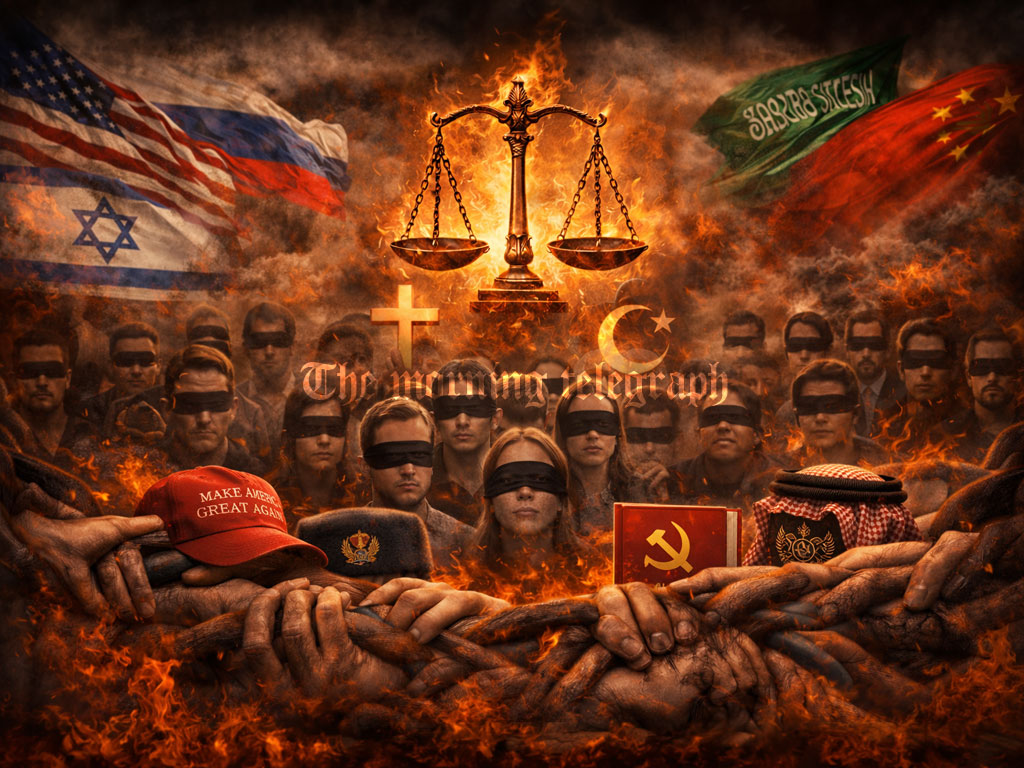
What is happening in Russia under Vladimir Putin, what unfolded in America under Donald Trump, what was nurtured in Hungary under Viktor Orbán before his recent defeat, what continues in Israel under Benjamin Netanyahu, what is maintained through centralized rule in China, and what is preserved through hereditary monarchy in Saudi Arabia, Qatar, and the United Arab Emirates are not the same political story. Their systems differ. Their histories differ. Their symbols and justifications differ. Yet they reveal something painfully familiar in human life. Power gathers and protects itself. Loyalty is rewarded more than truth. Fear is cultivated until people cling to authority not because it is moral, but because it feels necessary. Orbán’s loss in Hungary’s April 2026 election is a reminder that such patterns can be interrupted, but usually only after they have had time to harden.

In Russia, critics describe a system where power, repression, and corruption have become deeply entwined. In Israel, Netanyahu remains under an International Criminal Court arrest warrant issued in November 2024 over alleged war crimes and crimes against humanity, allegations he rejects. In China, party rule stands above meaningful democratic challenge. In the Gulf monarchies, authority remains concentrated in hereditary rule. In America, the pattern wears a different costume. There it moves through spectacle, wealth, family advantage, crony access, moral scandal, and a public culture so saturated with performance that even grave questions of conduct can be absorbed and normalized.
What does this tell us? That the outer costumes may change, party rule, monarchy, nationalism, security, religion, democratic theater, but beneath them the same weakness keeps reappearing. Power protects itself. Tribe excuses it. Law bends around it. Conscience is asked to wait. And when conscience waits too long, corruption stops looking like corruption. It begins to look like necessity, loyalty, realism, even righteousness.
One of the clearest signs that conscience has weakened is when double standards no longer shock people. The powerful are judged by one measure, the ordinary by another. What would ruin a lesser person becomes survivable, explainable, even admirable in the leader. Corruption is tolerated because it is said to serve stability. Cruelty is excused because it is framed as strength. Dishonesty is overlooked because the enemy is considered worse. Legal accusation becomes persecution. Public scandal becomes media bias. The law itself begins to look negotiable so long as it bends in the right direction.
That is the deeper sickness beneath these different systems. It is not only that power corrupts, but that people grow accustomed to corruption when it protects what they fear losing. They accept impunity in exchange for reassurance. They accept favoritism in exchange for belonging. They accept moral erosion in exchange for the comfort of feeling that someone is still in control and acting on behalf of their side. In that condition, public life becomes less about justice than about permission. The question is no longer, “Is this right?” but “Is this useful to us?”
In America, this is what makes Donald Trump so revealing. The image presented is one of force, disruption, and command. Yet real strength is not noise. It is not vanity. It is not impulsiveness amplified by cameras and carried by the arsenal of a powerful nation. A man may stand before military might, speak aggressively, and posture constantly, yet still be weak in character, weak in discipline, and weak in moral seriousness. If he is protected by loyalists, lifted by celebrity, and buffered by a culture willing to normalize almost anything, what appears to many as strength may be nothing more than weakness riding on the back of a machine larger than the man himself.
That is what tribal politics does. It teaches people to confuse performance with substance, force with character, domination with courage, and victory with truth. It trains them to make endless exceptions for the one who carries their grievance. And the longer this goes on, the less able the public becomes to feel corruption for what it is. The language of patriotism, faith, security, tradition, and national destiny remains, but its inner weight drains away. What is left is not conviction in the noble sense, but hardened loyalty asking conscience to wait until after the battle is won.
This becomes even more sobering wherever religion enters the picture, because faith at its deepest is meant to refine a human being. It is meant to humble the self, soften certainty, strengthen truthfulness, and make one more alert to pride, cruelty, deceit, and the temptation to dominate. Faith, when alive inwardly, is not decoration for identity. It is a discipline of conscience. It does not ask first, “Who is on my side?” It asks, “What is true? What is just? What is mine to correct in myself?” Once those questions are no longer central, something sacred has been replaced by something more useful to the tribe.
That replacement rarely happens in one dramatic moment. It happens through a thousand small permissions. One statement overlooked. Then another. Behavior rationalized because the stakes feel too high. The quiet persuasion that this is not the time for moral clarity, that one must be realistic, strategic, united. In this way, faith ceases to be an inward light and becomes an outer shield. It no longer corrects the believer. It protects the group. It blesses fear. It sanctifies enemies. It begins to treat victory as moral vindication and aggression as courage. But victory has never been a reliable sign of truth. Very often it is only a sign that fear has found an efficient instrument.
That is where tribe becomes so seductive. Tribe offers what conscience often does not. It offers certainty. It offers belonging. It offers the relief of being among one’s own, of having one’s wounds echoed and one’s grievances affirmed. It tells the individual not only that he is not alone, but that he is right without needing to examine himself too deeply. Conscience offers no such comfort. Conscience interrupts. It asks a person to stop in the middle of certainty and look again. It asks whether what feels righteous is actually righteous, whether what is being defended is truly good, whether anger has disguised itself as moral seriousness.
And now the pattern is no longer confined to domestic politics. Reuters reports that the current U.S.-Israeli war with Iran began on February 28, 2026, and has already threatened shipping through the Strait of Hormuz, strained weapons supplies, and raised fears about inflation, energy disruption, and global recession. The consequences do not stop at speeches, borders, or party loyalty. They move through trade routes, military stockpiles, economies, and the fragile lives of ordinary people far removed from the decisions being made. When conscience is pushed aside long enough, power does not remain theatrical. It becomes combustible. And once it becomes combustible, the whole world is made to carry the heat.
What this reveals is that the danger is never confined to one man. A man may rise, divide, dominate, and eventually pass from the stage. But the condition that welcomed him remains unless it is understood. That condition is the inward readiness to prefer loyalty over truth, identity over honesty, and triumph over self-examination. Wherever that condition exists, another figure will come. The face may change. The language may change. The system may change. The pattern will not.
And permission is what matters most. Every age imagines its worst failures are caused only by the few at the top, but history tells a quieter truth. Much of what becomes dangerous in public life begins as something permitted in private hearts. The excuses are made there first. The standards are softened there first. The appetite for certainty, dominance, and vindication is fed there first. By the time it appears on a public stage, it already has roots.
That is why moral language becomes so deceptive when attached to tribe. It allows people to feel virtuous without paying the cost of virtue. They may speak of order while harboring contempt. They may speak of faith while nurturing cruelty. They may speak of family while excusing dishonor. They may speak of freedom while desiring domination. The words remain noble, but their inward content has changed. They no longer describe a discipline of being. They have become banners for belonging.
A society in such a condition does not suffer merely from disagreement. It suffers from the severing of moral language from moral life. Once that severing takes place, people no longer evaluate a thing by its truth or goodness, but by whether it advances their side. They no longer ask whether a leader embodies virtue, only whether he fights effectively. They no longer ask whether a claim is honest, only whether it is useful. Because usefulness is easier to defend than truth, the descent can continue while still feeling justified.
None of this is written to condemn one group as uniquely fallen. Tribe is an ancient human temptation. It appears wherever people are frightened enough, wounded enough, or proud enough to value solidarity more than sincerity. It can appear on the right and on the left, in churches and universities, in families and movements, in corporations and revolutions. The names and symbols change, but the mechanism is familiar. We feel vulnerable, we cluster together, we choose our version of the good, and then we begin excluding whatever truth threatens our comfort or our identity.
That is why the issue is finally not about politics alone, but about whether a human being is still willing to be corrected. That may be the simplest test of conscience. Not whether one speaks beautifully of values, nor whether one belongs to a community that honors them in name, but whether one can still be inwardly interrupted by truth. Whether one can still feel discomfort when one’s side lies. Whether one can still refuse cruelty even when it is effective. Whether one can still recognize that no tribe, no leader, and no movement becomes righteous merely because it carries our hopes.
The danger is rarely only the man. It is the room prepared for him. The silence that receives him. The fear that protects him.
The faith that no longer questions, but rushes to defend.
It is the moment truth is asked to kneel before belonging.
The moment conscience is told to wait until after victory.
And once that happens,
what is false can wear the clothing of righteousness,
and what is cruel can pass
as conviction.
The question before us is not only what kind of political figure has risen, but what kind of inward hunger keeps preparing the ground for such figures to rise at all. What is it in us that prefers certainty to honesty, force to character, belonging to truth? What fear is so deep that we are willing to call something righteous simply because it protects our side? These are not easy questions, but they may be the only ones worth asking if we genuinely care about the future of public life.
No society becomes whole by defeating one man while leaving untouched the condition that made him possible. If conscience remains weak, if truth remains negotiable, if tribe remains sacred, the pattern will return. Another voice will come. Another banner will be lifted. Another promise of rescue will be offered to those who feel forgotten, threatened, or displaced. Again the test will not merely be political. It will be moral.
That may be the real work of our time. Not to become more clever in defending our tribe, but more honest in examining what tribe does to the heart. Not to perfect our outrage against the other, but to notice how quickly we make exceptions for ourselves. Not to speak more loudly of faith, values, and virtue, but to live in such a way that these words recover their weight. Conscience cannot survive where loyalty is worshipped. Truth cannot lead where belonging has become the highest good.
Hope begins here: in the refusal to hand over one’s moral sight for the comfort of collective certainty. In the willingness to say that no leader is above truth, no cause above honesty, no tribe above conscience. In the willingness to recognize that real strength belongs not to the loud, the inflated, the childish, or the morally undisciplined, but to the person who can govern himself before seeking to command others. Only then does faith become faith again, rather than a shelter for fear. Only then does public life regain the possibility of integrity. Only then does the soul stand a chance of remaining free.
Author’s Note
I did not write this as a performance of politics, but as an honest reflection on a condition I see repeating across nations, religions, and systems of power. The names may change, the flags may change, the language may change, but the danger remains the same: when human beings begin protecting power more fiercely than truth, conscience is the first thing lost.
About the Author
Roshan Jayasinghe is a writer and observer of human systems. His work explores the gap between man made constructs and lived humanity, with a focus on how economics, trade and everyday choices intersect with questions of fairness, responsibility and inner alignment. Through essays for publications in The Morning Telegraph, he aims to remind readers that they are not passengers in a fixed machine, but active custodians of a shared world.