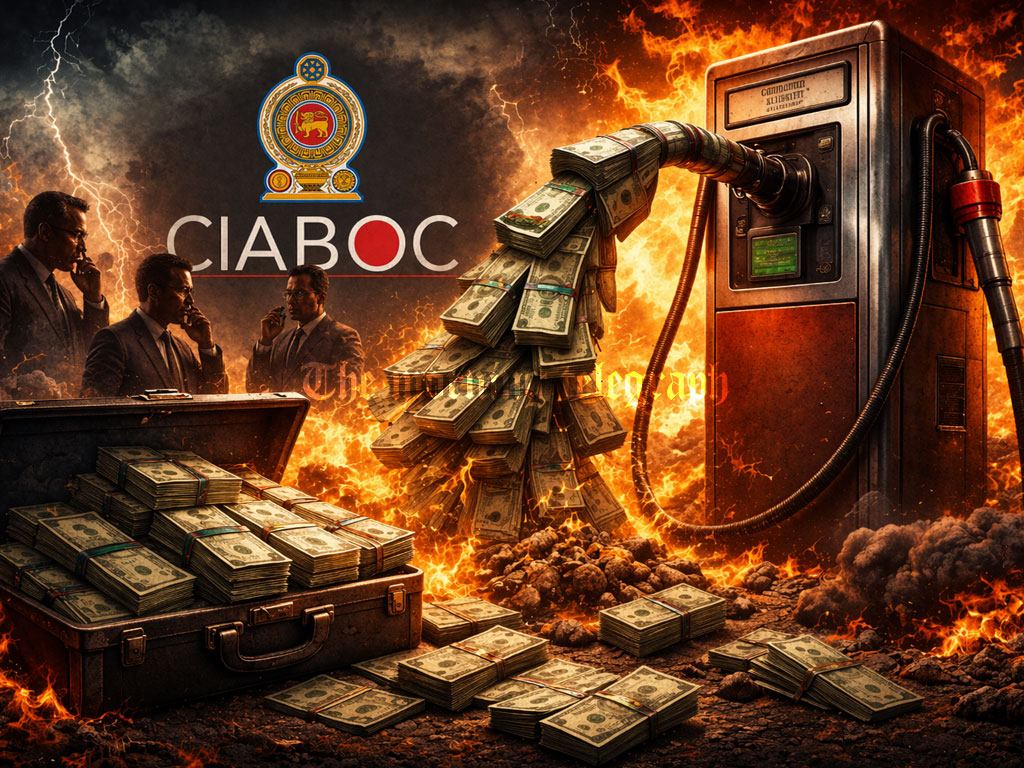
A bombshell complaint accuses top officials of engineering a fuel crisis to justify inflated imports, exposing a suspected multi-billion rupee scheme built on artificial shortages, risky decisions, and massive profit margins.
A special complaint has been filed with the Commission to Investigate Allegations of Bribery or Corruption, alleging that a massive financial irregularity of 17.715 billion rupees or 56.27 million US dollars has occurred in the import of fuel into the country in the recent period. The complaint, filed by Mr. Sankha Chandima Abhayawardena, directly accuses several high-ranking officials of the current government.
The complainant points out that this crisis has been created due to the government’s failure to accumulate the necessary strategic stocks despite early warnings that the supply of oil in the world market could be disrupted. The complaint states that the appointment of an official accused of creating an artificial fuel shortage as the Chairman of the Ceylon Petroleum Corporation in 2022 was the beginning of this corruption process.

It further states that the Criminal Investigation Department reports (C105/22/CR) have confirmed that the officer has previously concealed fuel stocks on 582 occasions.
To:
Hon. W.M.N.P. Iddawala,
Chairman, Commission to Investigate Allegations of Bribery or Corruption
Subject: A Massive Robbery of LKR 17.715 Billion (USD 56.27 Million)
Honorable Chairman,
A special complaint has been submitted to the Commission to Investigate Allegations of Bribery or Corruption, alleging that a massive financial irregularity of LKR 17.715 billion (USD 56.27 million) occurred during the importation of fuel into this country over the recent past. This complaint, filed by Mr. Sankha Chandima Abhayawrdhana, directly accuses several high-ranking officials of the current government.
The complainant points out that the crisis was created because the government failed to build up the necessary strategic reserves, despite prior warnings that global oil supplies could be disrupted. The complaint states that the beginning of this corrupt process was the appointment of an official as Chairman of the Ceylon Petroleum Corporation, who had previously been accused of creating an artificial fuel shortage in 2022.
The complaint further states that, according to Criminal Investigation Department records (C105/22/CR), it has been confirmed that this same official had hidden necessary fuel stocks on 582 occasions.
Honorable Chairman,
- The whole world knew that Israel and the United States had been on a massive war footing against Iran since July of last year, including positioning naval aircraft carriers near Iran. In the event of any attack, the global oil supply would be disrupted. It is common practice that oil bought at low prices before the war is sold by ships carrying those stocks to new buyers around the world at high prices with large profits. Governments normally respond to such situations by issuing long-term tenders and building up large reserves. The Sri Lankan government usually employs both of these strategies.
- However, it is observed that President Anura Kumara Dissanayake, Minister Kumara Jayakodi, and the Chairman of the Ceylon Petroleum Corporation have avoided doing any of this since last year, which appears to be paving the way for a massive robbery.
It is also observed that the Chairman of the Ceylon Petroleum Corporation was the Operations Manager of the Muthurajawela Terminal of Ceylon Petroleum Storage Terminals Limited, the same person who was instrumental in destabilizing the country by artificially creating a fuel shortage in 2022. Regarding this, according to Criminal Investigation Department document No. C105/22/CR, it is clear that he hid necessary fuel stocks on 582 occasions. We view the appointment of such a person as Chairman of the Ceylon Petroleum Corporation by the President and the Minister of Energy as paving the way for massive corruption.
- Furthermore, even if there was a war situation, Sri Lanka imports oil from India and Singapore. That means there is no security threat to our oil supply. Throughout March, the premium, including insurance, transport, and intermediary profit for all imported oil, remained at a low value between USD 3.54 and USD 4.43. Around March 20, President Anura Kumara said he would allow a new ship at sea to be diverted to Sri Lanka. He said that was the answer to the severe fuel crisis that was developing in Sri Lanka. However, it is clearly observed that the crisis occurred precisely because the President, the Minister of Energy, and the Chairman of the Ceylon Petroleum Corporation together refrained from building up the necessary strategic reserves. It is clearly observed that by allowing an artificial crisis to be created and then using it as a pretext, a massive irregularity exceeding LKR 17.715 billion has been committed by buying oil from India and Singapore, where there was no need to pay such high premiums.
In a statement made in Parliament, which is attributed to the President, he mentioned the ship scheduled to arrive on April 6-7, as well as ships scheduled to dock on April 12-13 and April 16-17. From these three ships alone, the loss due to excess premiums amounts to LKR 10,283,823,440.00—that is, LKR 10.283 billion (USD 3.27 million). Therefore, we have a very reasonable suspicion that when the President came to Parliament and announced that he would allow a ship at sea to be diverted, he and Minister of Energy Kumara Jayakodi were setting the political backdrop necessary for a financial irregularity similar to the one they were accused of in 2022.
- If strategic reserves had been built up in time, it would have been possible to supply the country’s fuel needs for 45–62 days at the previous price. Instead, by paying a higher fuel price, a massive financial irregularity of enriching intermediaries must be investigated. This irregularity, carried out through premiums, can be observed to be far larger than the irregularity committed through the premiums themselves.
Generally, by now, in addition to the production cost, the Additional War Risk Premium (AWRP) for oil ships has reached up to 2.5% of the vessel’s value, and for any vessel traveling through high-risk zones, approximately USD 3.50 – 4.50 per barrel is added to the landed cost.
World-renowned S&P reported on this as follows:
“Market reports said on March 27 that the additional war risk premium for transporting tankers through the Persian Gulf eased during the week ending March 27, as several ships transited the risky Strait of Hormuz amid hopes that a deal could be reached to end the Middle East war.
Shipping insurance executives at the Asia Pacific Maritime Conference in Singapore said that although AWRP of around 2.5% of vessel and machinery value was obtained for a seven-day period in the Persian Gulf earlier in March, it is now close to 1%. An official from a shipping insurance company said some tankers that successfully transited the Strait of Hormuz have even paid 0.8% AWRP after taking into account an unclaimed bonus. However, even under this scenario, AWRP is eight times higher than in the pre-war period, when it was 0.1%–0.15% or even lower, according to shipping insurance companies.”
It should be noted that the actual premium values that should have been paid are the premium prices paid for the fuel stocks brought to Sri Lanka after the war began during this same period. It should also be noted that for Fuel Oil, the maximum premium price we could find is considered the highest value available on the world market. With this special complaint, if we had arranged to buy oil directly from the Middle East region, I have also calculated the premium prices that could have risen using market data. Those data are shown below. Furthermore, even if Sri Lanka had to pay an additional amount, the table below shows that amount is significantly less than the price paid.
Regarding the systematic dismantling of renewable energy, which is critical for national security and the country’s future, thereby reducing the renewable energy capacity available in an emergency, the importation of low-grade polluted coal through a corrupt procurement process, and the massive purchase of thermal electricity, we have already submitted five complaints to your commission. This complaint concerns a corruption and theft of nearly LKR 18 billion that is being carried out by taking advantage of the energy crisis exacerbated by that coal thermal electricity route.
We kindly request your urgent attention to this series of complaints.
Thank you.
Sankha Chandima Abhayawrdhana