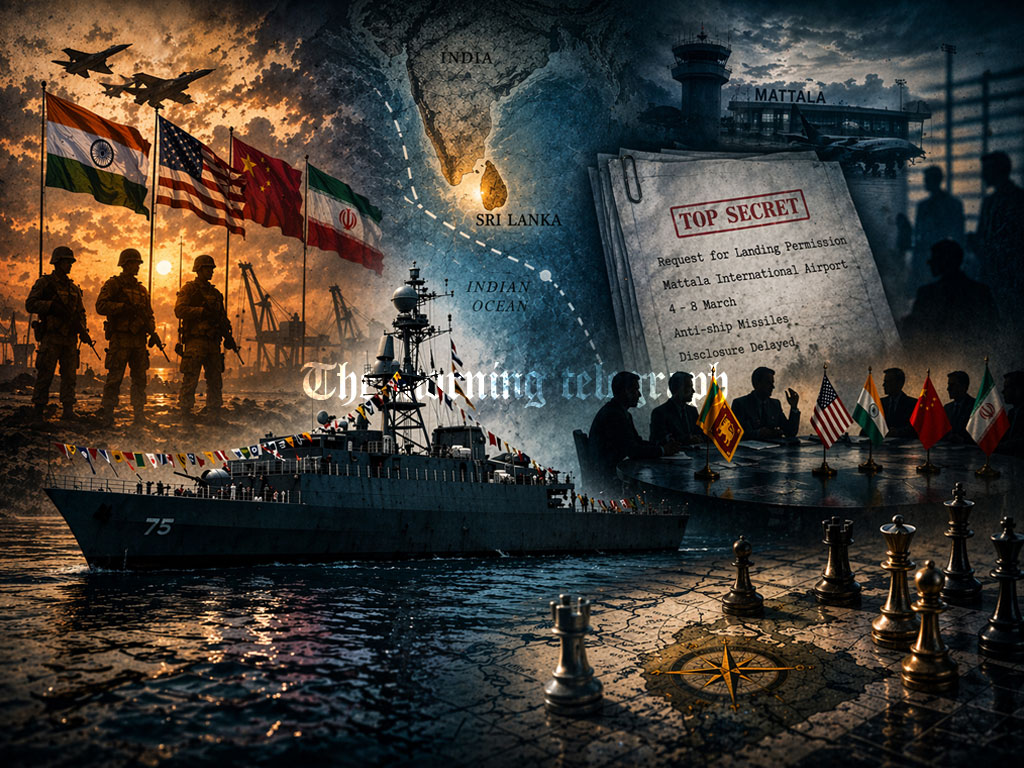
A hard-hitting analysis questions whether Sri Lanka’s claimed neutrality is a strategic illusion, as global powers, war tensions, and silent decisions place the island at the center of a dangerous geopolitical crossroads.
In 1971, when Pakistan sought permission from Ceylon to use Katunayake Airport for refuelling aircraft flying between West and East Pakistan during a conflict, Prime Minister Sirimavo Bandaranaike granted approval immediately, despite her close ties with Indian Prime Minister Indira Gandhi. That moment in history now resurfaces as a stark comparison to present-day Sri Lanka’s handling of foreign military access and geopolitical pressure.

Fast forward to recent events, Sri Lanka was reportedly informed on March 20 that the United States had requested permission earlier, on February 26, to land fighter jets at Mattala International Airport between March 4 and 8. The request was said to involve aircraft equipped with anti-ship missile capabilities. Yet the disclosure came only weeks later, raising serious concerns about transparency, timing, and national security decision-making.
The delay in informing the public, nearly 22 days after the request and well after the escalation of conflict, has triggered questions about whether such developments were classified or deliberately withheld. Observers have drawn parallels to past intelligence failures, asking whether lessons from history have truly been learned.
Government officials have attempted to downplay the issue, suggesting that requests such as those made by Iran for naval docking rights take weeks to process. However, critics argue that this explanation lacks credibility. Historical precedents, such as wartime naval movements and emergency diplomatic decisions, show that nations often act swiftly when strategic interests are at stake.
The timeline becomes even more puzzling when considering that within two days of the alleged US request window, military actions by the United States and Israel had already escalated tensions with Iran. This raises the question of whether Sri Lanka’s response time was a matter of bureaucratic delay or a calculated diplomatic balancing act.
Djibouti, where US forces are stationed, lies thousands of kilometres from Sri Lanka yet plays a critical role in global military logistics. The presence of advanced US military infrastructure there highlights the strategic importance of any potential operations involving Sri Lankan territory. Analysts question why such a request would be made and what implications it carries for regional stability.
Adding to the uncertainty, aviation experts note that fighter aircraft typically have limited endurance, making long-distance missions dependent on refuelling logistics. The absence of clear justification for such a request only deepens suspicion and fuels debate about Sri Lanka’s role in global military dynamics.
The situation is further complicated by questions of international law and diplomatic conduct. Critics ask whether Sri Lanka sought adequate clarification under established global legal frameworks or whether it simply navigated these developments without full transparency. The issue has sparked a broader conversation about sovereignty, accountability, and the responsibilities of a neutral state.
The Iranian dimension adds another layer to the narrative. Iranian naval vessels that participated in a fleet review in India were reportedly invited to Sri Lanka, raising questions about coordination and communication between regional powers. Conflicting statements about whether these invitations were official government decisions or naval-level arrangements have only added to the confusion.
The sinking of the Iranian vessel IRIS Dena has intensified scrutiny. The ship, initially seeking docking permission in Sri Lanka, was later destroyed under unclear circumstances. Rescue operations by Sri Lankan forces saved dozens of crew members, but the incident has left lingering questions about intelligence sharing and regional cooperation.
Survivors were brought to Sri Lanka and received medical care, reflecting the country’s humanitarian response. However, the broader geopolitical implications of the incident remain unresolved. Observers question whether external pressures influenced decisions or whether Sri Lanka acted independently in line with its stated neutrality.
Statements by international leaders have further complicated the narrative. Comparisons to historical conflicts and references to past military strategies have raised concerns about whether global powers are once again shaping smaller nations’ policies through indirect influence.
The concept of neutrality itself is now under scrutiny. While Sri Lanka has declared a neutral stance, critics argue that its actions suggest a more complex reality. Engagements with multiple global powers, including the United States, India, China, and others, point to a delicate balancing act rather than strict neutrality.
Historical parallels are frequently invoked to illustrate the risks of such positioning. From early 20th century conflicts to modern geopolitical rivalries, smaller nations have often found themselves caught between competing interests. The lessons of these experiences highlight the importance of clarity, consistency, and strategic foresight.
The evolving global order, marked by rising tensions between major powers, places additional pressure on countries like Sri Lanka. Economic dependencies, security considerations, and diplomatic relationships all influence decision-making, making neutrality increasingly difficult to maintain in practice.
Recent developments involving China and the United States further underscore this complexity. Strategic competition in regions such as the South China Sea and the Strait of Hormuz has implications far beyond those areas, affecting global trade, energy security, and political alliances.
As Sri Lanka navigates this challenging landscape, questions persist about its long-term strategy. Is neutrality a genuine policy or a flexible position shaped by immediate circumstances? Can the country maintain independence while engaging with powerful allies, or will it be drawn deeper into global conflicts?
Ultimately, the debate over Sri Lanka’s neutrality reflects broader concerns about governance, transparency, and national interest. In a world where geopolitical tensions continue to rise, the choices made today will shape the country’s future for years to come.