A shocking Right to Information request reveals conflicting answers from key state institutions, raising serious concerns about transparency, accountability, and the true existence of Sri Lanka’s much-discussed National Education Policy Framework.
A major controversy has emerged over Sri Lanka’s proposed National Education Policy Framework after a Right to Information request uncovered conflicting and confusing responses from three leading state institutions. The issue has sparked fresh debate about transparency, governance, and accountability in public policy development.

The inquiry, made under the Right to Information Act, sought details on the funds spent to develop the new education policy framework under the current government, along with information on the experts involved and the criteria used to select them. However, instead of clarity, the request exposed a web of contradictory answers.
The Right to Information is recognized globally as a fundamental right and is also protected under Sri Lanka’s Constitution. Strengthened further by the Right to Information Act No. 12 of 2016 introduced during the 2015 Good Governance administration, it was intended to ensure public access to state-held information and promote transparency.
Despite promises of openness and accountability made by the National People’s Power Party before coming into power, recent developments suggest that accessing information has become more difficult. Observers note that attempts to delay or obscure information appear to be increasing, raising concerns about whether transparency commitments are being upheld.
Background of the incident
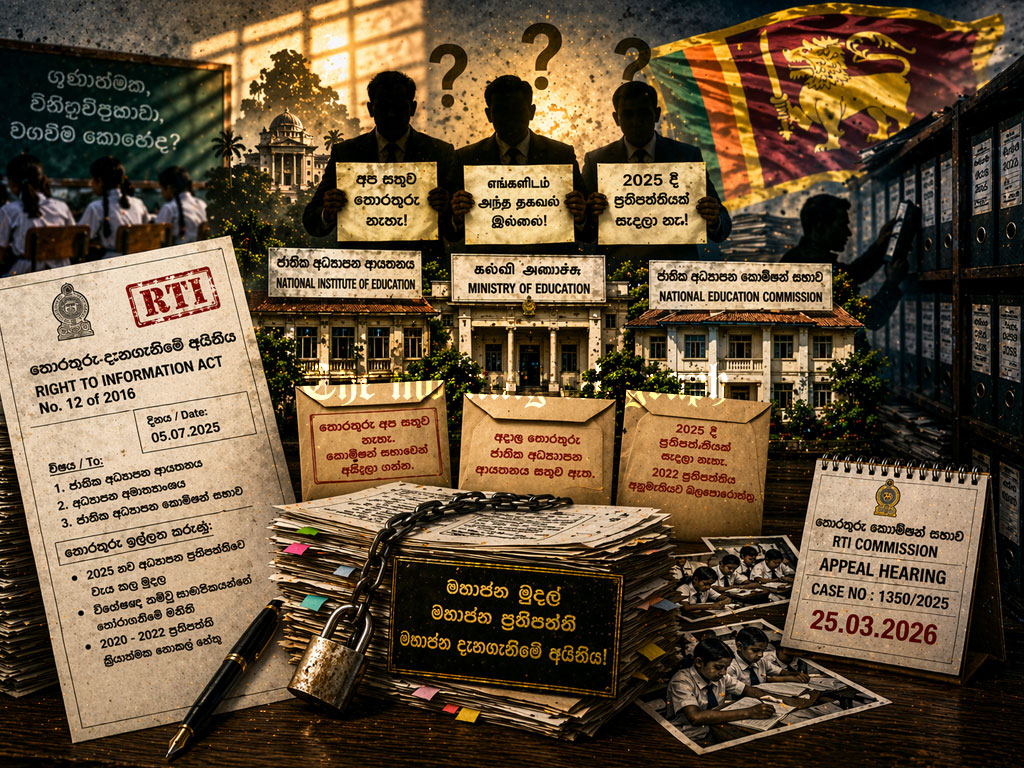
The request for information was submitted on July 5, 2025, to three key public authorities: the National Institute of Education, the Ministry of Education, and the National Education Commission. The request specifically asked for details on the financial cost of preparing the 2025 education policy framework, the qualifications and selection process of the expert committee, and the reasons for abandoning earlier policy frameworks developed between 2020 and 2022.
Three responses to the same information
The National Institute of Education responded by stating that it does not hold the requested information. It directed the applicant to seek details on costs and expert committees from the National Education Commission, while advising that Cabinet-related information should be obtained from the Ministry of Education.
In contrast, the Ministry of Education stated that the information is held by the National Institute of Education and redirected the inquiry back to the NIE, effectively creating a loop of responsibility between the two institutions.
The most surprising response came from the National Education Commission, which claimed that no new policy framework had been prepared in 2025 and that no funds had been spent. The Commission further stated that the policy developed in 2022 is still awaiting approval from the Presidential Secretariat.
The problem of transparency in policy formulation
These conflicting responses raise serious concerns in a context where the government has publicly discussed and promoted new education reforms. The inability of any institution to provide clear information about the development, funding, or existence of such a policy framework points to deeper issues in governance and record-keeping.
Critics argue that instead of facilitating access to information as required under Section 24 of the Right to Information Act, the institutions involved appear to be deflecting responsibility. The contradictory claims suggest a lack of coordination and potentially an attempt to avoid disclosure.
The matter has now escalated to a formal hearing under Appeal No. 1350 of 2025 before the Right to Information Commission. The Commission is currently examining the misleading responses and has scheduled further hearings on March 25, 2026.
As the case unfolds, it raises broader questions about transparency in public policy, the accountability of state institutions, and the public’s right to know how taxpayer money is being used in shaping the country’s education system.