Sri Lanka’s electricity sector faces mounting financial strain as rising costs, policy shifts, and structural challenges leave the CEB struggling to stay afloat even after multiple tariff revisions.
Despite a series of electricity tariff adjustments aimed at aligning prices with costs, the Ceylon Electricity Board continued to face severe financial pressure in 2025, according to the Central Bank Annual Economic Review. The situation highlights ongoing challenges within Sri Lanka’s energy sector and the difficulty of balancing affordability with financial sustainability.

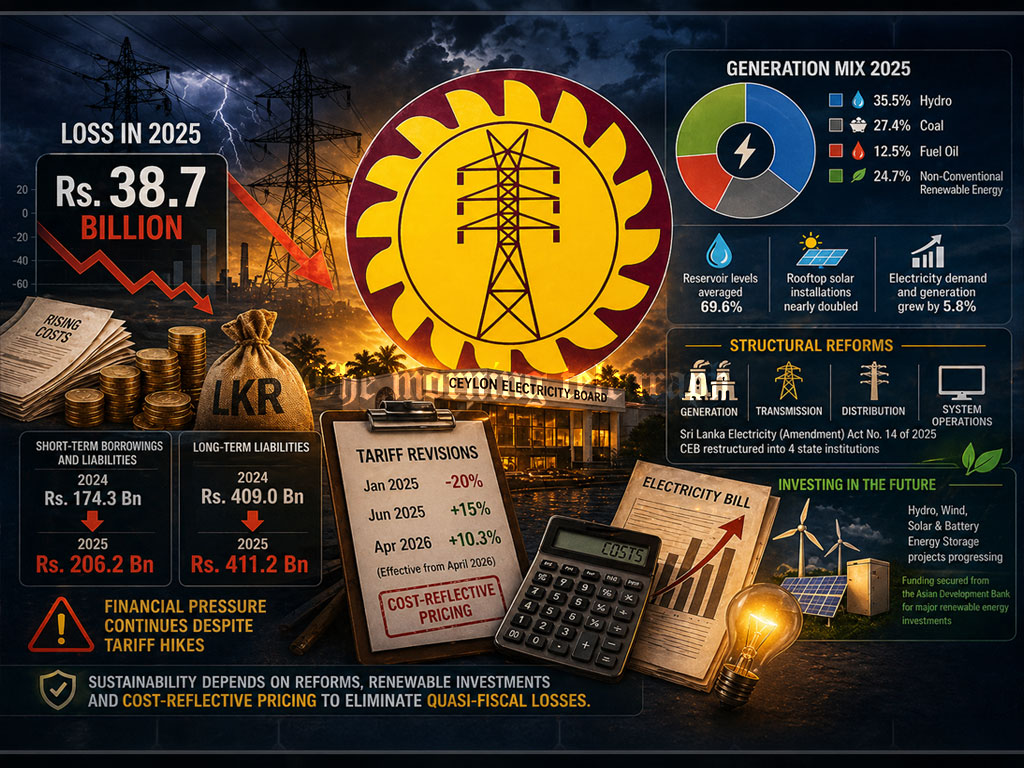
Reflecting the combined impact of tariff reductions and rising electricity generation costs, the CEB recorded an overall loss of Rs. 38.7 billion during the year. This significant loss underscores the gap between operational expenses and revenue generation within the national power utility.
Following earlier tariff cuts in 2024, electricity prices were reduced by an average of 20 percent in January 2025. However, the benefit to consumers came at a cost to the utility, as increased reliance on thermal power during the dry season drove up generation expenses in the first quarter, placing further strain on financial performance.
A 15 percent tariff increase introduced in June 2025 provided some relief, but it was not enough to fully recover the losses incurred earlier in the year. As a result, the financial position of the CEB remained fragile, with mounting liabilities and continued dependence on borrowings.
By the end of 2025, the CEB’s short term borrowings and liabilities had risen sharply to Rs. 206.2 billion, compared to Rs. 174.3 billion a year earlier. At the same time, long term liabilities increased from Rs. 409.0 billion to Rs. 411.2 billion, reflecting the growing debt burden on the institution.
Based on updated cost and revenue projections for the second quarter, authorities implemented a further tariff revision of 10.3 percent, which came into effect in April 2026. This move was seen as part of a broader strategy to stabilize finances and ensure cost reflective electricity pricing.
With the gradual recovery of economic activity, electricity demand and overall generation expanded by 5.8 percent in 2025. Growth was recorded across all major consumer segments, with the domestic sector showing particularly strong demand from the second quarter onwards. However, this growth slowed in the latter part of the year due to disruptions caused by Cyclone Dithwa.
On the supply side, improved hydropower conditions supported electricity generation, with reservoir levels averaging 69.6 percent throughout the year. The energy mix remained diversified, with hydro contributing 35.5 percent, coal 27.4 percent, fuel oil 12.5 percent, and non conventional renewable energy accounting for 24.7 percent.
Solar energy also showed notable progress, with rooftop solar installations nearly doubling during the year. This expansion reflects the growing role of renewable energy in Sri Lanka’s electricity sector and the push toward sustainable power generation.
The Central Bank also pointed to ongoing structural reforms within the electricity sector, including the enactment of the Sri Lanka Electricity Amendment Act No. 14 of 2025. This reform initiative includes the restructuring of the CEB into four separate state entities responsible for generation, transmission, distribution, and system operations.
In addition, the introduction of a national electricity policy and a revised tariff framework is expected to strengthen governance, improve operational efficiency, and encourage competition within the sector. These measures are viewed as critical steps toward modernizing Sri Lanka’s power industry.
Parallel to these reforms, infrastructure development projects across hydropower, wind energy, solar power, and battery energy storage have continued to progress. Significant funding support from the Asian Development Bank has also been secured to advance major renewable energy investments.
According to the Central Bank, maintaining cost reflective pricing, combined with structural reforms and continued investment in renewable energy, will be essential to ensuring the long term sustainability of Sri Lanka’s energy sector. Eliminating quasi fiscal losses through consistent pricing mechanisms remains a key policy priority moving forward.