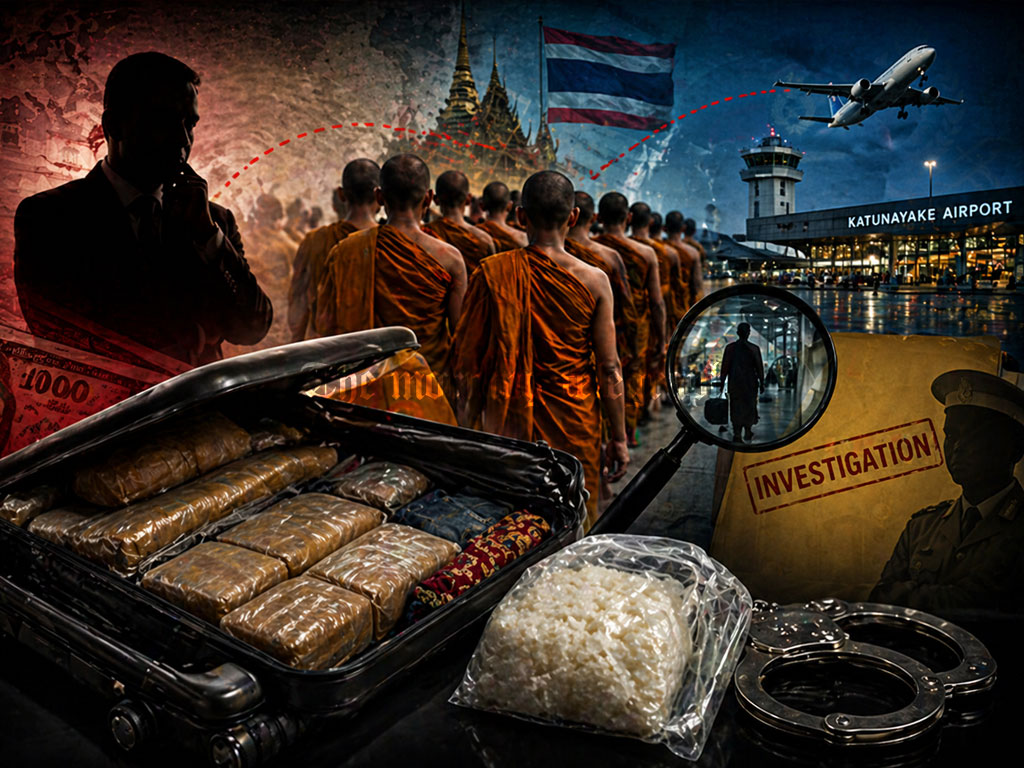
A controversial airport drug seizure raises serious questions about whether young monks were used as unsuspecting carriers, pointing investigators toward a powerful network operating behind the scenes.
The arrest of 22 Sri Lankan monks at Katunayake Airport with drugs valued at approximately Rs. 1.1 billion has sent shockwaves across the country, triggering widespread debate over whether this is simply a narcotics smuggling case or something far more complex. While the scale of the seizure itself is alarming, emerging observations suggest that the individuals arrested may not be the true masterminds behind the operation.

According to available information, the monks involved were student monks from different parts of Sri Lanka who had travelled to Thailand on a four-day trip sponsored by a private businessman. This detail has now become a central point of concern, raising suspicions that the group may have been unknowingly drawn into a larger international drug trafficking network. The circumstances surrounding the sponsorship and the organization of the trip are now being closely scrutinized as part of the ongoing investigation.
A key factor that has deepened suspicion is the manner in which the arrest took place. Reports indicate that this was not a routine airport inspection but rather an operation carried out based on specific intelligence. This strongly suggests that authorities had prior knowledge of the shipment, and possibly even of the individuals involved, well before the flight landed at Katunayake. Such targeted action raises critical questions about who else may have been aware of the movement and whether insiders played a role in facilitating or exposing the operation.
Another significant detail under investigation is the nature of the luggage used to transport the drugs. Authorities are now attempting to determine whether the monks carried their own personal bags or whether specially modified “false-walled” luggage was provided to them shortly before their return to Sri Lanka. This line of inquiry is crucial, as it may reveal whether the individuals were directly complicit or merely used as carriers without full knowledge of what they were transporting.
Investigators are also examining the possibility that the monks may have been misled regarding the contents of the luggage. It is being considered whether they were told they were carrying items such as electronics or fashion goods in order to avoid customs duties, a tactic often used in organized smuggling operations. If proven, this would further support the theory that the monks were not the primary actors but rather part of a larger, more sophisticated scheme.
At the center of the investigation now is the businessman who financed the Thailand trip. Identifying and interrogating this individual is seen as critical to uncovering the true “kingpin” behind the shipment. Authorities believe that this figure could hold the key to exposing a broader network involved in cross-border drug trafficking, potentially involving multiple layers of coordination and deception.
The case continues to unfold as law enforcement agencies intensify their efforts to trace the origins of the drugs, map out the network involved, and determine the level of awareness among those arrested. While public attention has largely focused on the shocking image of monks being linked to such a massive drug haul, investigators are being urged to look beyond appearances and focus on the deeper structures that may have orchestrated the operation.
As the investigation progresses, this incident is increasingly being viewed not just as a drug bust, but as a test of Sri Lanka’s ability to dismantle organized crime networks that may exploit vulnerable individuals to carry out illicit activities. Whether the arrested monks are perpetrators or victims remains a critical question, one that could reshape public understanding of the case in the days to come.
SOURCE :-
Muheed Jeeran
International Human Rights Activist
26 April 2026