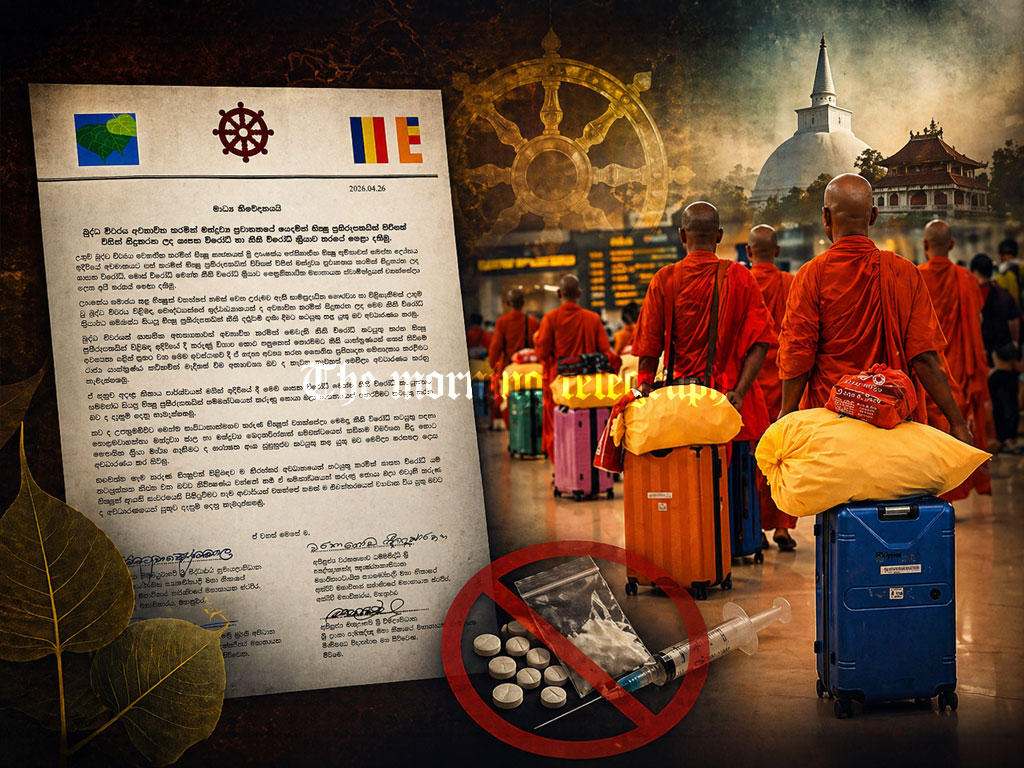
Sri Lanka’s top Buddhist leaders move swiftly to protect the integrity of the monastic order, vowing immediate action against individuals accused of abusing the sacred robe for drug trafficking.
Sri Lanka’s senior Buddhist clergy have issued a strong and deeply critical response to recent allegations involving monks linked to drug trafficking, describing the actions as a grave misuse of the sacred robe and a betrayal of public trust. The Most Venerable Prelates of the country’s leading Nikayas have made it clear that urgent steps will be taken to investigate those involved and remove them from the monastic order without delay.

In a decisive statement, the Prelates emphasized that individuals who hide behind the image of a monk while engaging in illegal activities such as drug trafficking are committing an act that is both anti religious and harmful to society. They noted that such behaviour not only violates the core principles of Buddhism but also undermines the long standing respect and reverence that the public holds for the Sangha in Sri Lanka.
The statement, issued as a formal media release, carries the authority of the Most Venerable Maha Nayaka Theros representing the Malwatta, Asgiriya, Amarapura, and Ramanna Maha Nikayas. These are the highest governing bodies within Sri Lanka’s Buddhist clergy, and their unified stance reflects the seriousness of the issue and the need to restore public confidence in religious institutions.
According to the release, a thorough investigation will be conducted into the individuals accused of involvement in drug trafficking networks. The Prelates have clearly stated that once the facts are established, those found guilty will be expelled from the monastic order immediately. This move is seen as a strong attempt to protect the sanctity of the Buddhist robe and ensure that the Sangha remains free from criminal influence.
The Prelates have also called on the Sri Lankan government and law enforcement agencies to take urgent action. They stressed that the state must intervene to dismantle organised drug trafficking operations that exploit religious identity as a shield. The misuse of monks in narcotics distribution has been described as a dangerous trend that requires immediate suppression through coordinated legal and security measures.
In addition, the statement highlights the need for stronger legal provisions that would enable authorities to take action against individuals posing as monks while engaging in unlawful activities. The Prelates have urged the government to introduce or enforce laws that would facilitate the removal of such imposters from the monastic community and hold them accountable under the law.
Security forces have also been called upon to intensify investigations into organised groups that target young monks. The Prelates warned that vulnerable individuals within the monastic system may be manipulated or recruited into criminal networks, making it essential for authorities to identify and dismantle these operations at their roots.
Another key concern raised in the statement is the need for greater supervision and discipline within the monastic order. The Prelates advised that preceptors and senior monks must maintain close oversight of younger members, ensuring that their conduct aligns with Buddhist teachings and ethical standards. Any deviation from these principles should be addressed immediately, with corrective measures taken to restore discipline and moral restraint.
The statement concludes with the endorsement of several prominent religious leaders, including Most Venerable Tibbatuwawe Sri Siddhartha Sumangala Thero of the Malwatta Chapter, Most Venerable Warakagoda Dhammasiddhi Sri Pannānanda Nyanaratana Thero of the Asgiriya Chapter, Most Venerable Karagoda Uyangoda Maithri Murthi Thero of the Amarapura Maha Nikaya, and Most Venerable Makulewe Sri Wimala Thero of the Ramanna Maha Nikaya.
Their collective voice signals a firm commitment to addressing the issue decisively and preserving the dignity of the Buddhist monastic tradition in Sri Lanka. As investigations unfold, the focus now shifts to how effectively authorities and religious institutions can work together to eliminate criminal infiltration and uphold the values that define the Sangha.