A controversial procurement deal has triggered serious corruption concerns as millions worth of goods arrive before approval, raising urgent questions about transparency, accountability, and misuse of public funds.
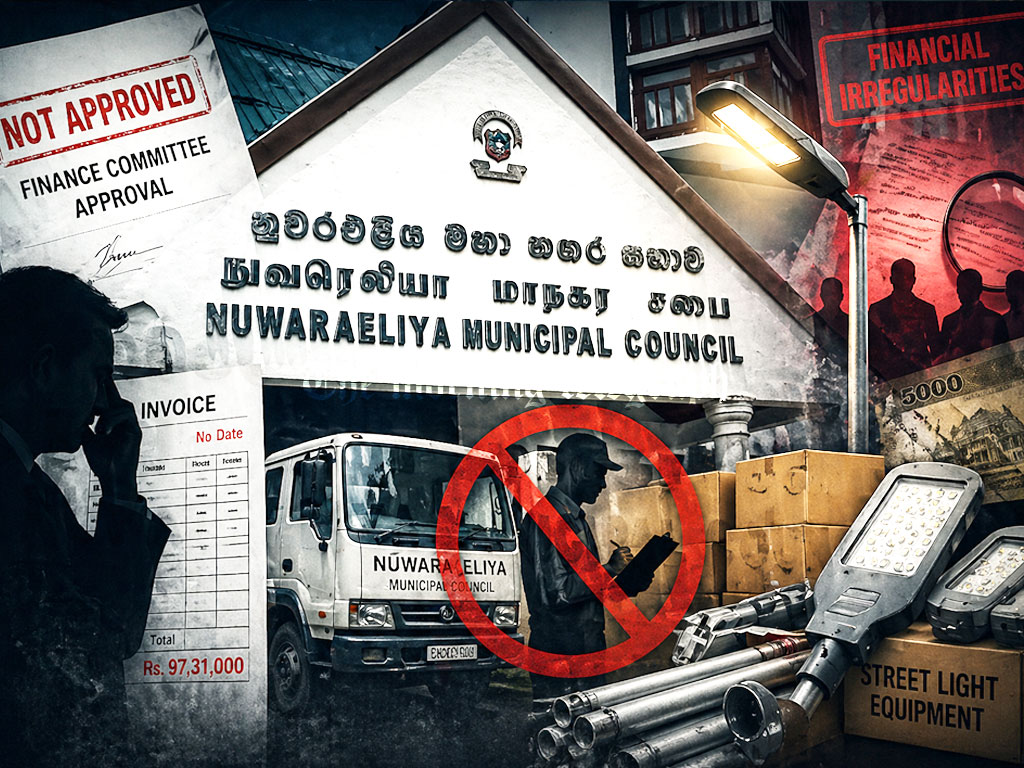
A consignment of equipment and raw materials valued at Rs. 9.7 million for street lighting projects under the annual development programme of the Nuwara Eliya Municipal Council has come under scrutiny after it was delivered to the Council’s storage facility even before receiving approval from the Finance Committee. Further controversy surrounds the transportation and inspection process, with allegations of procedural violations and potential financial fraud emerging during a recent Council session.

The issue was brought to light by Municipal Council member Jude Chandana Madagama during the April annual general meeting, where he strongly opposed the approval of the Finance Committee report. While the Council proceeded to pass other items within the report, the matter relating to the disputed transaction was excluded due to the concerns raised.
Following the meeting, further clarification was sought from Madagama, who also serves as the Chairman of the Mechanical Street Lighting and Transport Committee. He stated that multiple irregularities were evident in the procurement process, including the absence of prior Finance Committee approval, unauthorised use of a Municipal Council vehicle to transport goods, and the involvement of an unqualified individual in inspecting and accepting the consignment.
Madagama emphasised that the situation reflects a breakdown in procurement governance and public sector accountability. He pointed out that tender regulations clearly place the responsibility of transporting goods on the supplier, not on the Municipal Council. However, in this instance, goods were reportedly collected using a Council vehicle without proper authorisation or documented approval from either the Finance Committee or the Mayor.
He further questioned the decision to allow a firefighter to inspect and sign off on technical equipment, noting that such responsibility should fall to a qualified engineer or technical officer. The absence of professional oversight has raised concerns about the quality of the materials and the long term reliability of the street lighting project.
Adding to the controversy, Madagama revealed that the designated technical officer had declined to inspect the goods, citing an inability to do so. This refusal has intensified suspicions about the integrity of the procurement process and whether there was undue pressure to expedite the acceptance of the consignment.
The issue of supplier credibility has also been highlighted. According to Madagama, the same supplier had previously provided street lighting equipment of poor quality, with even sample units reportedly failing shortly after testing. Despite this history, the supplier appears to have been selected again, raising questions about procurement decision making and vendor evaluation procedures.
He further noted that the invoices associated with the consignment lacked proper dates, creating additional concerns regarding transparency and warranty accountability. Without clear documentation, there is no assurance that the Council will be able to claim responsibility or compensation if defects arise in the future.
Madagama stressed that the primary responsibility for the situation lies with the Municipal Commissioner and other state officials involved in the procurement process. He called for an immediate internal investigation and warned that legal action could follow under the Bribery or Corruption Act or other applicable laws, depending on the findings.
He also rejected any justification that the procurement was rushed due to events such as the Spring Carnival, stating that public funds cannot be misused under the guise of urgency or unofficial priorities. He pointed out the unusual nature of the transaction, where goods had arrived even before financial approval was granted, a deviation from standard procurement timelines where delivery typically takes several months.
The Council member confirmed that the goods would not be put into use until the investigation is completed, given the scale of the transaction and the serious nature of the allegations.
Meanwhile, Nuwara Eliya Municipal Council member Nuwan Porutota from the Samagi Jana Balawegaya stated that if the invoices are found to be in order, payments should be processed now that Finance Committee approval has been obtained. However, he agreed that any irregularities must be thoroughly investigated before proceeding.
Attempts to obtain responses from Municipal Commissioner Wijekon Bandara and Municipal Accountant Nandana Gunawardana were unsuccessful, as both officials declined to comment on the matter despite repeated inquiries.
As the situation unfolds, the incident has sparked broader concerns about procurement transparency, financial governance, and accountability within local government institutions, placing the Nuwara Eliya Municipal Council under intense public and political scrutiny.