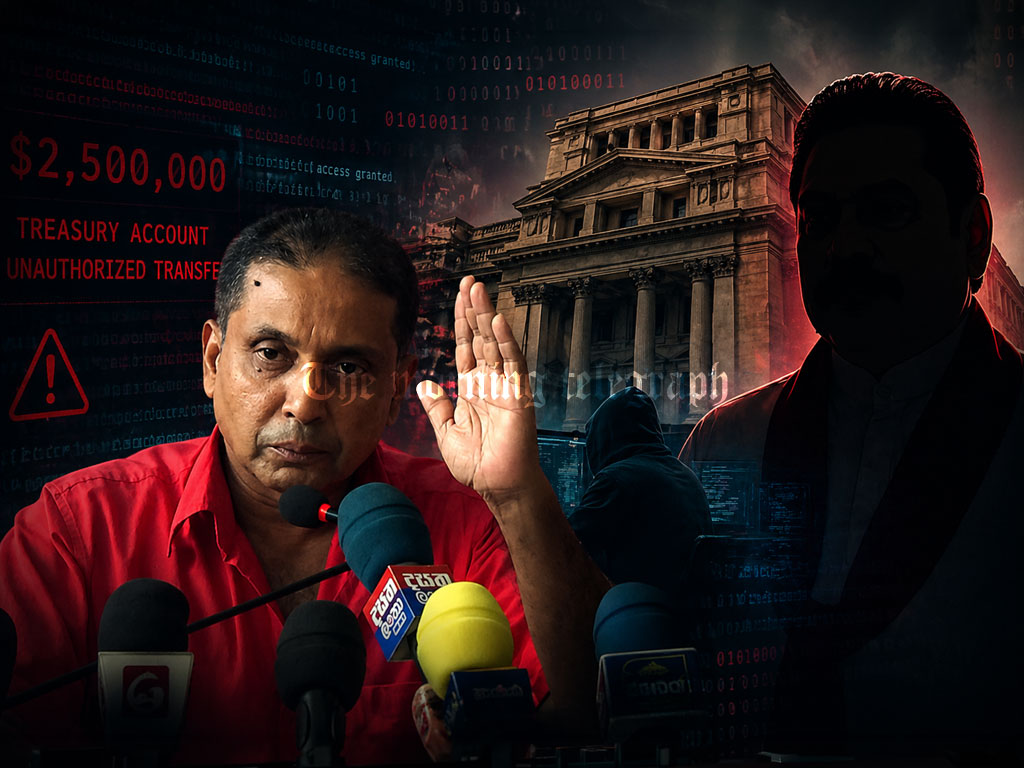
A fresh political storm erupts as explosive claims suggest a deep rooted conspiracy behind Sri Lanka’s $2.5 million Treasury cyber theft, raising urgent questions about power, influence, and the integrity of state institutions.
The controversial theft of $2.5 million from the Sri Lankan Treasury has now taken a sharp political turn, with Chameera Perera, Chairman of the Sri Lanka Labour People’s Front, alleging that the incident is not an isolated cybercrime but the outcome of a calculated internal conspiracy. According to Perera, the Treasury hack and financial fraud were orchestrated by individuals operating within state institutions, with links to close associates of the Rajapaksa political network.

Speaking at a recent media briefing, Perera stressed that this alleged Treasury heist must be investigated thoroughly as a case of institutional corruption and not merely a technical or cyber security lapse. He argued that the scale and nature of the financial irregularity point to insider involvement, raising serious concerns about governance, accountability, and systemic weaknesses within Sri Lanka’s financial administration.
Perera further claimed that individuals aligned with the Rajapaksa camp have gradually established control over key state institutions, enabling them to manipulate processes and obstruct ongoing investigations into major financial crimes. He warned that such influence not only undermines transparency but also threatens the credibility of Sri Lanka’s public sector and law enforcement mechanisms.
Highlighting what he described as a troubling double standard, Perera noted that individuals accused of financial frauds amounting to nearly Rs. 800 crore continue to operate freely, even commenting publicly on incidents such as the Treasury cyber theft. This, he said, reflects a deeper failure in the justice system and raises questions about selective accountability in high profile corruption cases.
He also linked the current developments to broader patterns of unresolved crimes in Sri Lanka, suggesting that incidents like the Treasury hack are part of a larger network of hidden operations. According to him, the exposure of such financial crimes is gradually revealing deeper connections to past events, including serious national security incidents, while efforts are simultaneously being made to suppress the truth and shield those responsible.
Perera concluded by reiterating that the Treasury hacking incident should not be treated in isolation but as a critical turning point that demands transparent investigation, institutional reform, and political accountability. He urged authorities to act decisively to uncover the full extent of the alleged conspiracy and restore public confidence in the country’s financial and governance systems.