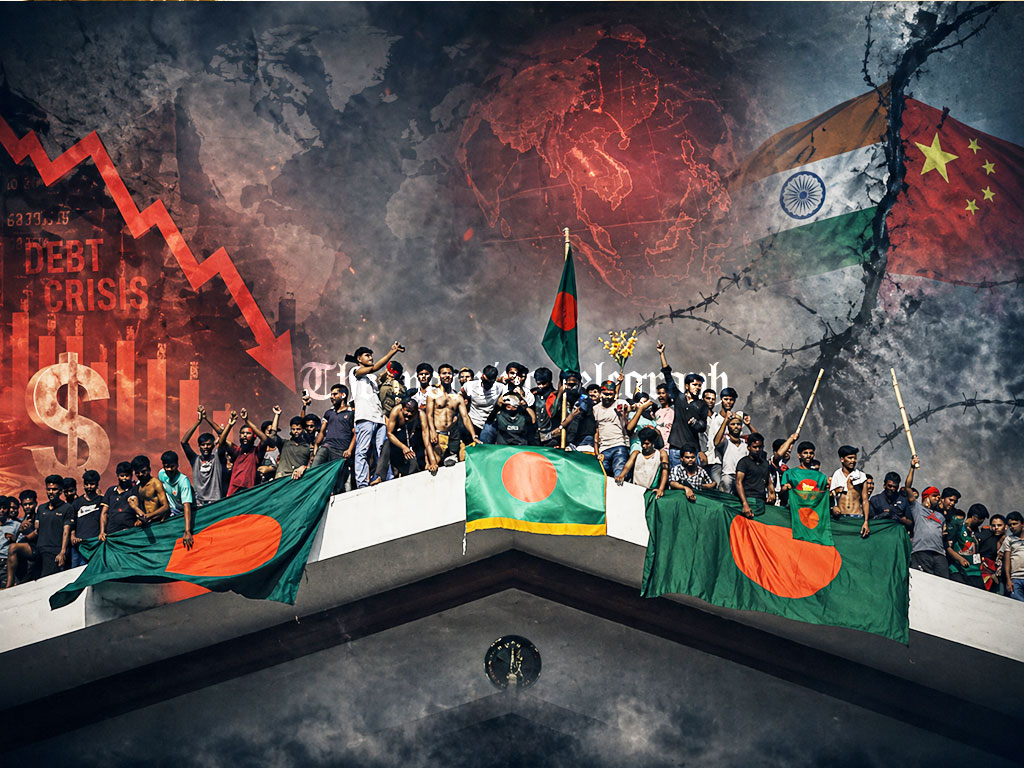
Once hailed as South Asia’s rising economic success, Bangladesh now faces a powerful combination of mounting debt, fractured ties with India, and geopolitical uncertainty that could reshape its future.
For decades, Bangladesh stood as one of South Asia’s most compelling development success stories. Emerging from the devastation of the 1971 war, the country steadily built a powerful garment industry, reduced extreme poverty, and earned global recognition from development economists. A quiet but critical factor behind this growth was its stable and strategic relationship with India. Today, however, that foundation appears shaken, and the timing could not be worse.

Bangladesh now finds itself at a crucial turning point, confronting a growing debt crisis while simultaneously navigating one of the most serious diplomatic breakdowns in its modern history with New Delhi. International observers are increasingly questioning whether the country has the capacity to manage both economic pressure and geopolitical tension at the same time.
The numbers alone paint a worrying picture. According to Bangladesh’s Economic Relations Division, the country is expected to repay nearly 26 billion dollars in foreign debt between fiscal years 2026 and 2030. This figure represents almost two thirds of the total 40 billion dollars repaid over the entire period since independence, signaling a rapid escalation in financial obligations.
Large infrastructure projects have contributed significantly to this burden. Developments such as the Rooppur Nuclear Power Plant, the Padma Rail Link, the Karnaphuli Tunnel, and the Dhaka Metro have increased external borrowing, pushing annual debt servicing requirements toward an estimated 5.5 billion dollars by 2030. At present, the debt service to revenue ratio has already reached 16.5 percent, approaching the 18 percent threshold often flagged by the International Monetary Fund as a critical risk level.
If current trends continue, projections suggest Bangladesh could take until 2063 to fully clear its existing debt obligations. This long-term financial pressure raises concerns about fiscal sustainability, economic stability, and the country’s ability to maintain growth momentum.
At the same time, Bangladesh’s diplomatic environment has become increasingly fragile. During the 15 year tenure of former Prime Minister Sheikh Hasina, relations with India were often described as a golden era of cooperation, particularly in trade, energy, and security. That stability came to an abrupt end in August 2024, when a student-led uprising led to the collapse of her government, forcing her to seek refuge in India.
Since then, relations between Dhaka and New Delhi have deteriorated sharply. In December 2025, following the killing of a student activist, both countries suspended regular visa services amid rising anti-India protests. This breakdown in engagement has deepened uncertainty at a time when cooperation is most needed.
Further tensions emerged when interim leader Muhammad Yunus made remarks suggesting Bangladesh could serve as an extension of the Chinese economic sphere, referring to parts of India as geographically constrained regions. These comments heightened concerns in New Delhi about shifting geopolitical alignments in the region.
Compounding the issue is the looming expiration of the Ganges water sharing agreement in 2026. With negotiations stalled and no clear resolution in sight, India has already reduced its financial assistance to Bangladesh, signaling a cooling of bilateral support at a critical moment.
The economic implications of this strained relationship are significant. Bangladesh relies heavily on India for trade access, energy supply, and investment flows. When this partnership weakens, the country’s ability to absorb economic shocks becomes increasingly limited. Economists within Bangladesh warn that declining export earnings, reduced foreign direct investment, and mounting debt could push the nation toward a crisis scenario similar to that experienced by Sri Lanka.
Despite these challenges, there are signs of potential recovery. The Bangladesh Nationalist Party secured victory in the February 2026 parliamentary elections, opening the door for a possible reset in foreign policy. Indian Prime Minister Narendra Modi has already initiated efforts to rebuild diplomatic ties with the new leadership, indicating that both sides recognize the importance of restoring stability.
Bangladesh now stands at a defining moment in its economic and political journey. Its resilience, long demonstrated through decades of growth and transformation, is being tested under unprecedented pressure. The path forward will depend on its ability to manage debt responsibly, rebuild strategic partnerships, and navigate an increasingly complex geopolitical landscape.
Without the steady support of its most important regional partner, overcoming this crisis will be a formidable challenge. Yet, if handled with careful policy decisions and renewed diplomacy, Bangladesh may still find a way to stabilize its economy and reclaim its position as one of South Asia’s most dynamic emerging economies.