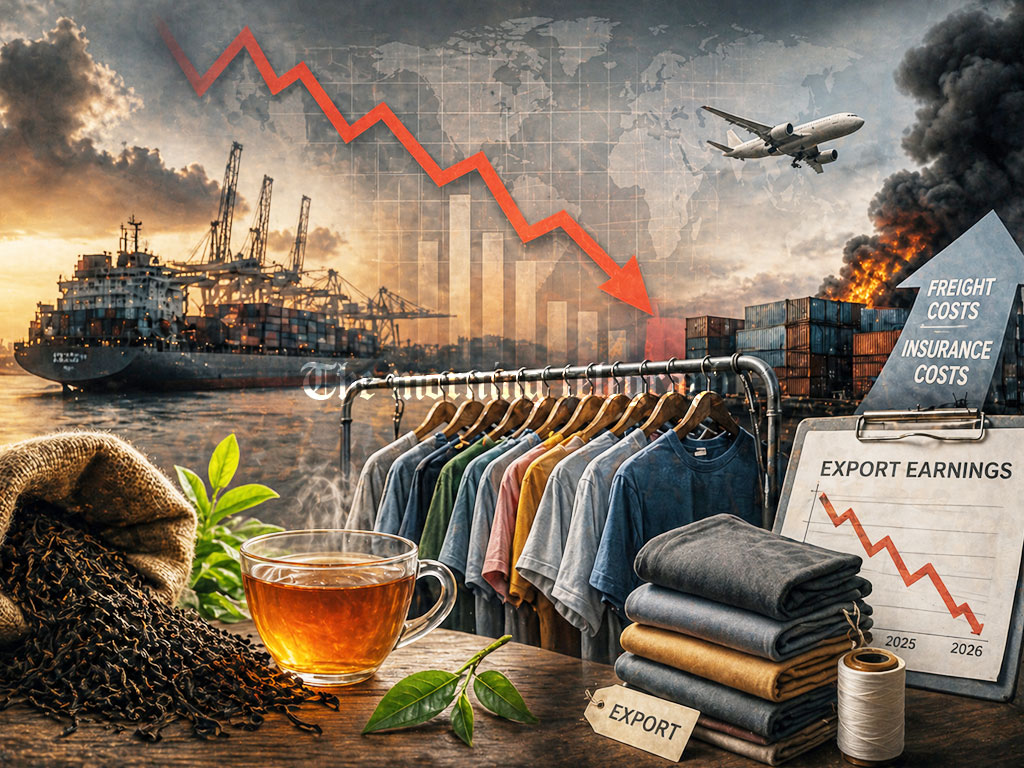
Sri Lanka’s export sector is showing mixed signals. While overall trade grew slightly, the first quarter of 2026 brought worrying declines in apparel, textiles, and tea. Add rising freight and insurance costs from the Middle East crisis, and exporters are feeling the heat. Here is what the numbers reveal.
The latest data on Sri Lanka export revenue decline shows that earnings from apparel and textiles, as well as tea, have decreased in the first quarter of this year compared to the same period last year. During the first quarter of 2025, which covers January, February, and March, Sri Lanka earned 1,383 million US dollars from apparel and textiles export earnings. However, in the first quarter of 2026, that figure fell to approximately 1,272 million US dollars, signaling a troubling tea export drop 2026 and a parallel slump in garments.

The decline was not limited to the clothing sector. Tea export revenue also dropped from 370 million US dollars in the first quarter of 2025 to 351 million US dollars in the same period of 2026. Other key sectors joined the downward trend. Export revenues from rubber products, spices and essential oils, and mineral oil products all decreased in the first quarter of this year compared to the previous year, highlighting a broader challenge for Sri Lanka’s trade performance.
Despite these setbacks in specific categories, Sri Lanka’s total export revenue for the period from January to March 2026 reached 4,308 million US dollars. According to Mangala Wijesinghe, Chairman and Chief Executive Officer of the Export Development Board, this represents a 2 percent growth compared to 2025. He further explained that in the latest Export Development Board report, merchandise export revenue for the first quarter of this year stood at 3,387 million US dollars, while services export revenue reached 921 million US dollars, offering a rare bright spot amid the overall slowdown.
Sri Lanka’s export sector is facing serious headwinds. The Chairman noted that the Middle East war impact on freight and higher insurance premiums following the conflict have created a problematic situation for Sri Lankan exporters in Q1 export performance 2026. The primary reason for the Sri Lanka export revenue decline is the increasing cost of exported goods themselves, driven by global logistics disruption and regional instability.
Exporters faced particular difficulties when shipping goods to Middle Eastern countries during the first two weeks of last March. Both air and sea freight routes presented numerous challenges, affecting everything from apparel exports to shipments of spices and essential oils. However, by mid March, there was some improvement in air freight. The Chairman said that due to ongoing difficulties in direct sea freight, exporters are now exploring alternative routes to ship goods to Middle Eastern nations, adapting to the new reality of rising insurance costs shipping across conflict zones.
The impact is not limited to the Middle East. Increased freight and insurance costs are currently having a measurable effect on exports to other countries as well. Sri Lanka’s export sector challenges are compounded by a global environment where supply chains remain fragile. Exporters are learning to navigate a more expensive and unpredictable logistics environment, hoping that better days lie ahead for Sri Lanka trade news.
For now, the mixed signals in the first quarter suggest that while services are holding steady, traditional merchandise exports need renewed focus and support.