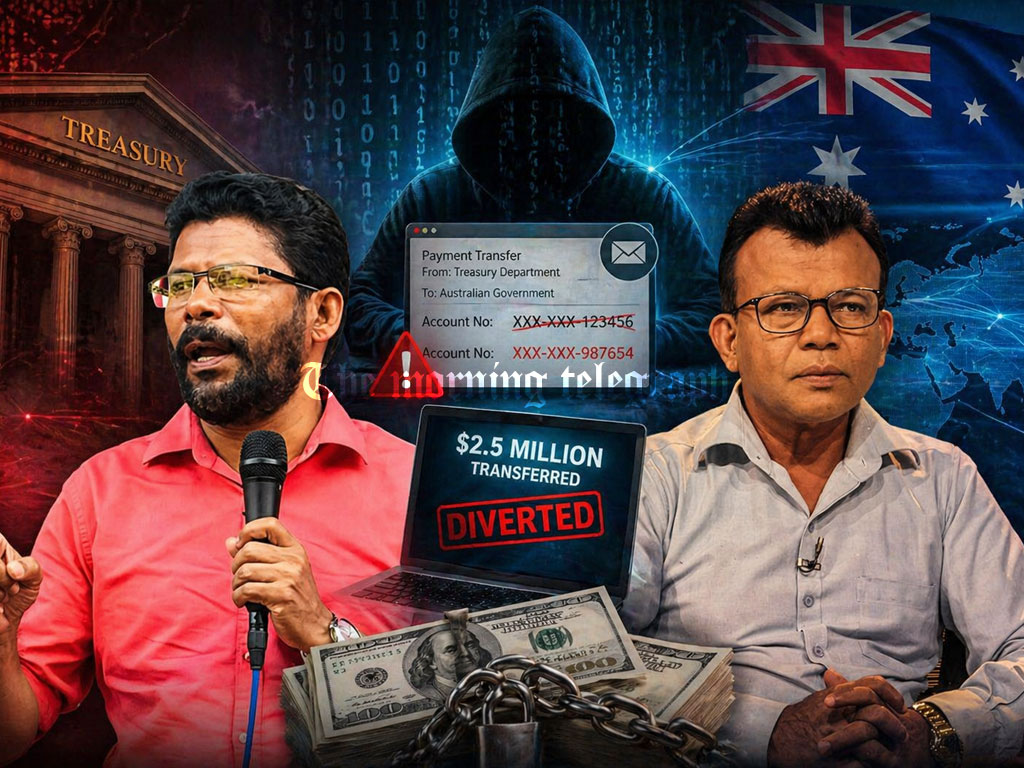
Two NPP MPs offer clashing narratives on a $2.5 million Treasury transfer gone wrong, exposing a battle between cyber crime claims and political blame as Sri Lanka searches for the truth behind the missing funds.
National People’s Power Member of Parliament Sunil Rathnasiri has claimed that a sophisticated cyber attack was behind the disappearance of $2.5 million, part of a larger debt settlement exceeding $22 million owed to the Australian government. According to Rathnasiri, the payment process was compromised when an official email was intercepted mid transmission by a cyber criminal, who altered the bank account details and redirected the funds to a third party account.

Addressing a public gathering, Rathnasiri emphasized that this was not an act of internal fraud but a clear case of cyber crime targeting a government financial transaction. He stated that such cyber security breaches can occur in any country and insisted that the Sri Lankan government has already initiated legal and investigative action to trace the funds and identify those responsible. His remarks directly challenge growing public concern around Treasury fraud and financial mismanagement in Sri Lanka.
However, the narrative does not end there. Rathnasiri also accused opposition forces of attempting to weaponize the incident for political gain, alleging that critics are deliberately portraying the cyber breach as government corruption. He maintained that labeling the incident as theft or fraud by the current administration is misleading, stressing that the issue lies within the realm of cyber security vulnerabilities rather than governance failure.
In contrast, fellow National People’s Power MP Devaananda Suraweera offered a broader and more politically charged defense. Speaking to the media, Suraweera firmly denied any involvement of NPP members or state officials in corruption, instead shifting the spotlight toward what he described as remnants of the old “blue green” political establishment. According to him, these actors, whom he indirectly labeled as political hackers, are responsible for both past economic destruction and present attempts to discredit the government.
Suraweera argued that the accusations currently being directed at the government stem from frustration among those who have lost power. He pointed to previous incidents involving alleged financial irregularities and institutional breakdowns, suggesting that the same forces are now attempting to manipulate public perception around the Treasury cyber crime incident. His comments introduce a political dimension to what Rathnasiri framed primarily as a technical cyber fraud case.
Addressing public sentiment, Suraweera claimed that citizens do not view the current leadership as corrupt, but instead criticize the government for not moving swiftly enough to prosecute individuals linked to past corruption. He emphasized that legal processes require time, particularly when evidence must be gathered through proper democratic and judicial mechanisms. This assertion attempts to reinforce the credibility of the government’s anti corruption stance amid the ongoing controversy.
He further noted that the President has declared state funds and the Treasury as protected communal assets, underscoring a policy commitment to financial accountability and transparency. According to Suraweera, any irregularities in financial transactions are subject to both domestic and international investigations, with efforts underway to recover lost funds and strengthen oversight systems in Sri Lanka’s financial governance framework.
Despite political tensions and competing narratives, Suraweera expressed confidence that the government will overcome these challenges. He stated that attempts by elements of the previous political culture to obstruct progress will not succeed, and projected that 2025 will be a decisive year in restoring economic stability and public trust in Sri Lanka.
As the debate unfolds, the core question remains unresolved. Is this truly a case of sophisticated cyber crime exploiting weaknesses in government systems, as Rathnasiri insists, or does it reflect deeper systemic and political accountability issues raised indirectly through Suraweera’s counterattack? With investigations ongoing and public scrutiny intensifying, the truth behind the missing $2.5 million continues to sit at the intersection of technology, governance, and politics.