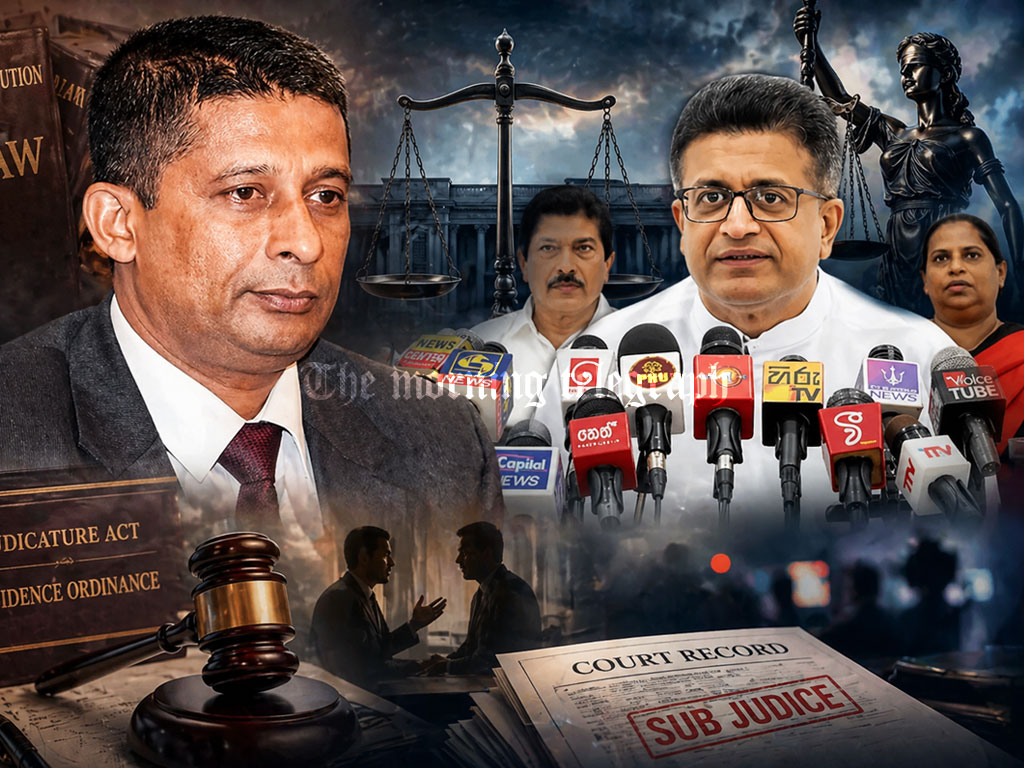
A legal storm erupts as Udaya Gammanpila challenges reports that a Colombo Fort Magistrate barred him from representing Major General Suresh Sallay, raising serious questions about constitutional rights, legal ethics, and media accuracy in a politically charged case.
These remarks were made by party leader and Attorney-at-Law Udaya Gammanpila at a media briefing held today by the Pure Sinhala Heritage party, where he strongly rejected recent claims surrounding his legal role in a high-profile case.
Last week, several media outlets reported that the Colombo Fort Magistrate’s Court had allegedly barred him from acting as legal counsel for Suresh Sallay, and had also prevented him from meeting his client in that capacity. Gammanpila dismissed these claims as inaccurate and misleading. He stated that no magistrate has the authority to prevent a lawyer from representing a suspect, emphasizing that the learned magistrate would be fully aware of this legal position.

He pointed to Article 13(3) of the Sri Lankan Constitution, which guarantees the fundamental right of a suspect to be heard through legal representation. He further referenced Section 260 of the Criminal Procedure Code, which affirms a suspect’s right to obtain legal advice, and Section 41 of the Judicature Act, which recognizes a lawyer’s right to appear on behalf of a client. Together, these provisions reinforce both the suspect’s right to choose legal counsel and the lawyer’s professional right to represent them.
Gammanpila argued that it would be a troubling precedent if a complainant were allowed to decide who represents a suspect, rather than the suspect themselves. He noted that no such practice exists in any legal system worldwide. According to him, he was formally appointed as Sallay’s lawyer through a letter submitted by Sallay’s wife to the Director of the Criminal Investigation Department. As long as he remains a practicing attorney, he insisted that no court, police authority, or official from the Attorney General’s Department can prevent him from fulfilling that role.
He further argued that even if such judicial authority existed, it could not be exercised without affording him an opportunity to be heard. Denying him that opportunity would violate the fundamental principles of natural justice, particularly the requirement to hear both sides before making a decision.
Addressing hypothetical concerns, he stated that even if he had committed an offence, a magistrate does not possess the authority to impose disciplinary sanctions on a lawyer by restricting their ability to appear in court. That authority, he said, rests solely with the Supreme Court. Based on this, he expressed confidence that the magistrate would not have made such an order, and suggested that the issue likely stems from inaccuracies in media reporting. He confirmed that he has instructed fellow lawyers to obtain a certified copy of the relevant court proceedings to establish the facts.
Gammanpila also responded to claims that Additional Solicitor General Dilip Peiris had raised objections to his involvement in the case. According to reports, Peiris had allegedly argued that Gammanpila was unsuitable to represent Sallay because of his interactions with the media and his authorship of a book on the Easter Sunday attacks. Gammanpila dismissed these concerns, describing them as politically influenced and legally unfounded, while suggesting that Peiris has made similar controversial statements in previous cases.
He cited Section 126 of the Evidence Ordinance, which prohibits lawyers from disclosing client information without consent, noting that this provision protects confidentiality and client privacy. He clarified that any information he shared publicly regarding Sallay’s condition was done with the full consent of both the client and his family. In his view, this practice is consistent with international norms, where lawyers often act as spokespersons for high-profile clients.
Drawing a comparison, he referenced recent legal proceedings involving Donald Trump, where his attorney Alina Habba regularly addressed the media on his behalf. He questioned why similar conduct would be deemed inappropriate in Sri Lanka, suggesting a double standard in the criticism directed at him.
He also defended his right to author a book on the Easter Sunday attacks, stating that freedom of expression allows individuals to comment on ongoing matters, provided they do not interfere with judicial proceedings. He clarified that the legal restriction known as sub judice applies only from the time charges are formally filed until a verdict is delivered. Outside that period, he maintained, expressing opinions or publishing material does not violate the law.
As the controversy unfolds, the case continues to raise broader questions about legal rights, judicial authority, and the intersection of law and media in Sri Lanka. The outcome of the certified court records is now expected to clarify whether the controversy stems from a judicial directive or a misinterpretation amplified through media reports.