Hambantota solar scandal deepens as 1,000 acres of elephant habitat face clearing amid claims of illegal approvals and state failures.
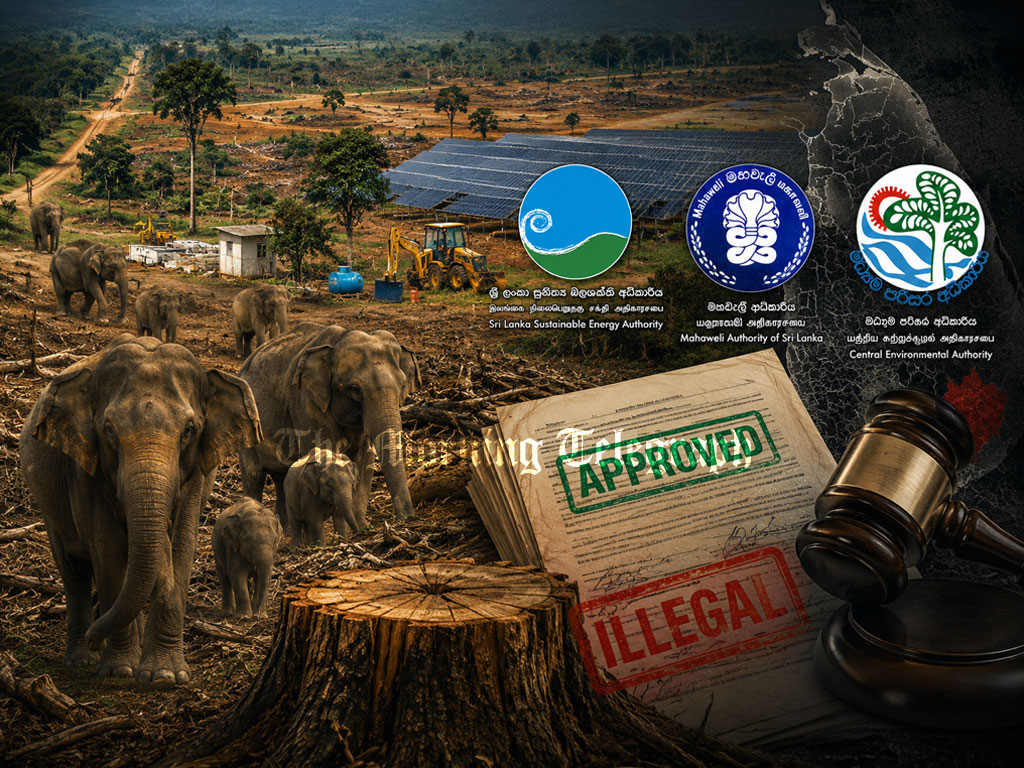
Hambantota solar scandal allegations have intensified after claims that nearly 1,000 acres of forestland, identified as key elephant habitat in Seenukkugala, Orukengala, and Kapapuwa in the Hambantota Divisional Secretariat area bordering the Hambantota Elephant Management Reserve, have been cleared for large-scale solar power plants.
According to the allegations, 17 companies have begun construction by misleading the Sri Lanka Sustainable Energy Authority (SLSEA), the Mahaweli Authority, and the Central Environmental Authority (CEA). The strongest evidence cited is the approval granted to two unregistered companies and several companies linked to the same board of directors. It appears these illegal actions may have happened either by misleading state institutions or through bribery. Yet, even after these facts were exposed, no state institution has stepped forward to stop the damaging activities.

The 150 MW solar power plant project, described as a US$150 million investment, is being implemented by a group called the “Hambanthota 150 MW Solar PV Project – Group of Companies.” However, this is not a registered company.
Among the 12 companies operating under this group, eight namely Geneco Pvt Ltd, Solargen Pvt Ltd, Stallion Energy Solar Pvt Ltd, Elephant Power International Pvt Ltd, Madunagala Agrico Pvt Ltd, Leisure Creation Pvt Ltd, Talna Solar Pvt Ltd, and Greenline Solar Pvt Ltd have Palawinnage Charana Mitsuka Kumaratunga, Dulanga Kumaratunga, Madusanka Puravarna Fernando, and Chinese national Liu Kai as key board members.
Liu Kai, who represents the boards of five companies, is listed as the main investor in the entire project. Charana Kumaratunga represents the boards of seven companies and also appears to be the main partner behind the group implementing the project.
Environmental approvals, land leases, and agreements with the SLSEA and the Ceylon Electricity Board (CEB) have reportedly been handled separately, company by company, although the firms belong to the same group.
The reason for using multiple companies in this manner appears to be to avoid the environmental impact assessment process and make it easier to lease land from the Mahaweli Authority. It also appears that state institutions have supported these illegal shortcuts and omissions.
Investigations have further revealed that Electrolyte Pvt Ltd and Circle Line Pvt Ltd, operating under the Hambanthota 150 MW Solar PV Project – Group of Companies, are not registered companies.
This raises a serious question as to how the Mahaweli Authority, the SLSEA, and the CEA entered into agreements and leased land to companies with no legal personality. It appears officials of these institutions acted without proper due diligence.
The communities affected by these illegal and harmful activities include nearly 5,365 farming families in the Mayurapura division settled under the Left Bank of the Mahaweli Project, along with farming communities in Gonnoruwa, Meegahajadura, Thanamalwila, and Galwewa.
As nearly 1,000 acres of forest on the border of the Elephant Management Reserve are cleared for solar projects based on allegedly illegal approvals, elephants driven out of their habitats are entering villages in large numbers.
This has sharply worsened the human-elephant conflict. People have died in elephant attacks, while the number of permanently disabled victims has also increased. Some farmers have abandoned their farmlands, turning the issue into a growing social and economic crisis. The killing of elephants has also escalated.
All this amounts to a violation of the fundamental rights of the people. Article 27(14) of the Constitution states that the state shall protect, preserve, and improve the environment for the benefit of the people.
When read together with Article 12(1), which guarantees equality in the application, protection, and dispensation of the law, citizens have a fundamental right to be free from illegal and arbitrary acts or omissions that cause or permit environmental pollution or degradation.
Officials of institutions funded by taxpayers cannot act against the aspirations of the people. However, the SLSEA, the Mahaweli Authority, and the CEA appear to have acted in favour of the solar companies.
Therefore, the Commission to Investigate Allegations of Bribery or Corruption (CIABOC), the Auditor General’s Department, and the Attorney General’s Department must urgently intervene and take steps to halt these illegal solar projects.
Sajeewa Chamikara
Land and Agricultural Reforms Movement