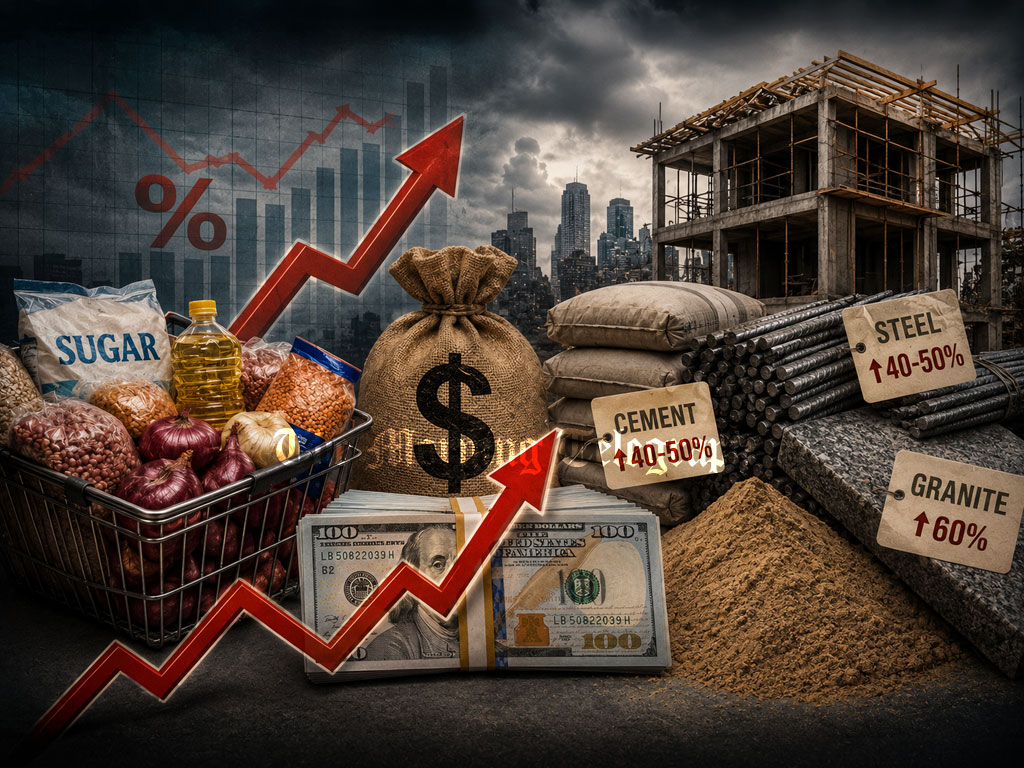
Housing dream fades as rupee depreciation drives essential import costs higher and building material prices rise by 40-50%.
Housing dream concerns are rising as Sri Lanka’s weakening rupee pushes up essential import costs and threatens a sharp increase in construction material prices.
The Essential Food Items Importers Association says price increases for many essential goods in the coming months are unavoidable due to the rapid depreciation of the local rupee against the US dollar.
An official of the association, speaking to the media, said the main reason for the current situation is the sharp increase in import costs.

The spokesperson noted that the present government cannot be directly blamed for the rupee’s fall, recalling that many global economies have already suffered serious setbacks due to the crisis in the Middle East region.
Even the smallest item imported into Sri Lanka from the global market has to be paid for in dollars.
With the dollar now nearing the Rs. 340 level, importers say they are unable to pass any benefit to local consumers, even when prices of some essential goods fall in the international market.
For example, although the global price of a metric ton of big onions has dropped from US$ 300 to US$ 250, the depreciation of the rupee means that relief cannot be passed on to the public.
The association says many other goods are facing the same situation. At present, even if prices are not increased, there is no possibility of reducing them.
The fall of the rupee has already affected the prices of several goods, including sugar.
In particular, with India banning sugar exports until September 30 of next year, the government has had to look for alternative countries to meet local demand.
However, the association confirmed that Sri Lanka has sufficient sugar stocks for local consumption until new markets are secured.
Meanwhile, the Sri Lanka National Construction Association says the local construction sector is also facing a serious collapse due to rupee depreciation and rising fuel prices.
A spokesperson for the association said prices of nearly 300 types of building materials are expected to rise by around 40% in the future.
Prices of key raw materials such as cement, sand, and concrete wire have already increased.
In the current market, granite prices have risen by 60%, while carpet prices have increased by between 40% and 50%.
Although tile prices have not changed yet, the association says those prices are also expected to rise soon.
Under existing procurement regulations, when prices increase, additional provisions must be paid. However, this applies only to projects that have been ongoing for more than three months.
If the rupee weakens further, the government will have to bear an additional cost of between 40% and 50% above the contracted amount for ongoing government construction projects.
Considering the current crisis, the association says this price adjustment relief should also be extended to short-term projects lasting less than three months.
It has also urged the government to pay the increased cost to contractors without delay according to price indices, in order to prevent the construction sector from collapsing completely.
The association says a Cabinet paper is being prepared for this purpose.