Sri Lanka fuel crisis measures face scrutiny as regional nations impose work-from-home, travel limits, fuel controls, and energy-saving plans.
Sri Lanka fuel crisis fears remain high even though the Middle Eastern war situation has temporarily eased, with its global economic impact continuing to grow by the day.
The South Asian region has felt some of the strongest effects, especially through the fuel and energy crisis and the rising value of the US dollar.
Although governments across the region have introduced different measures to deal with the situation, the economic and social pressure caused by these measures does not appear to be easing.

What has Sri Lanka done so far?
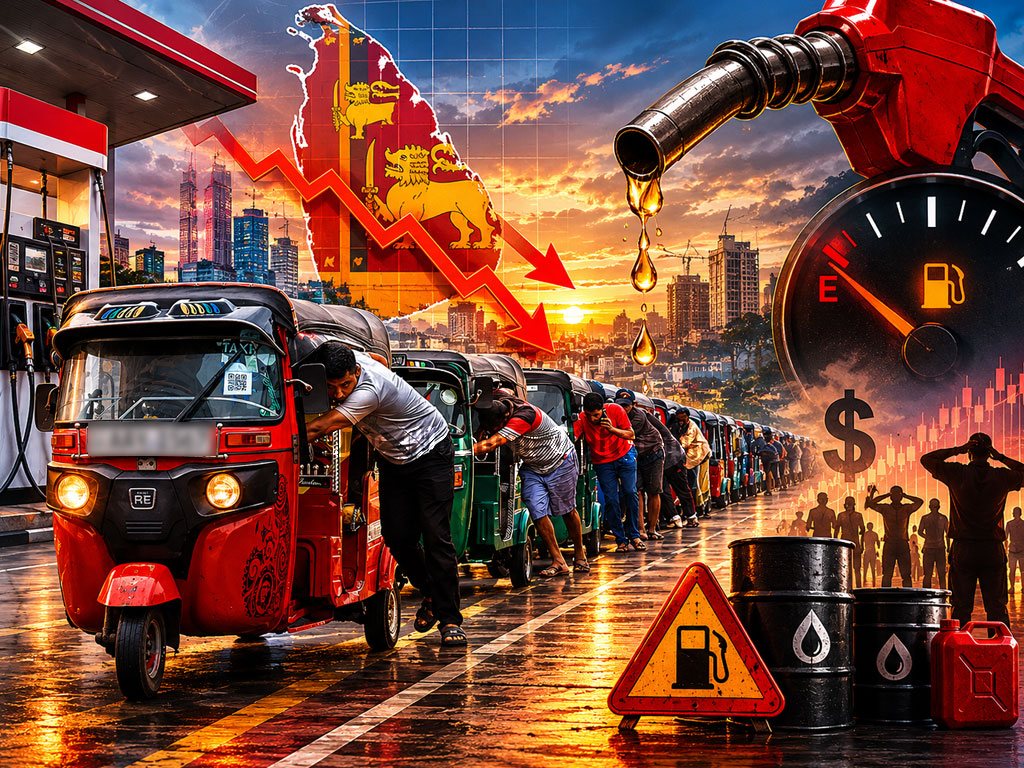
When the war began, people in Sri Lanka also started buying fuel uncontrollably. This led to fuel shortages, while long queues were again seen at filling stations.
To prevent fuel hoarding, reduce consumption, and manage the fuel crisis, the government reintroduced the earlier QR code system.
In addition, it also introduced a system to issue fuel on odd-even days based on vehicle numbers.
Although both systems are still in operation, there have been regular reports of instances where they are not being properly implemented.
Fuel issued without proper regulation
A person who wished to remain unnamed said he had obtained fuel on several occasions without using the odd-even or QR code systems.
“The day before yesterday I got fuel from a shed near Negombo. They didn’t check the QR or the odd-even. They gave me a full tank of fuel. There were about two cars and three three-wheelers there, and they were given fuel the same way,” he said.
He also said he had been able to obtain fuel from certain filling stations in this manner several times.
Wednesday holiday and halt on state events
As another step to deal with the energy crisis, the government declared a special public holiday from March 18.
However, the government later cancelled that additional holiday from April 08.
Furthermore, all events organized by the government were temporarily suspended as part of the response to the crisis.
How state institutions are responding
Minister of Public Administration, Provincial Councils and Local Government Chandana Abeyratne said state institutions were advised from the beginning of the crisis to use fuel and energy sparingly.
He said some progress had been achieved as a result.
The Minister also said steps had been taken to limit state events and to hold certain meetings and conferences online.
“Except for essential matters, almost everything else is being done in a way that can be done at minimal cost. Meetings are held online without bringing in officials,” he said.
Minister Abeyratne said discussions are underway on proposals to face a possible worsening of the fuel and energy crisis in the future.
However, he said no final decision had been made.
“Several methods, ideas, and proposals have been submitted. There are also proposals that are impractical to implement. Attention has been focused especially on controlling non-essential activities in a way that does not hinder other work in the country,” he said.
Rules relaxed for Vesak festival
The government has also taken steps to relax regulations imposed on fuel and electricity use for the Vesak festival.
A statement from the Prime Minister’s Media Unit said Secretary to the Prime Minister Pradeep Saputhanthri had informed Buddha Rashmi Vesak zone organizers about the decision.
The statement said: “Due to the current crisis, it has been decided to use fuel and electricity sparingly compared to previous years. Accordingly, the Chief Incumbent of the Colombo Gangarama Temple, Dr. Ven. Kirinde Assaji Thero, stated that arrangements have been made within the Buddha Rashmi Vesak zone to decorate with Vesak splendour, giving priority to the offering of principles with minimal fuel and electricity costs, and to delight the devotees with material offerings, and that this year’s Vesak zone will be held from 7:00 pm to 12:30 am.”
What did the President say about fuel limits?
President Anura Kumara Dissanayake said on May 20 that the monthly cost of importing fuel had increased due to rising fuel and dollar prices.
He made the remarks while attending a programme in the Batticaloa district under the “Whole Country Together” national operation.
The President said several measures had been taken to face the situation.
He also said the collapse of the rupee was a short-term situation and that everyone should face it strongly.
“The increase in the dollar price has also increased the monthly cost of importing fuel. Therefore, there is pressure on our rupee and demand for the dollar. Many measures are planned to face this crisis. For a short period, we must control this pressure on the dollar. For that, we must limit fuel usage,” the President stated.
How has India responded?
Due to the war heat in the Middle East, fuel prices have also risen in neighbouring countries such as India, Pakistan, Bangladesh, and Nepal.
Those countries are also facing pressure from the rising dollar value and the wider energy crisis.
Prime Minister Narendra Modi has requested Indians to work from home more, minimize foreign travel, and avoid buying gold for one year.
The Indian Prime Minister described saving fuel as a patriotic act.
He also asked citizens to use public transport more often.
A 90-day fuel saving and conservation programme is underway in New Delhi to help address the economic pressure caused by the energy crisis and the weakening Indian rupee.
Employees who can work remotely have been allowed to work from home two days a week.
The private sector has also been requested to introduce similar measures.
Pakistan imposes tougher restrictions
Pakistan has also taken several strict steps to face fuel shortages and rising fuel prices.
The government has moved to introduce a four-day work week and allow about 50% of public sector employees to work remotely.
Fuel issued for government vehicles has also been reduced by 50%.
Online education has been made temporarily mandatory for universities and higher education institutions.
The Prime Minister of Pakistan has asked citizens to limit weddings and parties to 200 guests and one main meal.
He has also requested limits on gatherings.
Fuel prices in Pakistan are now reviewed every Friday.
Nepal cuts working days to five
To face the crises caused by the Iran war, Nepal reduced the working week for government offices and educational institutions from six days to five.
The Nepalese government has requested companies to limit electricity usage.
Citizens have also been asked to reduce non-essential travel and cut fuel consumption.
Bangladesh limits fuel use
Since the beginning of the war, Bangladesh closed its universities to prepare for possible crises.
The government also moved to limit the amount of fuel that can be purchased per day.
Business and office operating hours were also reduced.
As another measure, Bangladesh has closed fertilizer factories and redirected their gas supply directly to power generation plants.
Take at least 20% of the economy online
Economists were also asked what measures the Sri Lankan government should take to face the crisis.
Professor of Economics Priyanga Dunusinghe said online education and online work should be introduced to manage the current situation.
“Take at least 20% of the economy online. Request the private and public sectors to work online. It’s possible to start with the school system, at least online for those above grade 6 in schools in the Western Province. Take universities online, take technical colleges online. Request that tuition classes be held online. Through this, fuel usage will decrease significantly,” the Professor said.
He stressed the importance of conducting education activities online.
Professor Dunusinghe said the method should be followed step by step and that at least part of economic activity should be carried out online for the next two years.
“Sri Lanka cannot bear the cost of importing fuel. When bearing fuel costs this way, the transport system collapses, and vehicles come in more than necessary,” he said.
He added that there was no visible improvement in public transport and that the government did not have the economic strength to intervene effectively in that area.
Saving foreign exchange through firewood
Professor Priyanga Dunusinghe also suggested limiting gas usage in rural areas where firewood can be used, since gas consumption is higher in urban areas.
“Gas consumption was promoted, saying that firewood smoke is bad for the lungs. Everyone went to using gas. The final result is that firewood rots into the ground. It has become necessary to import gas using foreign exchange,” he said.
Vehicles were not imported for people’s needs
The Professor also said the excessive import of vehicles after the country reopened vehicle imports had contributed to the crisis.
He said Sri Lanka should have a system where vehicles are imported only after orders are placed for the required quantity.
“Several parties in the economy spent the foreign exchange that was collected with great difficulty on importing cars and luxury goods. A large number of those vehicles were not brought in for people’s needs. They are in showrooms and sales,” he said.
“When people go on the road, they don’t think ‘I need to buy a vehicle, I need to take a vehicle’. Or they don’t think ‘I need to take other luxury goods as I go’. Allow ordering and importing according to that order,” the Professor said.
Professor Priyanga Dunusinghe emphasized that because of this reduction in foreign exchange, the general public is forced to pay higher prices for essential goods and medicines.