Chola Copper Plates returned by the Netherlands reveal Buddhist links between India, Indonesia, Sri Lanka, and ancient maritime trade.
Chola Copper Plates from Leiden have reopened a powerful historical story linking the Chola Empire, Buddhism, Indonesia, Sri Lanka, and ancient maritime trade across the Indian Ocean.
During Indian Prime Minister Narendra Modi’s recent official visit to the Netherlands, Dutch leaders agreed to return the Chola Copper Plates of Leiden from the Leiden University Museum.
These copper plates date back to the reign of Emperor Rajaraja Chola I, who ruled from 985 to 1014 CE.
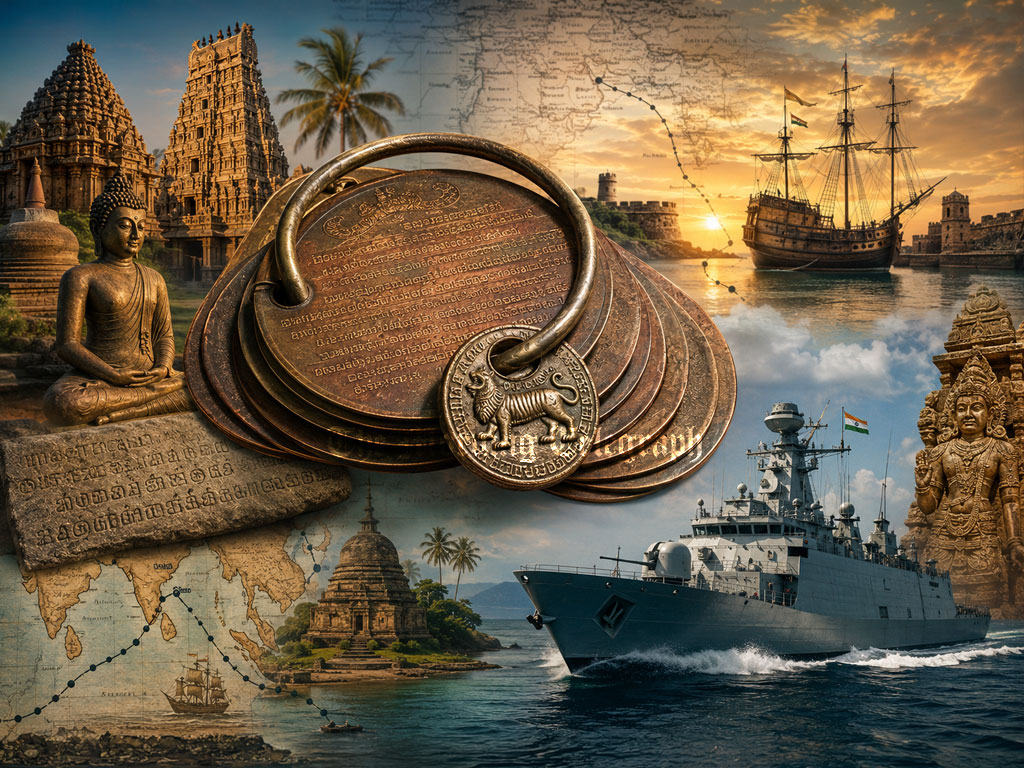
The collection consists of 21 plates weighing approximately 30 kilograms. They are bound together by a bronze ring carrying the seal of the Chola dynasty.

India’s 14 years of diplomatic efforts finally succeeded when the Dutch government agreed to return this priceless historical artefact.
The copper plates were taken to the Netherlands more than 300 years ago from Nagapattinam, also known as Naga Port, in southern India.
India’s efforts to recover artefacts taken during the colonial era deserve recognition.
The plates had been held by Leiden University since 1862. Most of them are written in Tamil, while five are in Sanskrit.
They formalise oral commitments made by Rajaraja Chola I, the father of Rajendra Chola I.
What the emperor recorded on these plates is especially important to Buddhists across the world.
The Chola Kingdom had strong maritime links with Indonesia.
The copper plates contain royal directives on the importance of Buddhist shrines, pagodas, and monasteries in the Nagapattinam area. They also record the revenues to be donated to these Buddhist sites.
In particular, the village of Anaimangalam was donated to the Buddhist vihara known as Chulamaniyarma Vihara in Nagapattinam, Tamil Nadu.
What makes this even more fascinating is that the vihara was built with the support of the Srivijaya Kingdom in Indonesia, which maintained maritime trade links with the Chola Kingdom.
When the Dutch arrived in the region, the Dutch East India Company, or VOC, built a new fort named Fort Vijft Sinnen in Nagapattinam.
During excavations of what they believed to be a “Chinese pagoda,” the copper plates were reportedly discovered.
Between 1687 and 1700, Nagapattinam was controlled by the VOC, while the port functioned as an important trade link with South India.
South of Nagapattinam, the Dutch also maintained outposts in Delft Island and Fort Hammenhiel, the gateway to the ancient Sri Lankan port of Kayts.
Delft Island still has an ancient Buddhist stupa.
Nainativu, also known as Nagadeepa, remains one of the most important Buddhist shrines in Jaffna.
According to ancient traditions, the Naga people were seafarers.
If you visit the Nagapooshani Amman Hindu Temple, the second-largest Hindu temple in Jaffna, located in Nainativu, you can see a stone inscription issued during the reign of King Parakramabahu I, who ruled from 1153 to 1186 CE.
The inscription explains how fees should be charged from ships visiting Kayts harbour and how donations should be distributed among religious institutions, both Hindu and Buddhist.
I am not an archaeologist, but a seafarer.
I believe it is now time for us to seriously study the religious harmony that once existed between southern India and Sri Lanka.
Another interesting development is that the Indian Navy launched its newest Offshore Patrol Vessel project, known as the New Generation Offshore Patrol Vessel, or NGOPV, at the Garden Reach Shipbuilders & Engineers Dockyard in Kolkata on 20 May 2026.
These ships are known as the Sangamitra class.
The first vessel will be commissioned as Indian Naval Ship Sangamitra.
At 113 metres in length and 14.5 metres in width, with a displacement of 3,000 tonnes, these vessels are equipped with advanced weapons, radars, and modern systems.
They will become a significant addition to the Indian Navy.
Eleven ships of this class have already been approved for construction.
Once again, the Indian government is acknowledging Emperor Ashoka’s maritime expeditions, which carried Lord Buddha’s message of peace and coexistence to the world.
The spiritual ties established through Theri Sanghamitta remain well known to every Sri Lankan.