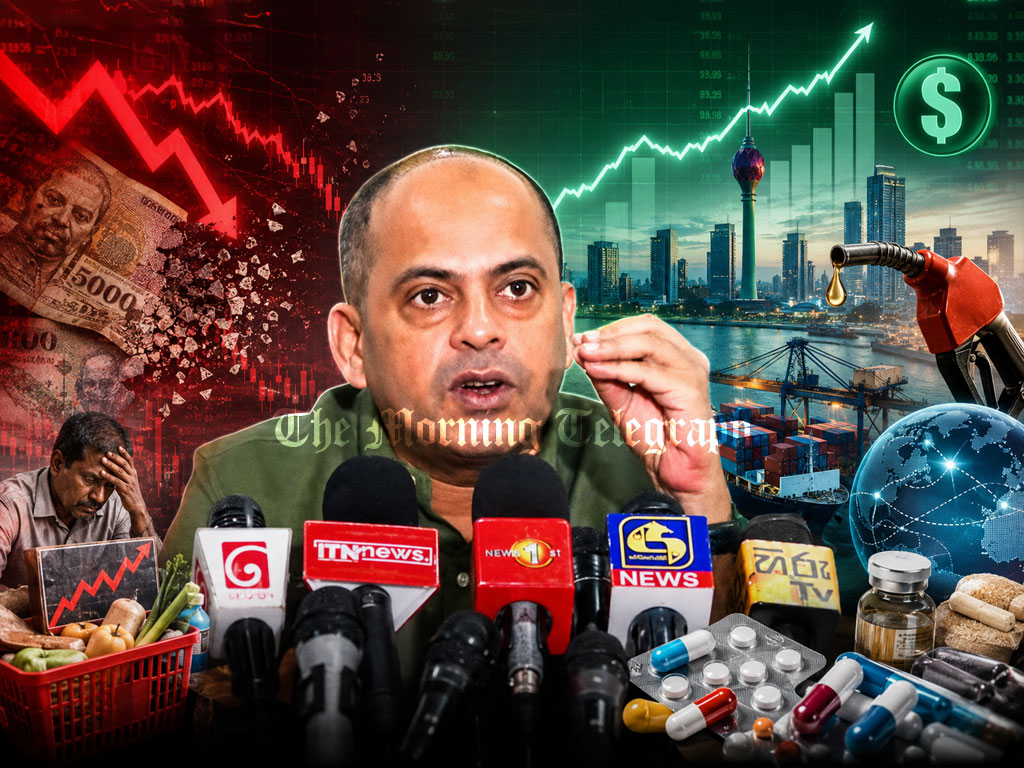
Marikkar warns rupee depreciation is raising debt, medicine risks, fuel costs and economic pressure as SJB demands long-term fixes.
Marikkar warns rupee depreciation is pushing Sri Lanka toward deeper economic pressure, with the cost of living rising sharply as the currency weakens further.
S.M. Marikkar said that while the government had promised to reduce VAT on medicines, it had failed to properly facilitate the importation of pharmaceuticals into Sri Lanka.
He noted that under a law introduced in 2015, when the rupee depreciates by 5 percent, the prices of imported medicines must be reviewed.

However, he said the current government and the National Medicines Regulatory Authority have not presented any discussion or programme on how medicine prices should be revised during imports.
At present, he said, the prices of essential goods and transportation charges have already increased.
According to Marikkar, all these price hikes are connected to the depreciation of the rupee.
He warned that there is also a major risk in not allowing discussions and price revisions for medicines when the rupee weakens by 5 percent.
In such a situation, he said, importers may stop importing medicines.
If medicine imports decline, shortages could occur in government hospitals, creating severe hardship for the public.
Marikkar said the government is boasting that it brought the dollar rate down from Rs. 355 to Rs. 336.
He said a weaker dollar would be beneficial to the country, but maintaining that rate depends on market confidence.
What exists in the market at present, he argued, is only a temporary balance.
In May alone, Sri Lanka imported fuel worth US$ 521 million.
Marikkar said funds received from the International Monetary Fund and the Asian Development Bank are enough to finance only around two months of fuel imports.
In addition, he said, the country’s trade deficit exceeds US$ 200 million.
Therefore, he said temporary borrowing must stop, and long-term solutions must be found.
He also said economic experts have warned that the ongoing war-like situation in the Gulf region could cause the Gulf economy to decline by around 30 percent.
If that happens, migrant workers’ jobs could be at risk, which would negatively affect Sri Lanka’s foreign remittances.
Marikkar said long-term solutions are therefore essential.
He said that if lasting answers cannot be found for the country’s economic problems, the only alternative is to attract investors and increase investments.
The Samagi Jana Balawegaya also urged Sri Lankan migrant workers to send money through official banking channels instead of illegal methods.
Marikkar said doing so would help prevent further economic collapse.
He stressed that the government must seek permanent solutions instead of applying temporary patches to the country’s economic problems.
Marikkar further stated that it currently costs the Ceylon Petroleum Corporation Rs. 561 to produce one litre of diesel.
He said the government imposes a tax of Rs. 163 per litre, pushing the price of one litre of diesel close to Rs. 750.
He also claimed that the corporation earns around Rs. 492 per litre of diesel.
To reduce pressure on the economy amid rising fuel and import costs, he said restrictions could be imposed on the importation of televisions, refrigerators, and electric fans.
Otherwise, he warned, the dollar shortage cannot be addressed.
Marikkar said the agreement signed between Sri Lanka and the IMF will expire after March next year.
Therefore, he said, the government will need to negotiate another agreement with the IMF after that period.
However, he warned that the public should not be burdened in order to generate long-term revenue.
He said the government must immediately take steps to bring in investments and increase dollar income.
Marikkar claimed that due to the government’s reckless policies, if the rupee depreciates by just one rupee against the dollar, the country’s debt burden increases by Rs. 40 billion.
If the rupee depreciates by Rs. 10, he said, the debt burden rises by Rs. 400 billion.
When the National People’s Power government took office, he said, the dollar stood at Rs. 292.
It has now risen to Rs. 336, an increase of Rs. 44.
As a result, Marikkar claimed, the country’s debt burden has increased by approximately Rs. 1,600 billion.
He said the Samagi Jana Balawegaya would welcome the dollar rate falling to Rs. 250.
However, he argued that the government has no capability to achieve that.
Since the National People’s Power government came to power, he said, only around US$ 10 million has entered the Colombo Stock Exchange.
He added that the government had failed to bring in even a single major investor.
Marikkar said the same group now in government had previously prevented the administration from functioning properly.
However, he said the Samagi Jana Balawegaya did not organize strikes or actions that would inconvenience the government or damage the economy during this period.
Nevertheless, he said the party would work in the future to mobilize the public against the government.
He also said the government must respect democracy and immediately hold the Provincial Council elections.
Such an election, he said, would allow the public to judge whether the government had fulfilled the promises it made during its 20 months in office.
It would also allow people to decide whether they had truly received the prosperous country and beautiful life they were promised.
Marikkar said the General Secretary of the Janatha Vimukthi Peramuna is not the secretary of the country.
He said JVP General Secretary Tilvin Silva has no authority to decide whether elections should be held.
He added that the Samagi Jana Balawegaya is ready for Provincial Council elections at any time, but claimed the government is afraid to hold them.