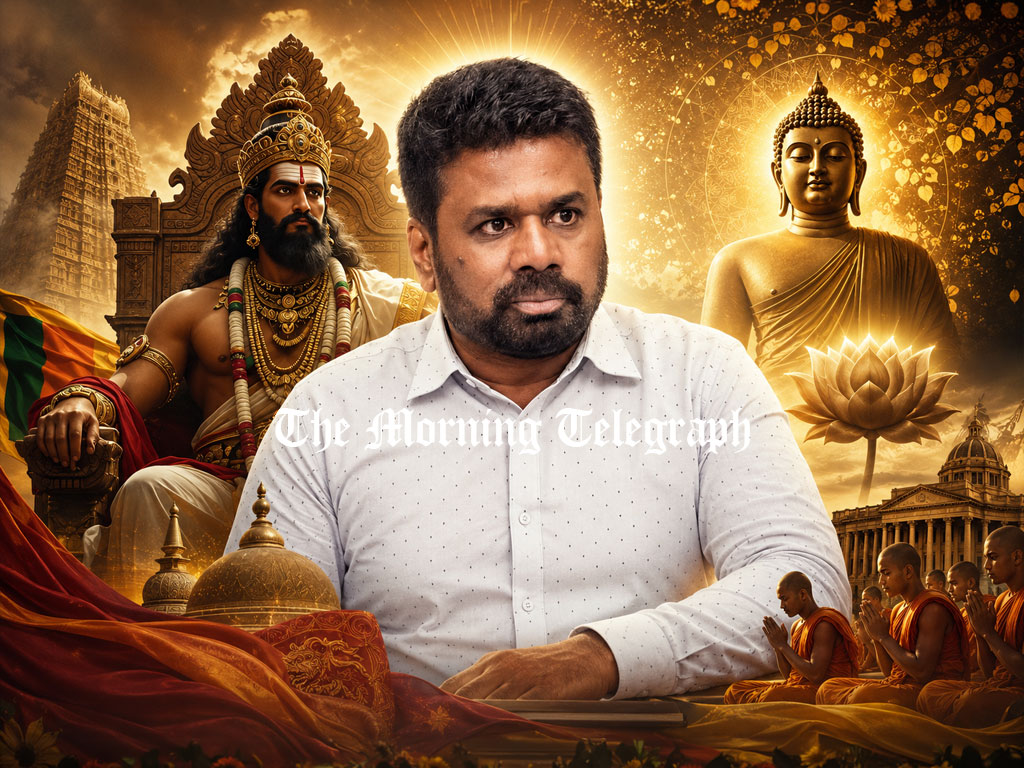
AKD says religious revival and economic recovery must go together as State Vesak Festival begins in Matara with major Buddhist reforms.
AKD says religious revival is essential for Sri Lanka’s economic recovery, warning that the country must protect the Buddha Sasana and Dhamma for future generations.
President Anura Kumara Dissanayake said the best resolution Sri Lankans could make on this Vesak Full Moon Poya day was to recognize the responsibility entrusted to everyone to preserve the Buddha Sasana and Dhamma, and to join hands for that purpose.
The President made these remarks while attending the inaugural ceremony of the State Vesak Festival held this afternoon (27) at the ancient Rajamaha Viharaya in Midellewala, Thihagoda.

He pointed out that the Buddha Dhamma was not preached only for those living today, or only for the revered monks who wear the robe, but for the liberation and well-being of all people across the world.
President Dissanayake also stated that the government hopes to expedite the enactment of necessary laws to enable the Maha Sangha to maintain the Sangha institution in a disciplined manner.
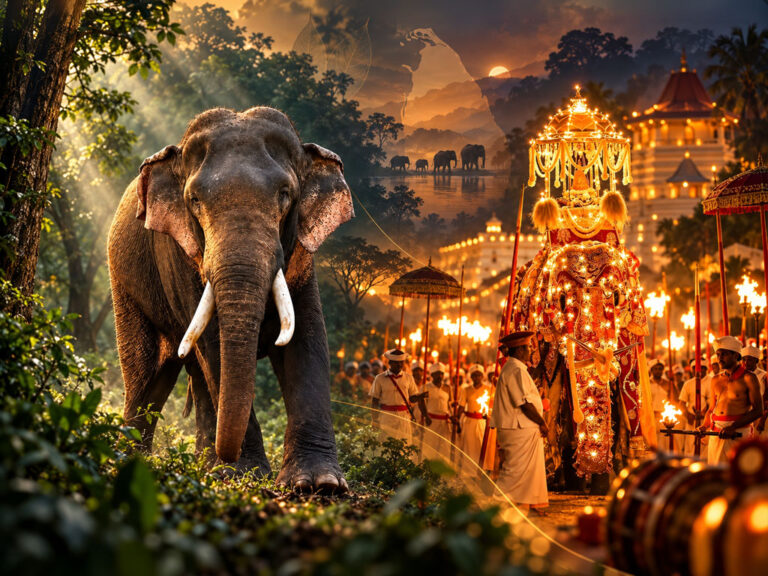
The 2026 State Vesak Festival, marking 2570 years of the Buddha, is being held under the theme “Abhittharetha Kalyane” and named “Dakshina Prabha.”
The festival is centered around the city of Matara from today until June 1, coinciding with the National Vesak Week.
The “Dakshina Prabha” National Vesak Festival consists of two main zones: the Dhamma Offering Zone and the Material Offering Zone.
The Dhamma Offering Zone will be held around the historic Matara Fort area, while the Material Offering Zone will be held around Matara city and the Beach Park.
The Dhamma Offering Zone will include a Sacred Relic Exhibition, sermons and Dhamma discussions with renowned preachers, as well as Kavi Bana, Dana, Seela, and meditation programmes.
The Material Offering Zone will feature large pandals erected at the Fort and city centre, a creative lantern competition at the Matara Beach Park, and devotional song performances by the tri-forces and police on the beach near Pigeon Island.
It will also include puppet shows showcasing traditional southern art and several other cultural events.
Several special attractions are also planned, including a modern technological display using AI technology to create Buddhist symbols and patterns in the sky.
The programme will also feature the presentation of Jataka stories through traditional southern puppetry, along with digital Jataka story and film screenings across the city through LED screens.
Alongside the State Vesak Festival, a photo exhibition organized by the Indian High Commission was opened under the patronage of President Anura Kumara Dissanayake and Indian High Commissioner Santosh Jha.
The President and the delegation also viewed the photo exhibition.
The issuance of a special commemorative stamp for the 2570th State Vesak Festival also took place at the event.
Three Vesak commemorative stamps created based on three temples in the Matara District were also issued, with the first stamp being presented to the President.
President Dissanayake also granted offering land deeds to several historically significant sacred sites in the Southern Province during the ceremony.
Addressing the State Vesak Festival, President Anura Kumara Dissanayake said Sri Lanka was participating in a historically significant and important occasion.
He said the Buddha was one of the greatest teachers ever to appear in the world.
The President noted that the Buddha’s birth, enlightenment, and Parinibbana all fall on Vesak Full Moon Poya day, and that Sri Lankans have celebrated this thrice-blessed event for a long time.
He questioned what secret had allowed this Dhamma to survive unbroken for centuries.
He said Buddhism arrived in Sri Lanka 236 years after the Buddha’s Parinibbana, which was 2,334 years ago from today.
The President said he believed the reason the Dhamma had survived unbroken for 2,334 years, while preserving its essence, was because it was based on the law of cause and effect, or Hetuphala Vada, and because it was a realistic doctrine.
He recalled that the Dhamma realized by the Buddha was preached by him to 60 monks on the first Esala Full Moon Poya day after his enlightenment.
There, the President said, the Buddha advised that the Dhamma should be preached for the welfare and happiness of the many.
He said the first factor that enabled the survival of the Dhamma was the law of cause and effect inherent in it.
The second factor, he said, was the Dhammadhara and Vinayadhara monks.
President Dissanayake said the Dhamma survived for a long period through oral tradition.
Until the Dhamma was written down, he said, it must have been an extremely difficult task for monks to remember all of it together.
Therefore, he said, the Dhammadhara and Vinayadhara Maha Sangha made great sacrifices to preserve the Dhamma through oral tradition, dividing it according to different Nikayas.
He noted that the Digha Nikaya was preserved by the Digha Bhanakas, the Majjhima Nikaya by the Majjhima Bhanakas, and the Samyutta Nikaya by the Samyutta Bhanakas through oral tradition.
In this way, he said, the Maha Sangha preserved and carried forward the essence and foundation of the Dhamma for centuries.
Later, during the reign of King Valagamba, the Tripitaka was written down and preserved in written form.
The President said Dhamma books are now present in temples.
However, he asked who conveys the essence of those books to Buddhist people.
He said he had never seen a monk turning the pages of a Dhamma book and preaching page by page.
Instead, he said, monks study the Dhamma, accumulate that knowledge, and then preach it to the people.
President Dissanayake then referred to the request to amend Sections 41 and 42 of the Vihara Dewalagam Act of 1931.
He said a request had also been made to restore the power of monks to take disciplinary action through the Dharmadhikarana, or Ecclesiastical Court.
The Tri-Nikaya Maha Sangha, he said, had also made a written request to him to amend Sections 41 and 42 of the Vihara Dewalagam Act.
The President said the relevant minister had presented a concept paper on this matter, and the Cabinet had agreed to it.
Accordingly, an amendment was prepared.
He said any amendment must be approved by the Attorney General’s Department.
The Attorney General’s Department had proposed several amendments to it.
Recently, the President said, he organized a discussion involving the Mahanayaka Theros of the Malwatta, Asgiriya, Ramanna Maha Nikayas, and the Amarapura Maha Nikaya, along with the Commissioner of Buddhist Affairs and the Attorney General.
The venerable monks informed him that a final agreement was reached at that discussion.
Therefore, the President said, the government would very soon enact the necessary laws to allow the Sangha institution to be maintained in a disciplined manner.
He said the Dhamma was not only for people living today or for monks wearing robes.
It was preached, he said, for the liberation and well-being of everyone.
Therefore, he said, all people have a responsibility to ensure that the essence of the Dhamma is preserved without destruction.
The President said the most learned Sobhitha Thero had pointed out that there had been instances where the Dhamma was being distorted in the guise of the Dhamma itself.
He asked what rulers could do about this.
He said Sobhitha Thero had invited him to act in this regard like the kings of the past.
“We are ready,” the President said.
However, he said such actions require the support of the Dhammadhara and Vinayadhara respected Maha Sangha.
The President invited everyone to work together to protect the Dhamma preached for the liberation of all people worldwide.
He said he did not want these actions to be interpreted as political decisions or government decisions.
Instead, he said he would prefer them to be understood as actions that Buddhists must take.
Therefore, he said, these actions should become Buddhist decisions taken for the sake of the Dhamma, Buddhist people, and the future.
He then sought the support of the Maha Sangha for that purpose.
Looking at Sri Lanka’s history, the President said that whenever the country had declined religiously, it had also declined economically.
Likewise, he said, when the country declined economically, it also declined religiously.
He said that every era in which Sri Lanka achieved a religious revival was also an era of economic prosperity.
As Sri Lanka moves towards an economically prosperous state, the President said, the country also needs a religious revival.
He said his effort and the effort of his government was to bring about both economic and religious revival.
Referring to the reigns of King Dutugemunu, King Vasabha, King Mahasen, and King Parakramabahu I of Polonnaruwa, the President said those were eras of religious revival as well as economic prosperity.
Therefore, he said, economic prosperity cannot be achieved only by constructing buildings, roads, factories, and technological equipment.
The President said economic revival could be achieved only in a righteous society.
He described such a society as one that is understanding, ready to look at others with compassion, and willing to reject hatred, anger, and hypocrisy.
He said that righteous society and economic revival must go hand in hand.
Therefore, he said, there is a need to record this era as an era of religious revival in Sri Lanka.
He added that he also knows an economic revival will be achieved in parallel.
The President said a large amount of work had already been done for this purpose.
He noted that the World Buddhist Conference is scheduled to be held in Sri Lanka in November.
He said he believed that event would become a great revivalist moment in the country’s religious revival.
The President said the government is ready to intervene whenever religious sites face difficulties or disasters.
He said Sri Lanka must build a state that has achieved righteous and high economic development.
He expressed strong hope that the government, as well as the venerable monks, would properly fulfill the roles entrusted to them in this regard.
He also emphasized the inseparable historical bond between Buddhism and Sri Lankan society.
The President asked what kind of society existed in Sri Lanka before Buddhism arrived 2,334 years ago.
He said the great power that transformed that society and culture into one that claims heritage to such a culture lies within the Dhamma and its spread in the country.
Otherwise, he said, it is unimaginable what culture Sri Lanka would have inherited.
He said Sri Lankans are a people who feel compassion for others in their suffering.
In times of disaster, he said, no one looks at race or caste, and everyone feels compassion.
The President said there is a historical heritage and story about the establishment of Buddhism and Sri Lankan society.
He said it is unimaginable to think of the formation of the Sri Lankan nation without Buddhism.
He asked whether Sri Lanka received only a Dhamma.
Along with that Dhamma, he said, the country received a formal education system.
Even today, he said, Sri Lanka has a very high-quality education system.
More than 99% of children born in the country go to school, he said, describing it as an excellent figure.
He said Sri Lanka is a country that stands at the forefront of literacy.
The first step in the country’s education, he said, was the arrival of Mahinda Thero.
An education system developed around the unwavering Maha Pirivenas and Maha Temples.
He said Sri Lanka also received a great Hela medicine system.
Historically, he said, there had been monk physicians.
The President said historical stories refer to remarkably skilled monk physicians.
The creator of the great Hela medicine system, he said, was also the temple, the Maha Sangha, and the Dhamma.
He added that great architects created magnificent works intertwined with the Dhamma.
Even today, he said, Sri Lanka has an engineering technology that claims heritage to those historic and marvelous creations developed in association with Buddhism.
Therefore, he said, the Dhamma greatly helped make the Sri Lankan nation cultured, humble, and hospitable.
The President said he believed the foundation of the Sri Lankan nation was the arrival of Mahinda Thero.
He said the distortion of this most excellent Dhamma causes pain to everyone.
The decline of Vinayadhara monks within this distorted Dhamma, he said, also causes pain.
The President then referred to the arrest of 21 monks in connection with drugs.
He said that after the arrests, he held discussions with the Tri-Nikaya Mahanayaka Theros.
They had suggested that, if possible, the monks should be defrocked before being produced in court.
The President asked how monks could be brought to court in handcuffs alongside others.
He said the representative Mahanayaka Theros of the Tri-Nikayas had actually agreed to that position.
Subsequently, he said, they decided that if the monks were proven innocent, they would be re-ordained.
However, he said, legal advice is not based on Dhamma.
Therefore, that did not happen.
The President said any negative incident based on this Dhamma causes pain.
He said Sri Lanka is a nation built with the temple.
The main festival in his village, he recalled, was the Poson festival.
The monk who taught them Buddhism was the chief monk of the village.
He said they were people who knelt on the gravel road and worshipped when monks walked to the tank in the evening to bathe.
They were people, he said, who grew up with that spirituality.
It was the monks who taught them Dhamma, right and wrong, and the future.
It was the monk who came to resolve a dispute in the village.
The President said such incidents cause pain to those who grew up with such spirituality.
Therefore, he said, the Maha Sangha must be granted the necessary powers to maintain discipline within their institutions.
He said he knows that not only he, but also the Mahanayaka Theros and the Maha Sangha, are distressed by these matters.
Based on such incidents, he said, if there is anything against this liberating Dhamma, a certain build-up takes place around it.
Therefore, he said, the time has come for Sri Lankans to reflect on themselves.
He asked whether the Dhamma that had been protected for 2,615 years should be allowed to be destroyed before the country’s eyes.
He said there were monks in history who risked their lives to preserve the Upasampada.
He asked whether they should not be remembered.
If a Dhamma preserved in such a manner is being distorted before people’s eyes, and if it is facing slander and false accusations, he asked what should be done.
On this Vesak Full Moon Poya day, he said, everyone must reflect on themselves.
The President said the Buddhist community, Christian fathers, Muslim Moulavis, Hindu Kurukkals, and all others must strive for a religious revival in the country to protect children and the younger generation.
He said schoolchildren and security forces officers have been arrested due to drugs, and massive quantities of drugs have been distributed.
He asked why this was happening.
Where Dhamma, discipline, and society have collapsed, he said, it is impossible to prevent crimes, misconduct, and social crises.
On the occasion of commemorating the thrice-blessed event of the Teacher, the President said everyone has a role to play in freeing the country from this evil situation.
He invited all people to join that effort.
The welcome speech at the State Vesak Festival was delivered by the Chief Secretary of the All-Ceylon Sasana Rakshaka Mandalaya, General Secretary of the World Young Buddhist Association, and Secretary of the Matara District Sasana Rakshaka Mandalaya, Ven. Mugunuwela Anuruddha Thero.
Special sermons were delivered by the Chief Secretary of the Malwatta Maha Viharaya side of the Mahavihara Vanshika Syamopali Maha Nikaya and Chief Incumbent of the historic Somawathi Rajamaha Viharaya, Ven. Pahamune Sri Sumangala Nayaka Thero.
The Chief President of the All-Ceylon Sasana Rakshaka Mandalaya, Sangha Council member of the Asgiri Viharaya side of the Mahavihara Vanshika Syamopali Maha Nikaya and Chief Sanghanayaka of the North Western Province, Professor Ven. Tumbulle Seelakkhandha Nayaka Thero, also delivered a special sermon.
Special sermons were also delivered by the Mahanayaka of the Maramavamsabhidhaja Sri Saddhammayuktika Parivena side of the Mahavihara Vanshika Sri Lanka Amarapura Maha Nikaya, Darshanapathi Most Ven. Kanumuldeniye Chandawimala Nayaka Thero.
The Chief Sanghanayaka of Southern Sri Lanka of the Sri Lanka Ramanna Maha Nikaya, Professor Ven. Omalpe Sobhitha Nayaka Thero, also addressed the event.
The Anumodana, or blessings, was performed by the Chairman of the Matara District Sasana Rakshaka Mandalaya and Secretary of the Thihagoda Regional Sasana Rakshaka Mandalaya, and Chief Incumbent of the Midellewala Purana Viharaya, Scholar Ven. Hakmana Gnaniawimala Thero.
The occasion was attended by Tri-Nikaya Mahanayaka, Anunayaka, and Secretary Theros, and provincial Maha Sangha.
Maha Sangha from Buddhist countries including Thailand and Vietnam were also present, along with clergy of other religions.
The event was also attended by Minister of Buddha Sasana, Religious and Cultural Affairs Dr. Hiniduma Sunil Senevi; Minister of Public Administration, Provincial Councils and Local Government Professor A.H.M.H. Abayaratna; Minister of Industry and Entrepreneurship Development Sunil Handunnetti; Minister of Women and Child Affairs Saroja Savithra Paulraj; Deputy Speaker Rizvi Salih; Deputy Minister Arkam Illiyas; and Governor of the Southern Province Professor Susiripala Manawadu.
Other public representatives including Members of Parliament also attended.
Indian High Commissioner Santosh Jha and other foreign ambassadors and high commissioners were present.
Ministry Secretaries including Secretary to the Ministry of Buddha Sasana, Religious and Cultural Affairs Prince Senadheera, other state officials, tri-forces commanders, and a large gathering of people also took part in the State Vesak Festival.