By Dwayne Ferreira
Bitcoin’s latest fall is not just another crypto dip. The crash is being driven by geopolitical tension, forced liquidations, ETF outflows, weak investor confidence, and money moving into stronger U.S. technology stocks.
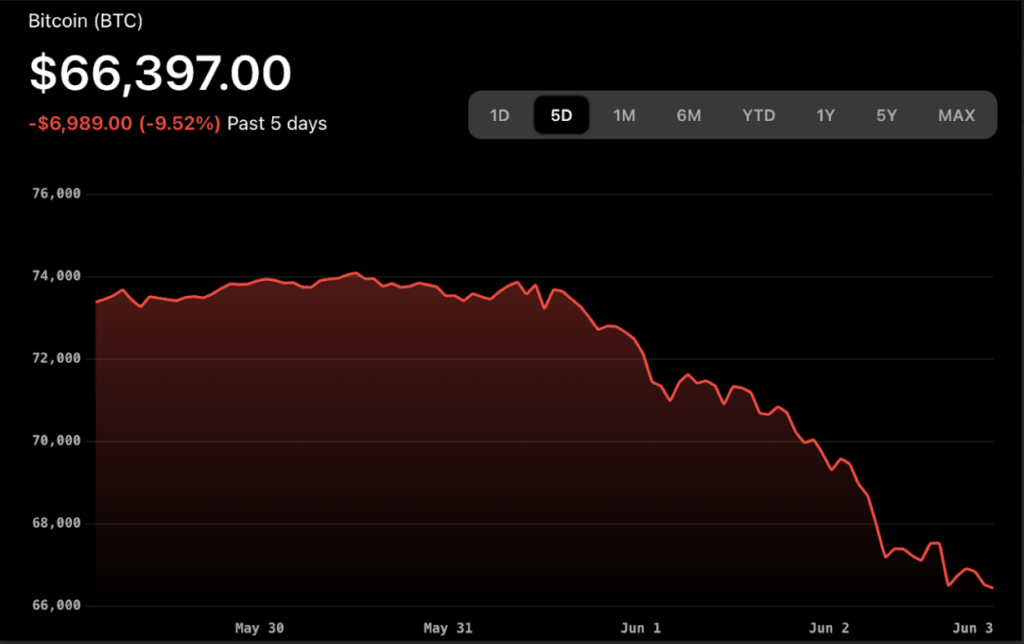
Bitcoin is under heavy pressure again, falling below the key $70,000 level and sliding toward the $66,000–$67,000 range. The move has shaken the wider crypto market and raised fears that Bitcoin’s recent strength may be fading.
This crash is not being caused by one single event. Several pressures are hitting Bitcoin at the same time. Rising geopolitical tension has pushed investors away from risky assets, while higher oil prices have added fresh worries about inflation and interest rates. In uncertain markets, Bitcoin often behaves less like “digital gold” and more like a high-risk asset.

The fall has also been made worse by forced liquidations. Many crypto traders use leverage, meaning they borrow money to place bigger bets. When Bitcoin drops quickly, those positions are automatically closed, creating more selling pressure. That is why the price can fall so sharply in such a short time.
Another warning sign is the flow of money out of Bitcoin ETFs. These funds helped support Bitcoin’s earlier rally by bringing in institutional investors. But recent outflows suggest some big investors are reducing risk or taking profits.
Confidence was also hurt by reports that Strategy sold a small amount of Bitcoin, its first sale since 2022. The amount was not huge, but the symbolism mattered because Strategy has long been seen as one of Bitcoin’s strongest corporate supporters.
At the same time, U.S. technology stocks remain strong, especially around artificial intelligence. This suggests investors are not abandoning risk completely. Instead, they appear to be choosing tech stocks over crypto for now.
The charts tell the story clearly. A Bitcoin price chart shows the breakdown below $70,000. A liquidation chart shows how leveraged traders were forced out. An ETF flow chart shows weakening institutional support. An oil price chart explains the risk-off mood. And a Bitcoin-versus-Nasdaq chart shows money rotating away from crypto and into technology.
For now, the key question is whether Bitcoin can hold the mid-$60,000 range. If it does, this may become a sharp correction. If it breaks lower, another wave of selling could follow.
Bitcoin is not dead. But confidence has clearly cracked. And in a leveraged market, when confidence breaks, prices do not fall slowly — they fall fast.