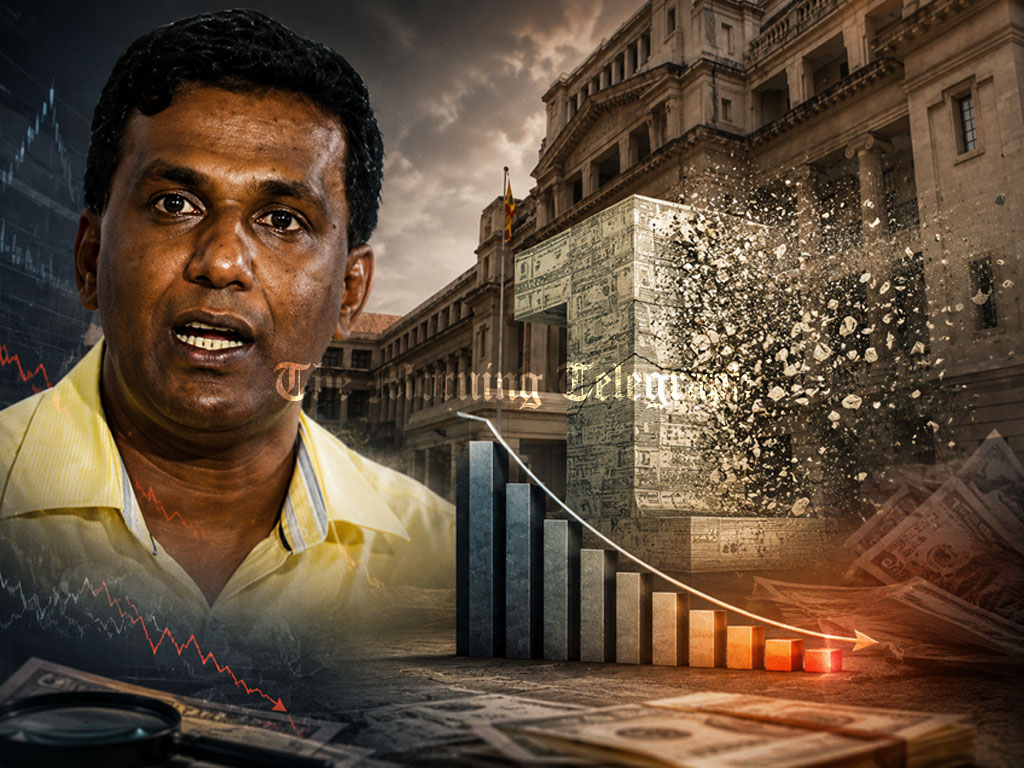
Treasury trillion claim questioned by Rajith Keerthi Thennakoon, who says the government added only Rs. 110 billion in cash balance.
The Treasury trillion claim repeatedly made by President Anura Kumara Dissanayake is only an optical illusion, former Governor Rajith Keerthi Thennakoon has alleged.
“There is no US$ 1,000 million reserve as President Anura Kumara Dissanayake keeps claiming at every turn. The Treasury cash balance on January 1, 2026, was Rs. 915 billion. On December 31, 2024, the Treasury cash balance was Rs. 805 billion. When the Ranil Wickremesinghe government was sent home, it was Rs. 800 billion. During this government’s first year, the Treasury cash balance increased by only about Rs. 110 billion,” Thennakoon said.
He made these remarks while addressing a press briefing of the Governors’ Forum held at the Nippon Hotel in Colombo.

Thennakoon accused the government of lying and taking credit for the work of others, claiming that its failure in economic governance is now clearly visible.
He said the amateurish manner in which the government is managing state-owned enterprises has become one of the main factors pushing the country toward economic destruction.
Referring to the Lanka Sugar Company, he said the institution recorded a profit of Rs. 2,835 million in 2023, but suffered a loss of Rs. 1,944 million in 2024 and a further loss of Rs. 3,193 million in 2025.
He accused Minister Sunil Handunnetti of staging media shows by opening brown sugar shops and wasting state funds, while failing to properly pay sugarcane farmers.
According to Thennakoon, farmers now lack money for sugarcane cultivation, while fertilizer and other necessary facilities are also unavailable.
He further said that due to political pressure, both the Chairperson and CEO of the Sugar Company resigned. State-owned enterprises are collapsing while the government merely watches, he alleged, adding that the economy is now “going down the drain.”
Thennakoon also referred to SriLankan Airlines, stating that the national carrier recorded a profit of Rs. 3,872 million in 2023.
However, after the current government came to power, he said the airline suffered a loss of Rs. 7,595 million in 2024 and a massive loss of Rs. 23,211 million, or Rs. 23.2 billion, in 2025.
Before that loss was recorded, the Treasury had already given Rs. 25 billion to SriLankan Airlines, he said.
Thennakoon claimed that a private sector chairman was appointed to SriLankan Airlines and that, during his tenure, a private foreign competitor was introduced on the London-Colombo and Melbourne-Colombo routes, which were among the most profitable routes for SriLankan Airlines.
He said the chairman then resigned, leaving the airline in a position where it cannot even be sold. Despite receiving Rs. 25 billion a year, he said, SriLankan Airlines continues to record losses.
According to the 2025 Annual Report issued by the Treasury, the Special Commodity Levy stood at Rs. 115 billion in 2024 and rose by 43% to Rs. 165 billion in 2025.
Thennakoon said this represents an increase of Rs. 39 billion above the estimated tax revenue.
He alleged that this means the government is taxing daily essential goods such as rice, potatoes, salt, dhal, and sprats without mercy.
He further claimed that of the Rs. 39 billion collected by taxing people who have never even seen an aircraft, Rs. 25 billion is being used to cover the losses of SriLankan Airlines.
Thennakoon also warned that the rupee is continuing to depreciate, while the Central Bank Governor tells the media, “We are doing an excellent job.”
He said inflation is rising, while officials continue to argue over whether it is 5% or 7%, all while claiming that the economy is being managed successfully.
He questioned how the economy could be doing well if monetary reserves are stagnating.
Thennakoon further said the economic growth rate remains stagnant, while the amount of currency in circulation has increased by 26%.
The result, he warned, is that prices are rising daily, from a gas cylinder to a packet of rice.
He said oil, gas, electricity, and all other essentials are increasing in price, placing a heavier burden on ordinary people.