By Roy Denish
“A saffron robe is not a shield.” AKD’s Dharma Court plan creates a parallel justice system for accused monks violating equal rights under the law. Child abuse belongs in criminal court, not behind monastery walls. Protect the Constitution. Resist legal exceptionalism.
In the delicate ecosystem of Sri Lankan politics, the boundary between state authority and religious institutionalism has always been porous. Yet, President Anura Kumara Dissanayake’s recent announcement at the National Vesak Festival, unveiling plans to re-establish a “Dharma Court” (Dharmadhikaranaya) to handle disciplinary issues among the Buddhist clergy, threatens to fundamentally fracture the bedrock of our legal system: the principle of equality before the law.
The government’s rationale, heavily backed by senior prelates of the Malwathu, Asgiri, Ramanna, and Amarapura chapters, is wrapped in a narrative of institutional purity. The argument goes that a surge in financial fraud, moral distortion, and criminal behavior by individuals in robes is degrading the sanctity of the Maha Sangha. By amending the century-old Viharagam and Devalagam Act, the state wants to hand the keys of justice over to the clergy, allowing them to discipline or disrobe errant monks internally before the civil or criminal justice systems can touch them.

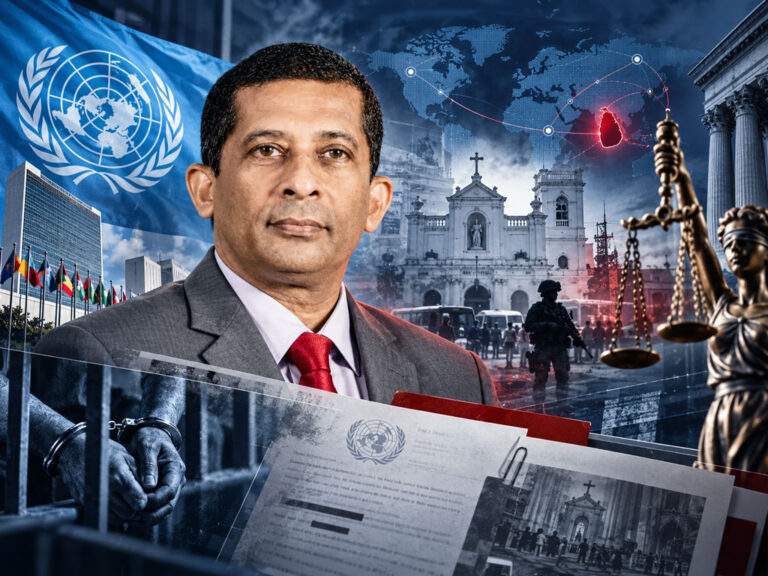
To its proponents, this is a matter of dignity, sparing the Vinaya (monastic discipline) from the heavy-handed, public humiliation of civil courts, where monks are led away in handcuffs.
But let us call this proposal what it truly is: the codification of a parallel judiciary that flagrantly ignores the limits set by our own foundational law.
Proponents of the Dharma Court often point to Chapter II, Article 9 of the Sri Lankan Constitution, which mandates that the State “protect and foster the Buddha Sasana.” Furthermore, the Constitution technically allows Parliament to create specialized institutions for the internal adjudication and settlement of matters relating to the discipline (Vinaya) of bhikkhus.
However, constitutional architects never intended for this provision to serve as a sanctuary for criminal behavior. Under Article 4(c) and Article 105 of the Constitution, the judicial power of the people is explicitly vested exclusively in the established public courts of the republic. The legal architecture splits jurisdiction cleanly down the center: internal monastic etiquette (such as succession disputes, temple property, or violations of monastic vows) can be mediated by councils, but the moment an action breaches the Penal Code of Sri Lanka, it falls squarely under the unshareable jurisdiction of the secular courts.
When we talk about “errant monks” in the context of modern scandals, we are not talking about simple infractions of monastic lifestyle. We are talking about predatory monks implicated in the horrific sexual abuse of children.
The primary casualty of this legislative maneuver is Article 12 of the Constitution, which explicitly guarantees that all persons are equal before the law and are entitled to equal protection under it.
When a republic begins sorting its citizens into different judicial tracks based on the clothes they wear, it ceases to be a true democracy. Child abuse is not an ecclesiastical infraction to be quietly arbitrated behind monastery walls under the guise of Vinaya. It is a heinous crime against vulnerable human beings and a severe offense against the state.
To insulate any segment of society from immediate civil accountability, or to grant them a parallel “buffer court” before they face a standard magistrate, is to create a class of citizens that is effectively above the law.
The Constitution explicitly notes in Article 12(4) that the state can take “special measures” by law, but strictly for the protection or advancement of women, children, or disabled persons, the victims. It does not allow for special judicial cushions to protect the institutional dignity of accused predators.
History tells us that when powerful institutions, be it the Catholic Church in the West or various religious enclaves in the East—are given the autonomy to police themselves regarding crimes against children, the result is rarely justice. Instead, it breeds a culture of institutional self-preservation, where protecting the “reputation” of the order consistently takes precedence over the safety and rights of the victims.
Ultimately, President Dissanayake’s proposal to erect a parallel court system to shield predatory monks is not just legally flawed; it is aggressively unconstitutional. The Sri Lankan Constitution provides absolutely no mechanism for the executive or legislature to delegate the adjudication of severe Penal Code offenses away from the secular judiciary. By attempting to filter crimes like child abuse through an ecclesiastical buffer, the administration is making a mockery of equal justice under the law.
In his rush to appease the powerful monastic lobby and shield his administration from politically fatal accusations of being “anti-Buddhist,” the President seems hell-bent on compromising the very rule of law he swore to protect. Systemic change cannot be built on a foundation of cowardice. When a government values the institutional comfort of religious elites over the constitutional rights and safety of abused children, it loses its moral mandate.
Spiritual dignity cannot be preserved by granting legislative immunity to predators. For the survival of the republic, this dangerous regression into legal exceptionalism must be fiercely resisted: under the Sri Lankan sun, the courthouse door must remain exactly the same height for everyone, whether they wear a business suit, a laborer’s uniform, or a saffron robe.