Kashmir crisis tensions between India and Pakistan remain a nuclear flashpoint rooted in partition, water, war, terrorism, and global risk.
The Kashmir crisis is often overlooked when people discuss the world’s most dangerous borders, with many immediately pointing to the heavily guarded line between North Korea and South Korea.
Yet there is another place that may be even more dangerous, a place where one miscalculation could drag the world into a nuclear nightmare. That place is Kashmir, the disputed region between India and Pakistan.
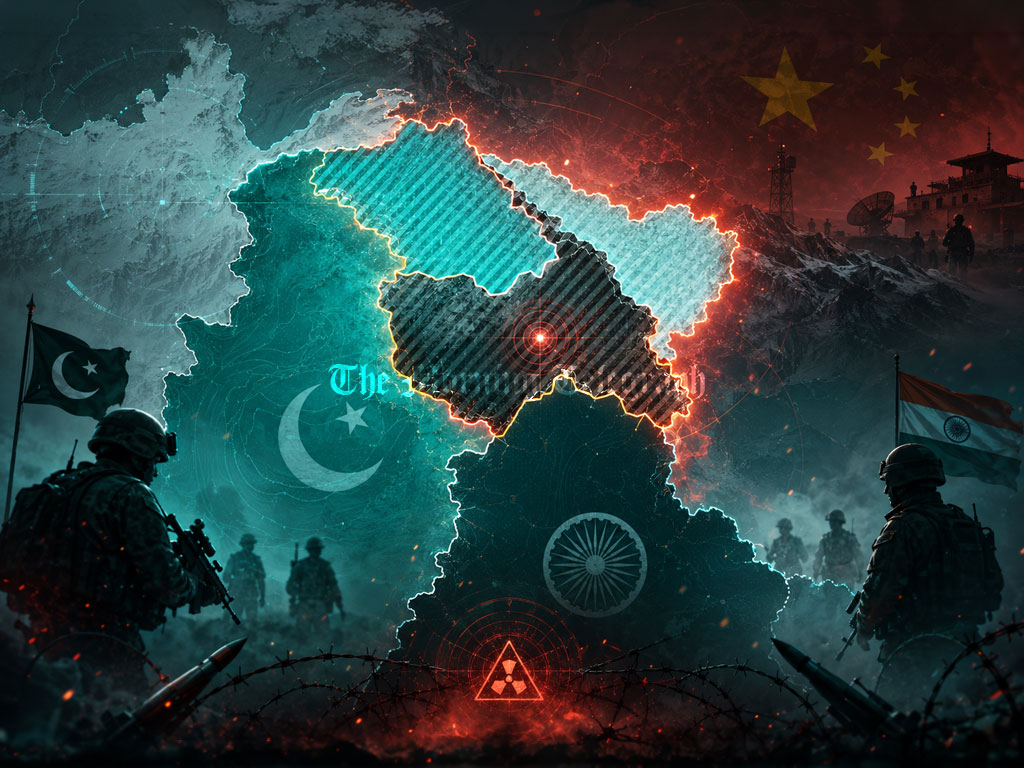
This border is so heavily fortified that it is often described as the only border in the world clearly visible from space. India and Pakistan are both nuclear-armed nations, each possessing more than 150 nuclear warheads. According to military experts, even a single terrorist attack in Kashmir could trigger a major war between the two countries, and such a war could potentially end in nuclear conflict.
If that happened, between 50 million and 125 million people could die. The wider world could then be forced to face a nuclear winter lasting for years. So why is Kashmir so dangerous, and how did this conflict begin?

The British colonial roots
The roots of this entire crisis lie in British colonial rule. By the 1940s, after World War II, Britain no longer had the economic strength to continue controlling India. In 1947, it decided to grant independence and leave the subcontinent.
But Britain did not leave without dividing the land along religious lines. The Dominion of India was created with a Hindu majority, while the Dominion of Pakistan was created with a Muslim majority.
To draw the new borders, the British brought in a lawyer named Cyril Radcliffe. The astonishing fact is that he had never visited India before and had no real experience drawing borders. He was given only about five weeks to divide an entire subcontinent.
Although both countries gained independence on August 15, 1947, the borders were announced two days later.
With partition, the largest and most tragic migration in history began. Hindus living in areas that became Pakistan started moving to India, while Muslims living in India began moving to Pakistan. The communal violence that erupted during this migration caused more than one million deaths. More than 15 million people were displaced.
That bloody past remains one of the deepest reasons for the hatred and suspicion between India and Pakistan to this day.
The princely states problem
When the British left, there were 565 princely states in India ruled by local monarchs. These rulers were given the freedom to choose whether to join India or Pakistan.
Most made their decisions based on geography and population. But three major states became serious problems.
Hyderabad had a Hindu majority, but its ruler was Muslim. He wanted to remain independent, but India sent in its army and took control.
Junagadh also had a Hindu majority, but its Muslim ruler decided to join Pakistan. India refused to accept this, sent troops, held a referendum, and annexed Junagadh to India.
Kashmir was the opposite. About 77% of its population was Muslim, but its ruler was a Hindu king named Maharaja Hari Singh. He wanted Kashmir to remain an independent country.
However, tribal militants supported by Pakistan invaded Kashmir. Realizing that he could not stop the invasion alone, Hari Singh asked India for help.
India said it would help only if Kashmir was ceded to India. The king agreed and signed the agreement. The Indian army entered Kashmir. Pakistan refused to accept the arrangement.
That marked the beginning of the first Kashmir war between India and Pakistan. In 1949, with United Nations intervention, the war was stopped and a ceasefire line was drawn. That line is now known as the Line of Control, or LoC.
This is why India today controls about 63% of Kashmir, while Pakistan controls the remaining portion.
Why both countries fight over Kashmir
India and Pakistan are not fighting over Kashmir only because of religion or national pride. There are also major geopolitical and economic reasons behind the conflict.
Water, especially the Indus River, is one of the biggest reasons. Pakistan receives about 75% of its water from the Indus River and its tributaries. These rivers flow through Kashmir before reaching Pakistan.
If India gains complete control of Kashmir, it could theoretically stop Pakistan’s water supply at any time and devastate the entire country. This is why the Pakistani military refers to Kashmir as its “jugular vein.”
China relations and the CPEC project also make Kashmir strategically vital. Pakistan’s capital, Islamabad, is located only about 45 kilometers from the Kashmir border. The only land route connecting Pakistan and China also passes through the Kashmir region.
China has built the $65 billion China-Pakistan Economic Corridor, or CPEC, through this region. If India captures all of Kashmir, Pakistan could lose its land connection with China completely.
Wars and conflicts since 1947
After 1947, India and Pakistan fought direct wars in 1965, 1971, and 1999. The 1971 war resulted in the creation of Bangladesh.
In that war, India intervened and East Pakistan broke away to become Bangladesh. Pakistan lost half of its population. India used this moment to show the world that the idea of Pakistan being the “homeland for all Muslims” was flawed.
By the time of the 1999 Kargil War, both India and Pakistan had nuclear weapons. This became the second time in history that two nuclear-armed nations fought each other directly.
Realizing that direct wars were difficult to win, Pakistan began encouraging terrorism and insurgency inside Kashmir. It started providing weapons and training to extremist groups such as Lashkar-e-Taiba and Jaish-e-Mohammed to attack India.
From 1989 to the present, between 42,000 and 70,000 civilians, soldiers, and militants have died in these conflicts. The 2008 terrorist attack in Mumbai, India, killed 166 people.
In February 2019, Jaish-e-Mohammed terrorists carried out a suicide attack on an Indian military convoy in Kashmir, killing 40 soldiers. In response, the Indian Air Force crossed the Pakistani border and bombed terrorist camps.
For the first time in history, two nuclear powers had carried out airstrikes inside each other’s countries. Dogfights followed, and an Indian jet was shot down. At that moment, many across the world feared that a fifth Indo-Pakistan war was about to begin.
Article 370 and its removal
Following these developments, in August 2019, the Indian government made a major decision. It revoked Article 370 of the Indian Constitution, removing the special autonomous powers previously held by the state of Kashmir.
Before this, outsiders could not buy land in Kashmir. After the revocation, anyone could buy land and settle there. The region’s Muslim-majority population fears that India may bring in Hindu settlers, change the demographic balance, and eventually turn Kashmir into a Hindu-majority area.
The nuclear threat
Today, relations between India and Pakistan remain extremely tense. In 2022, India accidentally fired a cruise missile capable of carrying nuclear warheads into Pakistan. Fortunately, it did not explode or cause major damage. But even a small mistake like that could trigger a catastrophe of global scale.
India follows a “No First Use” nuclear policy, meaning it says it will not use nuclear weapons first. Pakistan has no such policy. It possesses tactical nuclear weapons that could be used on the battlefield.
If Indian forces ever invade Pakistan, Pakistan would almost certainly consider using nuclear weapons. India would then retaliate.
According to a 2019 study by scientists, if a nuclear war broke out between India and Pakistan, smoke and ash from the bombs would rise into the atmosphere and block sunlight. This could lower global temperatures to levels comparable to an ice age, cause worldwide famine, and leave billions of people at risk of starvation.
When former US President Barack Obama was once asked what political problem in the world kept him awake at night, he answered with one word: “Pakistan.”
The Kashmir crisis is not merely a dispute over a piece of land. It is a powder keg that could decide the future of the entire world.
Whether this terrible conflict is one day resolved peacefully, or whether it ends in a catastrophe that affects humanity itself, will depend on the choices made in the future.