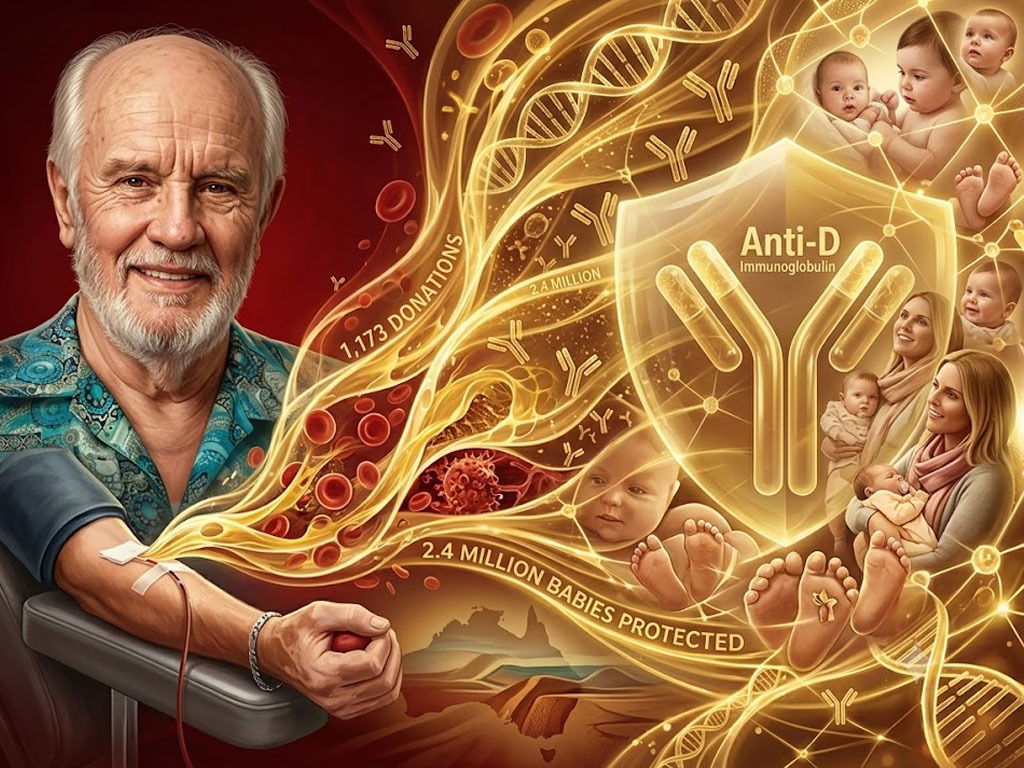
James Harrison blood donor made 1,173 donations, helping produce Anti-D treatments credited with protecting up to 2.4 million babies.
The James Harrison blood donor story became one of Australia’s most remarkable medical legacies after his rare plasma helped produce Anti-D treatments for mothers and babies.
His extraordinary journey began when he was 14. Harrison underwent major chest surgery and received more than a dozen units of donated blood.
The experience convinced him to become a donor when he was old enough. He kept that promise and began donating at 18.
Doctors later discovered that his plasma contained a rare and valuable combination of RhD-negative blood and Rh-positive antibodies.

How James Harrison’s Rare Blood Helped Babies
Doctors use Anti-D immunoglobulin to protect some RhD-negative mothers during pregnancy.
Problems can occur when an RhD-negative mother carries an RhD-positive baby. If the mother becomes sensitised to the baby’s blood, her immune system may produce antibodies that attack the baby’s red blood cells.
This can cause haemolytic disease of the fetus and newborn. In severe cases, the condition can lead to serious illness or death.
Harrison’s antibodies helped Australia produce Anti-D medication for pregnant women at risk. Lifeblood says his donations contributed to 2.4 million Anti-D doses for Australian babies.
His rare antibodies may themselves have developed because he received blood transfusions during his teenage surgery.
Harrison later became a pioneer of Australia’s Anti-D programme, which began issuing treatments containing his plasma in 1967.
More Than 60 Years of Donations
The James Harrison blood donor story became extraordinary because of his consistency.
He donated blood and plasma for more than 60 years and completed 1,173 donations. That achievement earned him the nickname “the Man with the Golden Arm.”
It also made him the world’s most prolific blood and plasma donor, according to Australian Red Cross Lifeblood.
Harrison made his final donation on May 11, 2018, when he was 81. Australian donation rules required him to retire at that age.
His contribution also touched his own family. Harrison’s daughter, Tracey, received Anti-D treatment during pregnancy, helping protect his grandson.
However, it is more accurate to describe the product as Anti-D immunoglobulin or medication rather than a vaccine.
It works by preventing an RhD-negative mother from developing antibodies against RhD-positive blood.
The Golden Arm’s Lasting Legacy
Harrison died peacefully in his sleep at a nursing home on February 17, 2025. He was 88.
Lifeblood announced his death on March 1 and praised his decades of service.
The organisation said his donations helped save the lives of more than two million babies. Its later account states that his 1,173 donations contributed to as many as 2.4 million Anti-D doses.
Although Harrison became famous worldwide, he remained modest about his contribution. He viewed donating as something ordinary people could do to help strangers.
Australia’s Anti-D programme now relies on fewer than 200 donors with suitable blood. Harrison’s story therefore remains both an extraordinary medical legacy and a reminder of the importance of regular blood and plasma donation.
The James Harrison blood donor legacy lives on through generations of Australian families protected by the treatment his rare plasma helped create.