NCPA actions in a major child abuse case have triggered controversy after allegations of intimidation, censorship, and criticism of officials.
The NCPA became a focal point of controversy following the shocking child abuse case in Anuradhapura, with concerns now emerging over the treatment of officials who actively intervened on behalf of the victim girl and challenged the conduct of the investigation.
The incident involving the alleged serious sexual abuse of a minor girl in Anuradhapura has deeply disturbed the country and generated widespread public concern.

In this sensitive case involving Pallegama Hemarathana Thero, the actions of the National Child Protection Authority (NCPA), which appeared on behalf of the victim and openly questioned the police investigation before court, have drawn significant public attention and praise from many quarters.
However, events that reportedly unfolded on June 5 during a meeting of the Forum of Women Parliamentarians at the Parliamentary complex have raised a separate and troubling debate.
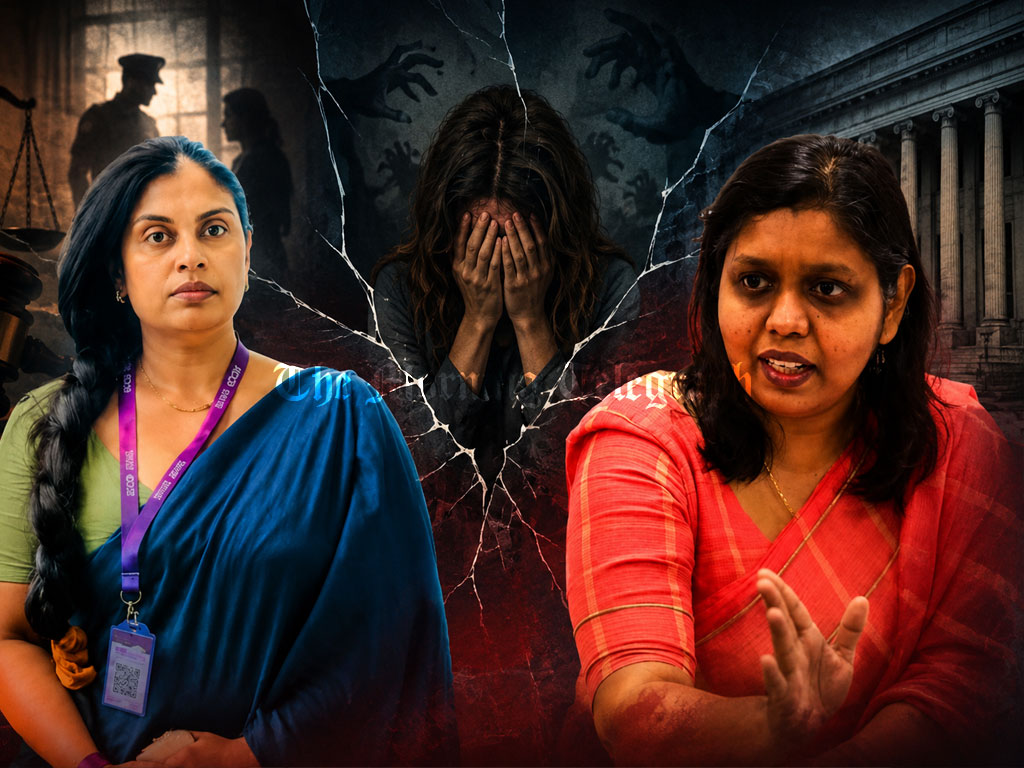
It has been reported that National People’s Power (NPP) Parliamentarian and Attorney-at-Law Lakmali Hemachandra strongly criticized Attorney-at-Law Sajeevani Abeykoon, the Director of Legal Enforcement of the National Child Protection Authority, who had appeared on behalf of the victim girl.
Critics argue that targeting an officer of an independent institution in this manner, whether for political advantage or to defend the government or police, should be condemned by society.
Under the Child Protection Ordinance, the National Child Protection Authority has a statutory responsibility to intervene whenever justice is not being delivered to a child victim.
The police, who had reportedly not arrested the suspect monk for nearly a month, eventually took action only after the Child Protection Authority filed a motion before court and secured a judicial order.
Against that backdrop, the Authority’s statement before court that it had to “carry a stick behind the police” has been described by supporters of the institution as an accurate reflection of events.
Lakmali Hemachandra, however, has reportedly maintained that the statement demoralized police officers and gave YouTubers and critics additional grounds to attack the government.
This raises a broader question. Is the primary responsibility of a parliamentarian and lawyer to protect political authority and state institutions, or to defend the rights of a vulnerable child victim seeking justice?
When Attorney Sajeevani Abeykoon reportedly attempted to respond to the criticism directed at her, the Parliamentarian’s instruction to “answer only what is asked” has been interpreted by some observers as an act of intimidation against a state official and a challenge to her professional independence.
The Forum of Women Parliamentarians is not an institution vested with judicial authority.
Historically, however, the forum earned respect for functioning as a collective platform that advocated for the rights of women and children beyond party political divisions.
Many still recall how, when Parliamentarian Rohini Kaviratne was subjected to the “Tiskutti” insult inside Parliament, members of the forum stood together across party lines and strongly objected to the conduct.
For that reason, critics say it is regrettable if a body once associated with such solidarity is now perceived as a venue where independent state officers are questioned and uncomfortable truths suppressed for political reasons.
The absence of any expression of appreciation toward the Child Protection Authority, despite its intervention on behalf of the victim girl, has also drawn criticism.
Reports indicate that only parliamentarians and officials aligned with the government attended the controversial meeting.
Among those present were Lakmali Hemachandra, Hemali Weerasekara, Hasara Liyanage, Sagarika Athawuda, and Deputy Minister Dr. Kaushalya Ariyaratne, among others.
One of the most significant questions arising from the meeting is why opposition parliamentarians were absent from a discussion involving a nationally significant child abuse case and an apparent dispute between state institutions.
Critics argue that by failing to participate in such an important discussion, opposition women parliamentarians missed an opportunity to fulfill their responsibilities.
Had they attended, they may have been in a position to support the NCPA officer when criticism was directed at her and challenge any political pressure that may have emerged during the discussion.
Another serious allegation arising from the meeting is that participants were warned against sharing details of the proceedings with the media.
According to reports, Parliamentarian Lakmali Hemachandra warned attendees that anyone disclosing information to the media could be summoned before the Parliamentary Privileges Committee for questioning.
It is further alleged that the Parliamentary Media Unit was instructed not to record the meeting.
Critics argue that these developments suggest that, under the banner of protecting a child victim, information was restricted in a manner that shielded politicians and the police from public scrutiny.
Parliamentary privilege, they argue, should not be used as a mechanism to conceal information from the public, intimidate state officers, or prevent media reporting.
Lakmali Hemachandra is also a lawyer by profession.
As a member of the legal profession, critics contend that a commitment to the rule of law and the independence of public institutions should remain paramount, and that independent officers should not be subjected to pressure on behalf of political interests.
Although the Parliamentarian has publicly stated that matters involving children should not be politicized, critics argue that the practical effect of the actions taken has been to weaken the very institution that stood up for the victim girl.
The long-term implications are also being questioned. If independent officials face criticism or pressure when intervening in child abuse cases, there are concerns about whether state officers will feel confident enough to act decisively in future cases involving vulnerable children.
Ultimately, many observers believe Parliament must uphold a higher ethical standard, ensuring that justice for victimized children and the protection of their rights remain above political loyalty, institutional interests, and partisan considerations.