By Roy Denish
SriLankan Airlines is once again battling financial turbulence, with accumulated losses nearing Rs. 600 billion and liabilities far exceeding assets. As the government deploys a special restructuring team to stabilize the national carrier, the future of Sri Lanka’s flagship airline may depend on whether decades of debt, lease burdens, and state-backed obligations can finally be cleared for takeoff.
SriLankan Airlines has triggered emergency cockpit interventions from the cabinet, with the government scrambling a specialized restructuring crew to pull the carrier out of a severe financial tailwind and navigate a deeply negative balance sheet.
While the immediate operational fuel gap is clocked at roughly 340 billion Sri Lankan rupees, or about $1.13 billion, the airline’s towering mountain of accumulated losses and negative equity represents a much heavier payload that threatens to stall any future divestment or strategic takeoff.

This urgent regulatory maneuver comes at a critical altitude for the debt-laden national carrier, which has spent decades flying through severe macroeconomic turbulence, heavy currency depreciation, and structural drag that continually grounds its profitability.
A deep dive into the carrier’s latest audited flight data recorder reveals a stark asset-to-liability mismatch that complicates the flight path forward.
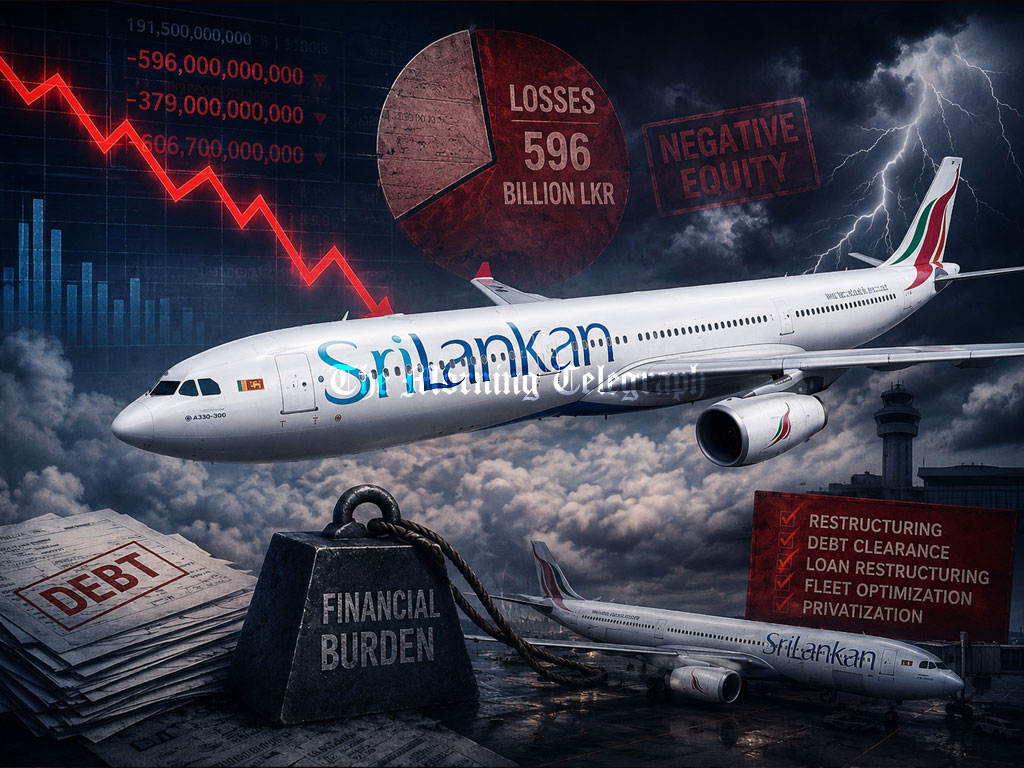
The group’s total accumulated losses climbed past 596 billion rupees by the final arrival of the 2024-25 financial cycle. After briefly climbing into clear skies with a 7.9 billion rupee profit in 2024, the airline hit immediate wind shear, sliding back into a net loss of 2.73 billion rupees for the fiscal year ending March 2025. This rapid loss of altitude was heavily driven by burning through an average of 30 billion rupees annually in financing costs alongside severe aircraft lease constraints that have left much of the fleet grounded or underutilized. Compounding the emergency, total group liabilities have ballooned to near 606.7 billion rupees against total system assets of just 191.5 billion rupees, leaving the carrier flying with a deeply negative total equity position exceeding 379 billion rupees.
The newly boarded restructuring committee has been handed the controls to clear the runway of legacy debts owed to state-owned enterprises, including the Ceylon Petroleum Corp. and the Civil Aviation Authority, which have long acted as financial shock absorbers for the carrier’s spillover.
The team is tasked with re-engineering high-interest commercial bank loans backed by treasury letters of comfort to make the airline airworthy for prospective private sector buyers.
Aviation analysts warn that unless this heavy baggage is completely unburdened from the balance sheet, attracting a global partner to secure a long-term codeshare or equity stake will remain grounded, as previous privatization attempts repeatedly aborted due to the unabsorbed liability load and complex state guarantees.