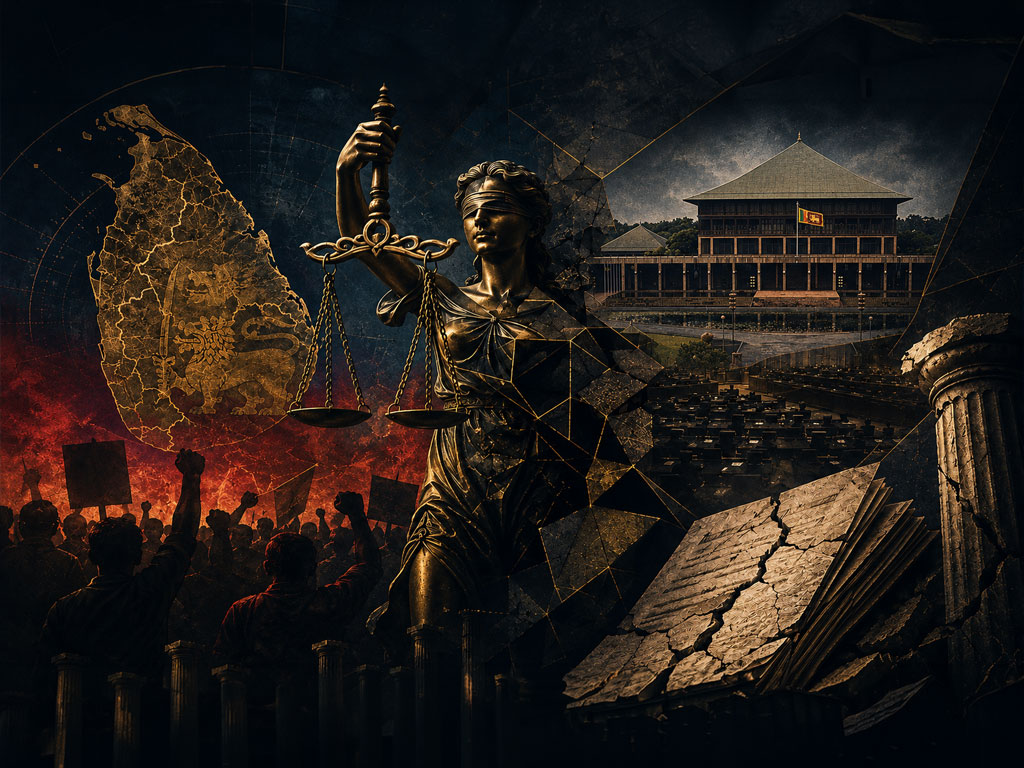
The 22nd Amendment debate is examined through Lacanian political theory, questioning whether moral protest can truly challenge structures of power.
The 22nd Amendment debate in Sri Lanka has moved beyond constitutional law into a deeper argument about democracy, morality and the limits of political protest.
This analysis approaches that conflict through Lacanian psychoanalysis and political philosophy. Its central argument is provocative: democracy is not fundamentally a moral harmony. Instead, it is a structure that regulates power, violence and political antagonism through law.
The Bar Association, opposition parties and other critics have described actions surrounding the 22nd Constitutional Amendment as anti-democratic.
If that criticism can be established legally, the democratic response should ordinarily be a legal challenge.
The argument here, however, is that protesters increasingly turn towards moral condemnation when legal mechanisms cannot deliver the result they seek.

When Law Itself Becomes the Political Battlefield
The argument begins with a difficult proposition.
Written law is not necessarily independent of political power or inherently ethical. Governments can often achieve political objectives without openly breaking the law.
Instead, power may operate through constitutional authority, legal technicalities and gaps within existing rules.
From this perspective, critics become politically frustrated because conduct they regard as fundamentally anti-democratic can still possess formal legal validity.
The contradiction therefore sits within democracy itself.
When legal resistance appears ineffective, opposition shifts into what Lacanian theory calls the “hysteric’s discourse.”
The government becomes the “master signifier.” Protesters confront that master by exposing inconsistency, weakness and hypocrisy.
They say, in effect: “The democracy you claim to represent is not real. You are fraudulent.”
Yet the argument identifies a paradox.
The hysteric challenges the existing master while still hoping another, more ethical master will eventually replace it.
This means protest may reject a particular government without challenging the deeper structure through which authority continues to reproduce itself.
The 22nd Amendment Debate Moves to Morality
Within liberal political tradition, democracy is commonly associated with ethical agreements, rights and humanitarian principles.
That belief implies the existence of institutions capable of guaranteeing justice when domestic political structures fail.
The analysis uses G.L. Peiris and other government critics as examples, arguing that appeals to the United Nations, foreign diplomatic missions, international institutions and the Maha Nayaka Theras represent a search for an external moral authority.
The criticism is not simply that these appeals occur.
Rather, it argues that protesters assume there is somewhere outside ordinary political conflict a final judge capable of declaring what is just.
From a Lacanian perspective, that assumption is itself ideological.
Democracy, in this reading, functions as a “master signifier” through which societies legally manage power, violence and unresolved antagonism.
A democratic structure can therefore respect the literal requirements of law while still producing outcomes critics regard as contrary to democratic principles.
That tension is crucial to the 22nd Amendment debate.
Critics have increasingly shifted from legal objections towards claims about ethics, fairness and political morality.
This transition deserves closer scrutiny.
When structural political conflict cannot be resolved, politics can be reframed as a simple moral struggle between “good and evil,” or between “the corrupt” and “the honest.”
Some of Patali Champika Ranawaka’s current political criticism can also be viewed through that framework.
The ‘Beautiful Soul’ and Safe Opposition
The analysis then turns to the idea of the “beautiful soul,” associated with Hegel and later used within psychoanalytic political thought.
The “beautiful soul” condemns corruption, immorality and injustice while presenting itself as morally untouched by the world it criticises.
However, the paradox is that passive moral opposition may help sustain the system it condemns.
A political structure can often absorb ethical criticism precisely because criticism alone does not necessarily threaten the structure of power.
Calling a government shameless or immoral may produce public outrage.
But according to this argument, it can also conceal the protesters’ inability to challenge that government legally or structurally.
Traditional liberal morality relies heavily on ideas of “the good,” social conventions, rights and universal justice.
The analysis argues that this can reduce political resistance to pleading before authority for more ethical conduct.
More protesters then gather outside the effective limits of legal action and denounce the government morally.
Yet the underlying political architecture remains intact.
Antigone and the Idea of the Radical Act
The argument contrasts this with what Lacanian theory describes as a “radical act.”
Such an act does not merely ask the existing symbolic order to behave better. It challenges that order itself.
Sophocles’ Antigone becomes the central example.
Antigone follows what she understands as her ethical obligation despite King Creon’s law and the broader social consensus surrounding it.
She does not appeal to Creon to become more compassionate.
She acts despite the consequences.
The analysis argues that contemporary protesters remain far from such a position.
Their opposition, in this reading, resembles “liberal moral outrage” conducted safely within the very political system they condemn.
They appeal to an imagined “big Other.”
That “big Other” might be the international community, the civilised world, religious authority or even history itself.
The hope is that somewhere, eventually, an unquestionable authority will record their moral righteousness and condemn their opponents.
But Lacanian theory insists that “the big Other does not exist.”
There is no final universal judge capable of guaranteeing morality.
Democracy Cannot Escape Political Antagonism
That brings the argument back to democracy itself.
This analysis does not claim democratic institutions are meaningless.
Instead, it challenges the belief that democracy automatically produces ethical outcomes simply because democratic procedures exist.
Power struggles remain inside democratic systems.
Legal authority and morality can diverge.
A government may act within constitutional powers while opponents still consider those actions harmful to democratic principles.
The 22nd Amendment debate therefore becomes, in this analysis, a test of how the opposition understands political struggle.
If criticism remains limited to demanding morality from those already holding power, the structure itself remains largely untouched.
The conclusion is intentionally uncomfortable.
Fighting entirely within moral boundaries can become a way of avoiding genuine political confrontation.
It allows protesters to preserve a clean conscience, record their objections and condemn those in power.
But if the underlying political structure remains unchanged, moral victory may coexist with political defeat.
The challenge, then, is not simply to identify who appears morally right.
It is to understand where power actually sits, how law sustains it and what kind of political action can genuinely alter the structure rather than merely denounce those controlling it.