Suresh Sallay’s arrest has sparked debate after multiple Easter Sunday investigations, local and international, reportedly made no allegations against him.
Suresh Sallay’s arrest and detention have reignited debate over the Easter Sunday investigations, with questions being raised about why action was taken against the former intelligence chief despite numerous official inquiries reportedly finding no allegations against him.
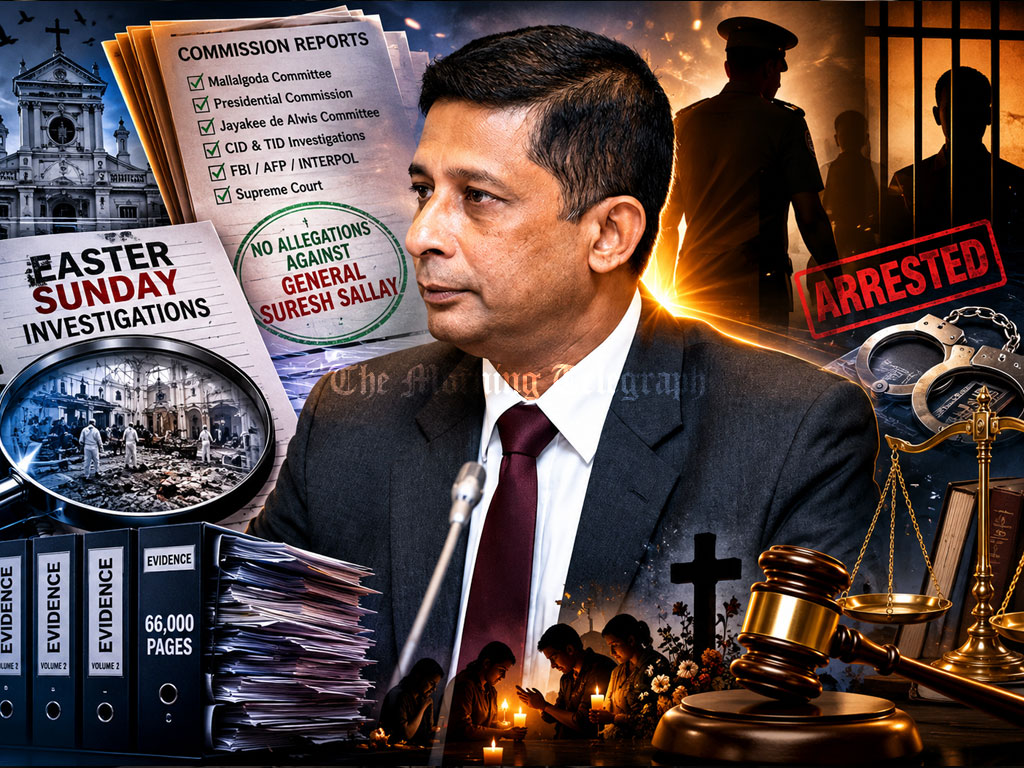
Those raising concerns point to the extensive number of commissions, committees, local investigations, and international probes conducted since the Easter Sunday attacks, arguing that none had identified General Suresh Sallay as a suspect or offender.
One of the earliest inquiries was the Mallalgoda Committee, appointed by then President Maithripala Sirisena in May 2019.

The committee consisted of Supreme Court Judge Justice Vijith Mallalgoda as Chairman, former Inspector General of Police N.K. Illangakoon, and former Secretary to the Ministry of Law and Order Padmasiri Jayamanna.
Investigations were conducted and a 272-page report was later submitted to the Parliamentary Select Committee. According to those citing the findings, the report contained no allegations against General Suresh Sallay.
A Presidential Commission of Inquiry was subsequently established on September 22, 2019.
Including evidence and supporting volumes, the commission reportedly compiled approximately 66,000 pages of material. It is claimed that nowhere in those findings was General Suresh Sallay accused of involvement in the Easter Sunday attacks.
In June 2024, the Jayakee de Alwis Committee was appointed to examine the conduct of intelligence agencies and officials linked to the attacks.
According to the findings cited, previous reports and court rulings had identified certain state officials and political authorities as being responsible for failures that prevented authorities from stopping the attacks. However, Suresh Sallay was reportedly not named among those identified.
That committee reportedly made serious findings and recommendations against former CID Director Shani Abeysekara and former Senior Deputy Inspector General of Police in charge of the CID, Ravi Seneviratne.
The report stated that despite receiving intelligence warnings and information regarding Zahran Hashim and his associates before the attacks, the two senior CID officials allegedly failed to properly assess the information, take preventive measures, or conduct adequate investigations.
As a result, the committee recommended that criminal legal action be considered against Shani Abeysekara and Ravi Seneviratne under provisions of the Penal Code relating to dereliction of duty and criminal negligence.
Those highlighting the report emphasize that no allegations were made against General Suresh Sallay.
Apart from these commissions and committees, investigations into the Easter Sunday attacks were also carried out by the Criminal Investigation Department (CID) and the Terrorism Investigation Division (TID) of the Sri Lanka Police.
International agencies, including the Federal Bureau of Investigation (FBI) of the United States, the Australian Federal Police (AFP), and Interpol, were also involved in investigative efforts.
Supporters of Sallay argue that until the current government came to power, none of these local or international institutions had made allegations against him.
The conclusions reached by foreign investigative bodies reportedly stated that the attacks were carried out locally, inspired by the ideology of the international ISIS terrorist organization, and planned primarily by Zahran Hashim.
Meanwhile, domestic commissions concluded that despite receiving prior intelligence warnings, authorities failed to prevent the attacks. Findings reportedly pointed to serious failures by the political leadership and senior defence officials responsible at the time.
According to those raising questions about Sallay’s detention, none of these conclusions identified him as being responsible for the attacks.
Records further indicate that 747 suspects have been arrested in connection with the Easter Sunday bombings, while the Attorney General has filed indictments against approximately 100 suspects under 14 separate High Court cases.
It is also pointed out that none of those accused have made allegations against General Suresh Sallay.
Attention has also been drawn to proceedings in the United States, where the Los Angeles Federal District Court filed terrorism-related charges against three Sri Lankan nationals accused of providing material support and assistance to ISIS.
Those citing the court proceedings state that no allegations against General Suresh Sallay appear in those documents either.
Similarly, no previously published Presidential Commission report or Supreme Court ruling has identified or convicted Suresh Sallay as an offender in relation to the Easter Sunday attacks.
Questions intensified after allegations made by Asad Maulana, who reportedly faces an arrest warrant on rape charges and later fled to Switzerland.
Following statements broadcast by Britain’s Channel 4 network featuring Maulana’s claims, General Suresh Sallay was arrested under the Prevention of Terrorism Act, detained, and subjected to investigation.
Critics argue that prior to his arrest by the CID on February 25, 2026, no charges had been brought against him despite years of investigations and multiple official inquiries.
Against that backdrop, those questioning the arrest continue to ask whether the detention of General Suresh Sallay was based on newly emerged evidence or whether other unseen influences may have played a role in the decision to take action against him.