Drug fraud proceedings reveal serious weaknesses in Sri Lanka’s health administration, raising concerns over accountability and oversight.
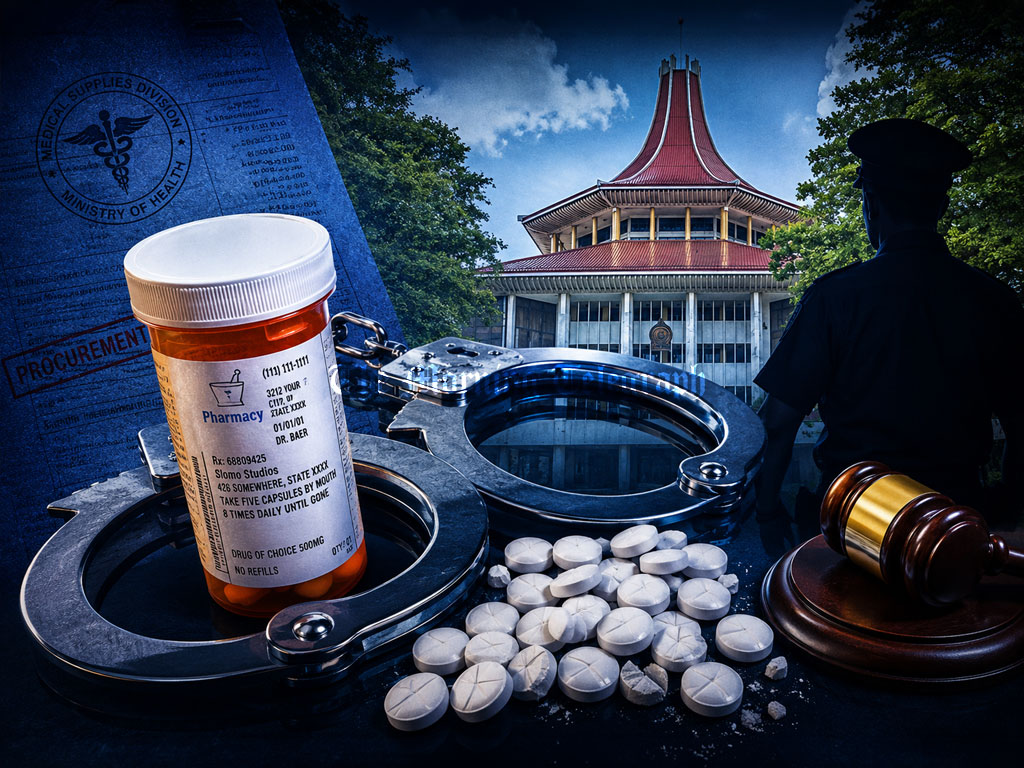
Drug fraud proceedings before the permanent three-judge High Court have exposed what many observers see as far more than the actions of a few individuals, revealing deeper structural weaknesses and a troubling lack of accountability across the state bureaucracy.
The case, which centers on the large-scale importation of substandard medicines, came under renewed scrutiny during hearings on June 12, when cross-examinations by defence counsel and the responses of witnesses shed light on the internal workings of the Medical Supplies Division (MSD), widely regarded as the operational heart of Sri Lanka’s public healthcare system.
A close examination of the court proceedings suggests that the issues raised extend beyond the allegations in the case itself and point toward broader failures within the state administrative mechanism.

Responsibility Avoided, Systems Left Behind
One exchange between defence counsel Priyantha Nawana and a witness highlighted what appeared to be significant shortcomings in information management within a key institution under the Ministry of Health.
Lawyer: Can you check how long it will take to receive a certain stock?
Witness: The Pronto system is not updated. Data can be obtained through the SPC.
Lawyer: Even if you log into the Pronto system at a meeting, can you check information about it?
Witness: No, Your Honour.
Lawyer: Can you do it at the MSD?
Witness: Yes, Your Honour. Through a laptop computer available at the institution.
For an institution responsible for managing approximately 1,540 essential medicines and nearly 8,000 surgical equipment items, the revelation that critical data systems remain outdated and that information retrieval depends on “a laptop computer available at the institution” drew considerable attention.
The exchange raised questions about whether the issue is merely a technological deficiency or whether such gaps create opportunities for inefficiency, mismanagement, and potential abuse.
Guidelines Ignored, Procedures Altered
The proceedings also examined how established policies and Standard Operating Procedures are implemented within the health sector.
Although the Drug Manual reportedly requires the maintenance of a three-month buffer stock, evidence presented suggested that shortages have continued to occur despite the existence of these safeguards.
Questions were also raised regarding a circular issued by the Health Secretary that reportedly altered established procedures by requiring original Waiver of Registration (WOR) certificates instead of photocopies.
The matter emerged during discussions about whether such administrative decisions contributed to confusion and delays within the procurement and supply process.
Courtroom Tensions During Cross-Examination
Defence counsel Asela Serasinghe sought to demonstrate what he described as negligence by state officials involved in the acceptance of medical supplies.
During questioning, he pointed to allegations that samples and labels had not been properly inspected when goods were received and that relevant deficiency documents, identified as Form 2v 24, were absent from the files.
The exchange led to objections from the Deputy Solicitor General and resulted in a tense atmosphere inside the courtroom.
Lawyer: According to that minute sheet, the Stores Controller has drawn the Assistant Director’s attention to the delay, hasn’t he, sir?
(Deputy Solicitor General objects)
Deputy Solicitor General: I object to the question asking whether it is only about the delay.
Lawyer: Allow the witness to testify freely without coercion.
Further exchanges concerning buffer stock requirements prompted the defence to suggest that pressure was being exerted on witnesses, a claim that intensified debate during the hearing.
When Everyone Is Responsible, No One Is
Evidence presented in court also focused on how drug stocks were accepted while the second accused was reportedly overseas and how institutional procedures continued during that period.
The testimony suggested that responsibility for key decisions was dispersed across multiple levels of the system, making it difficult to identify individual accountability.
A witness’s statement that “that responsibility falls on everyone” drew particular attention, as it appeared to illustrate a culture in which responsibility becomes so broadly distributed that no single officer can ultimately be held accountable.
The evidence heard before the High Court on June 12 exposed not only issues linked to the alleged drug fraud but also wider concerns regarding the functioning of Sri Lanka’s public administration.
The proceedings highlighted outdated information systems, procedural inconsistencies, circulars that can be altered with significant operational consequences, and questions regarding whether key officials possess sufficient understanding of their responsibilities.
As the trial continues, the case is increasingly being viewed not only as an effort to determine criminal liability but also as an examination of a state administrative framework that critics argue has become vulnerable to large-scale corruption, weak oversight, and a lack of accountability.
For many observers, the ultimate challenge will be whether the outcome leads merely to the punishment of individuals or to meaningful reforms within the institutions that allowed such failures to occur.
Court Record
2026/06/12
When the case concerning the importation of substandard drugs was heard before the permanent three-judge High Court on the 12th, Defence Lawyer Asela Serasinghe, who had been cross-examining the witness on the previous day, the 11th, continued his cross-examination.
Lawyer: The pending order mentioned in P 306 is the same order shown in the document I showed earlier, isn’t it?
Witness: It is the same order, Your Honour.
Lawyer: Next to 75,000 units, it says “Request delivery plan please.”
Witness: Yes, it requests that 40,000 units be supplied on January 23rd and 35,000 units on June 23rd.
Lawyer: That means they expect to receive them that way, doesn’t it?
Witness: Yes.
Lawyer: Please look at document 2 V 36 B. According to that, the delivery has not been received according to the delivery plan in P 300.
Witness: According to this computer record, it has not been received that way.
Lawyer: It has not been received in accordance?
Witness: Yes, Your Honour.
Lawyer: Look at the minute dated May 23, 2023. We examined the invoice. Regarding the minute in P 300, there is an invoice marked in a circle as 191 in 2v 34 in file 92. Look at the back page of that document. According to that seal, it states that based on sample inspection and label inspection, it can be accepted. Regarding the acceptance of this stock, the Stores Control Officer has not filled form 2v 24 in file 71 indicating problems during sample inspection and label inspection.
Witness: There is no deficiency form 2v 24 in the file.
(Deputy Solicitor General objects)
Witness: There is no fault with the documents and samples, and there is no problem with the file.
Lawyer: According to that minute sheet, the Stores Controller has drawn the Assistant Director’s attention to the delay, hasn’t he, sir?
(Deputy Solicitor General objects)
Deputy Solicitor General: I object to the question asking whether it is only about the delay.
Lawyer: Allow the witness to testify freely without coercion.
Witness: Your Honour, it is not about this delay.
Lawyer: Is it only about the delivery time?
Witness: Further details regarding stock acceptance have been inquired about.
Lawyer: Wasn’t it about the shelf life of a drug?
Witness: It was about this delivery date.
Lawyer: According to document P 299, the Ministry of Health sent a letter to the supplier stating that the stock was delayed.
Witness: Yes, Your Honour.
Lawyer: The Stores Controller also follows this document P 299. It lists from 1 to 11 as points or balls in paragraph 7. Point 11 in paragraph 7 of this document continues to the next page.
Witness: Yes, Your Honour.
Lawyer: The whole of this section was received expecting it to be about how the MSD functions, wasn’t it?
Witness: Steps were taken to avoid the delay. Notes 2V 37 have been issued by the Health Secretary.
Lawyer: Can the drug stock that is delayed be obtained for the panel mentioned in 2V 37?
Witness: Yes, Your Honour.
Lawyer: Was it mentioned in paragraph 12 of P 310 regarding P 309?
Witness: It has been included.
Lawyer: Out of the 180 drugs in the order list of P 299, only two are relevant to this case.
Witness: Yes, Your Honour.
Lawyer: You may know that when special tests were conducted on these drugs, there was an instruction to hand over all documents concerning the drugs to the investigating officers.
Witness: That happened on various occasions.
Lawyer: Do you know Acting Director G. Wijesuriya?
Witness: Yes, Your Honour.
Lawyer: Have you worked with him?
Witness: Yes, Your Honour.
Lawyer: Can you identify his official seal and signature?
Witness: Yes, he has now retired.
Lawyer: Have you worked with him?
Witness: Yes, Your Honour.
Lawyer: If shown a document related to the E01 procurement done by Mr. Wijesuriya, can you identify it?
Witness: Yes, I can, Your Honour.
Lawyer: Please examine numbers 1 to 9 in file number 64.
Witness: The signature and seal of the former Deputy Director General are on every page.
Lawyer: And that a list was prepared on page 9?
Witness: It is mentioned, Your Honour.
(The documents were marked subject to the burden of proof being on those who certified them)
Lawyer: Pages 1 to 9 list 45 types of drugs, don’t they?
Witness: Yes, Your Honour.
Lawyer: Only 44 and 45 are relevant to the case?
Witness: Yes, Your Honour.
Lawyer: Do you see that numbers 1 to 43 are drugs received by the MSD?
Witness: They have been entered with a GRN date.
Lawyer: I suggest that the drugs received by the MSD mentioned in P 293, and the documents regarding those stocks, are also mentioned in 2V 34.
Witness: It can be considered so.
Lawyer: When goods on folio 15 are accepted, does GR indicate a receipt?
Witness: Yes, Your Honour.
Lawyer: The voucher mentions its value and delay charges as well.
Witness: Yes, Your Honour.
Lawyer: The last folio indicates whether it is an NMRA registration or one that came with a WOR. In document 2V 39, numbers 44 and 45 are there, but it does not state that 3, 4, 5, 10, 13, 14, 15, 18, 20, 21, 23, 25, 27, 29, 30, 31, 33, 35, etc., were imported under WOR. Looking at these 45, only two were the subject of the case. Another 17 are mentioned as WOR.
Witness: According to these documents, yes, Your Honour.
Lawyer: Look at number 1. Check the GRN date.
Witness: 12-6.
Lawyer: Was that stock received while the second accused was abroad?
Witness: Yes, Your Honour.
Lawyer: Look at item 9.
Witness: Received on 2022/11/12.
Lawyer: Was that received while the second accused was abroad?
Witness: Yes.
Lawyer: When was item twelve received?
Witness: November 12th.
Lawyer: That means while the second accused was abroad?
Witness: Yes, Your Honour.
Lawyer: These are stocks received from November 2023?
Witness: Yes, according to this note, that is the case.
Lawyer: How many items does the MSD handle?
Witness: Approximately 1,540 drugs and about 8,000 surgical items.
Lawyer: This is a place that receives a large amount of information.
Witness: Yes, Your Honour.
Lawyer: The procurement method you mentioned was in place until September 2023. Was it still the same in 2024?
Witness: Yes, Your Honour.
Lawyer: By October 2023, problems started to emerge.
Witness: Yes, Your Honour.
Lawyer: The Director General of Health Services issued circulars.
Witness: Yes.
Lawyer: Circulars are issued to introduce new regulations. When circulars are issued, work is done accordingly. According to the Health Secretary’s circular, there was an instruction to carry out goods acceptance procedures, wasn’t there? See if you can identify this signature.
(That document was also marked subject to the burden of proof)
Lawyer: The original of this document may be in the file of the Deputy Director General of Health Services. The Secretary to the Ministry of Health introduced a new method, didn’t he? According to document 2V 40, the original of the WOR certificate is required with the goods.
Witness: Such instructions were given.
Lawyer: Wasn’t there such a thing before?
Witness: There wasn’t.
Lawyer: Was a copy of the WOR certificate taken before?
Witness: The new circular stated to bring the original WOR certificate.
Lawyer: Hasn’t such a thing happened before?
Witness: No.
Lawyer: It was stated to bring copies of the WOR, wasn’t it?
Witness: The new order in the new circular is to bring the original WOR.
Lawyer: After 2023/11/03, was the new method implemented? Was work done accordingly?
Witness: Yes, Your Honour.
Lawyer: According to document 2V 41, did the Director of the MSD issue a circular to the Stores Control Officers accordingly?
Witness: Yes, Your Honour.
(Shows the witness the circular with the signature of the second accused, Dr. Kapila Wickramanayake. It is marked as 2V 42)
Lawyer: The second paragraph has been removed.
Witness: Another one was issued on 11/15.
Lawyer: Has the method of implementation and the form been introduced?
Witness: It states that it should be checked.
Lawyer: Were checklists provided?
Witness: Yes.
Lawyer: At the end of November 2023, a Director came to the MSD. Who was that?
Witness: Dr. Dedunu Dias.
Lawyer: In addition to the circular of November 15th, was another circular issued on November 23rd?
Witness: Yes, Your Honour.
Lawyer: In addition to these two drugs, health orders had been placed for more than a month.
Witness: Yes, Your Honour.
Lawyer: Were all 15 drugs issued under Dr. Kapila Wickramanayake?
Witness: Only one order list relates to him.
Lawyer: Was there an uncertain period at the end of 2023, beginning of 2024, when officers were afraid to accept drugs coming under WOR?
Witness: There was such a situation.
Lawyer: Was there an order that orders that should be received by the Medical Supplies Division should not be cancelled without special permission?
Witness: Yes, Your Honour.
Lawyer: There is a drug called Rituximab in this list. Was it issued in November 2022?
Witness: It might have been issued.
Lawyer: Was that the procedure followed when accepting these drugs? Did you examine the file of Mr. Kasturi Ratnayake?
Witness: The SCO (Stores Control Officer) examined it.
Lawyer: Were the Stores Control Officer and the Assistant Director involved in accepting the drugs?
Witness: Yes, Your Honour.
Lawyer: In file 85, see where it is recorded as 870. The monthly value is 750.
Witness: Yes, Your Honour.
*(Lawyer Priyantha Nawana, appearing for the 10th accused, begins cross-examining the witness)*
Lawyer: The country’s health service gives a primary place to the people.
Witness: We give priority to distributing drugs to government hospitals.
Lawyer: To maintain the service, drugs must be imported in a timely manner.
Witness: Yes, Your Honour.
Lawyer: An assessment must be made based on previous years, and necessary drugs must be imported, as this is a very important task.
Witness: Yes.
Lawyer: The matter of distribution is also very important.
Witness: Yes, Your Honour.
Lawyer: When distributing, the available stock decreases, doesn’t it?
Witness: It fluctuates as it is received.
Lawyer: As the Chief Stores Controller, a great responsibility falls on you in that task.
Witness: That responsibility falls on everyone.
Lawyer: Isn’t it a responsibility to maintain a non-zero stock situation?
Witness: Yes, Your Honour.
Lawyer: Have you received the necessary guidelines from the department to manage this stock?
Witness: A compendium of key guidelines for stock management has been issued.
Lawyer: Is there a manual on drug management?
Witness: Yes, Your Honour.
Lawyer: Paragraph number 10 states that continuous efforts must be made to prevent drug stocks from running out.
Witness: Yes, Your Honour.
Lawyer: Is it your division’s responsibility to issue purchase orders properly, as well as to issue drugs properly?
Witness: Yes, Your Honour.
Lawyer: Is training provided to classify drugs according to UN classification?
Witness: Yes, Your Honour.
Lawyer: The central point for drug procurement is the Medical Supplies Division.
Witness: Yes, Your Honour.
Lawyer: There should be a procurement process that prevents stock from reaching zero, shouldn’t there?
Witness: There can be situations where stock becomes zero, for example, in a case like quality failure. Such situations exist.
Lawyer: Does the Drug Manual discuss maintaining a three-month buffer stock?
(Deputy Solicitor General objects. Threatens the witness)
Lawyer: Did someone tell you, Mr. Bandara, not to say that there should be a three-month stable situation?
Witness: No.
Lawyer: A buffer stock should be maintained for the drug stock, shouldn’t it?
Witness: It discusses a method of moving forward with replacement. This is a process that must be done periodically.
Lawyer: Drugs need to be available for distribution to patients, don’t they? The value called the monthly requirement is shown separately for each drug. Is the buffer stock determined accordingly?
Witness: Yes, Your Honour.
Lawyer: Does it state that the supply of drugs centralized in the MSD should be maintained in all hospitals across the island?
Witness: There should be a stock of one to two months.
Lawyer: Is that stock calculated relative to the monthly requirement?
Witness: I didn’t understand the question, Your Honour.
Lawyer: Aren’t you a pharmacist? Don’t you understand the term ‘relative’? Let me ask this way: if the monthly requirement is 100, then between 100 and 200 should be maintained in the hospitals, shouldn’t it?
Witness: Yes, Your Honour.
Lawyer: Is there a Sinhala version of the drug manual?
Witness: No, Your Honour.
Lawyer: Read number two. “This is essential to maintain buffer stock”. For example, it says MSD Stock 3 months, doesn’t it?
Witness: Yes, Your Honour.
Lawyer: Is the purpose of this drug manual to maintain drugs without a shortage of requirement?
Witness: Yes, Your Honour.
Lawyer: The Medical Supplies Division must work continuously for that purpose.
Witness: Yes, Your Honour.
Lawyer: Can you check how long it will take to receive a certain stock?
Witness: The Pronto system is not updated. Data can be obtained through the SPC.
Lawyer: According to you, Pronto is not updated. Can you check the prices taken on previous occasions?
Witness: It can be checked through computers.
Lawyer: Even if you log into the Pronto system at a meeting, can you check information about it?
Witness: No, Your Honour.
Lawyer: Can you do it at the MSD?
Witness: Yes, Your Honour. Through a laptop computer available at the institution.
Lawyer: Don’t you have a laptop?
Witness: Yes, I do, Your Honour.
At this point, the trial was adjourned until the following Monday (15th). On that occasion, Lawyer Rahul Jayatilake, appearing for the 9th accused, informed the court that since he will not be practicing law in Sri Lanka in the future, he will nominate another lawyer for this case.