
By Roy Denish
A chilling investigation revisits Suresh Sallay’s rise through Sri Lanka’s intelligence ranks and the explosive allegations linking shadow networks, suppressed warnings, and the Easter Sunday attacks to a deeper political-security operation.
From the shadows of Galle Face to the sealed rooms of the Galadari Hotel, the rise of Suresh Sallay from desk officer to spy chief is now being recast as one of Sri Lanka’s darkest intelligence mysteries. What was once dismissed as failure and incompetence is now being questioned as something far more sinister, a hidden operation that may have helped shape the country’s bloodiest modern tragedy.
The rise of Suresh Sallay from an administrative clerk to Director of Military Intelligence is still being debated in the boardrooms of every security establishment.
The wind sweeping across Galle Face Green that evening carried the salt of the Indian Ocean and the heavy, suffocating scent of a storm delayed.
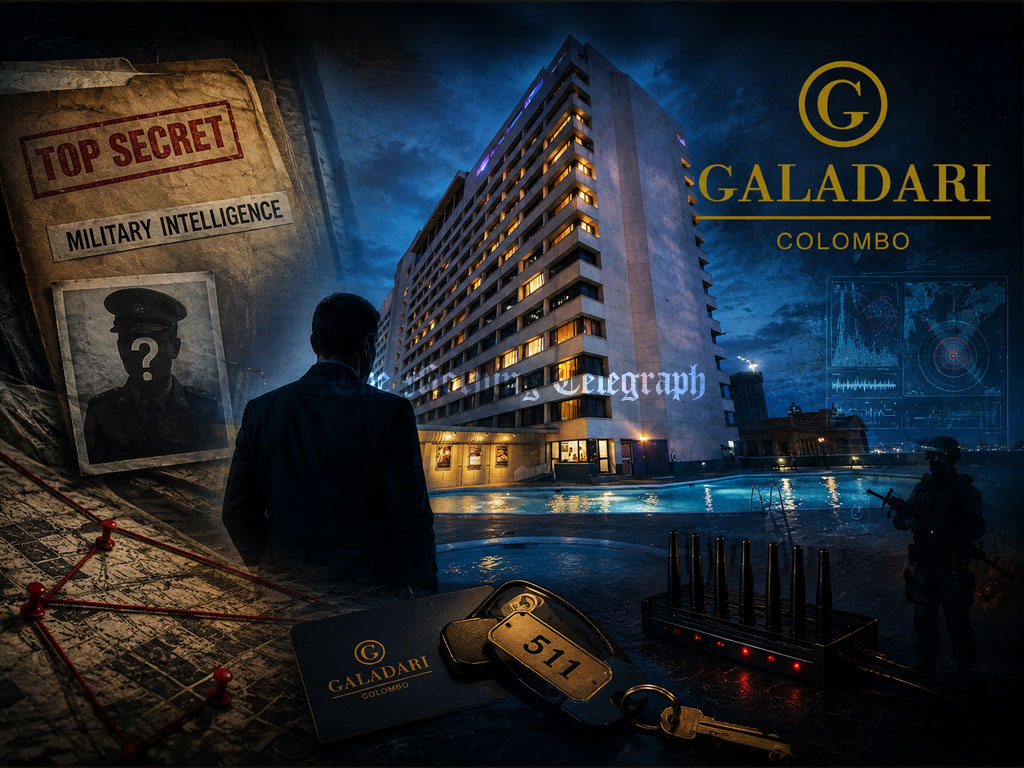
Across the tarmac, the grand façade of the Galadari Hotel loomed like a silent sentinel, its windows reflecting the fading, bruised light of the Colombo sky.
On the promenade, where families and street vendors usually clustered, two figures stood in the shadows, their silhouettes blurred by the mist.

The Meeting Opposite Galadari
It was here, directly opposite the hotel, that the conspirators met.
The meeting was short, frantic, and conducted in the hushed, rapid tones of men who knew that a single misstep would bring the entire architecture of the state crashing down upon them.
A local military intelligence informant, who had come too close to uncovering a horrific truth, listened as the final, absolute directive was delivered.
There was to be no alarm.
The tracking data was to be suppressed.
The clock was ticking, and the machinery of a grand, catastrophic deception had already been set in motion.
Secret Talks Inside the Hotel
While the preliminary encounters took place on the oceanfront promenade, the most secretive, high-level discussions were moved inside the fortress of the hotel itself.
According to subsequent intelligence dossiers and internal whistle-blower accounts, the critical hush talks where operational details were coordinated with the extremist network took place within the secure, private confines of a designated luxury room on one of the hotel’s upper accommodation floors.
Before the talks could even begin, a specialized team of military intelligence technicians was deployed to the room to enforce absolute operational security.
Using advanced sweeps, they conducted a meticulous strip-search of the entire suite, scanning every light fixture, electrical outlet, and vents for hidden spy cameras or clandestine listening devices.
To guarantee zero external intercept, the room’s landlines were physically disconnected, cellular jammer profiles were initiated, and the space was entirely insulated from the outside world.
This enclosed room provided the absolute digital and physical insulation necessary for a senior intelligence chief to meet away from public scrutiny, solidifying the operational immunity that allowed the cell to proceed toward its targets.
The Desk Officer Who Defied Military Gravity
To the casual observer, the rise of Major General Suresh Sallay through the ranks of Sri Lanka’s military intelligence apparatus was a standard bureaucratic march.
But to those who inhabited the shadow world of the Directorate of Military Intelligence, his ascent was an unnatural phenomenon, a disturbing riddle that defied the traditional laws of gravity governing military merit.
In the traditional theater of counter-intelligence, reputations were forged in the mud and blood of the northern theater.
True operatives built their names on the slow, agonizing cultivation of deep-cover informant networks, surviving on raw instinct and field tradecraft.
By that unforgiving metric, Sallay was a ghost.
Internal veterans, speaking from the safety of retirement, remembered him not as a field commander, but as a creature of the fluorescent lights, a career desk officer whose domain was restricted to administrative files, logistics, and the quiet whir of computer servers.
No Field Networks, But Digital Power
He possessed no organic human networks within the enemy territory of the Liberation Tigers of Tamil Eelam.
During the final, bloody chapters of the civil war, when high-value cadres were brought into interrogation rooms, Sallay was frequently present, yet his intelligence products were widely dismissed by peers as derivative, heavily reliant on third-party intermediaries.
What he lacked in field tradecraft, however, he balanced with a highly specialized, dangerous modern asset: an early mastery of digital surveillance and computer hacking.
In a changing world, information was the ultimate currency, and Sallay became its most adept broker.
The Hendavitharana Connection
Every riddle requires a key, and Sallay’s key was Lieutenant General Kapila Hendavitharana.
As the powerful wartime Director of Military Intelligence and later Chief National Intelligence Officer, Hendavitharana was the master architect of the state’s shadow architecture.
Sallay secured his position within this inner sanctum not through battlefield victories, but by managing internal administrative flows and carrying tales directly to his patron.
This top-heavy favoritism sent shockwaves through the rank-and-file.
Seasoned operational commanders watched in mounting frustration as a career desk officer systematically bypassed highly decorated field veterans.
The meritocracy fractured, driving talented, independent counter-intelligence officers to apply for transfers out of the intelligence regiments entirely rather than serve under a command culture built on administrative patronage.
Sarath Fonseka’s Warning Move
The structural decay did not escape the sharp eyes of then-Army Commander Field Marshal Sarath Fonseka.
Recognizing the profound deficit in Sallay’s operational capabilities and suspicious of his method of advancement, Fonseka made a decisive move to protect the integrity of frontline command.
He sidelined Sallay, transferring him far from the administrative loops of Colombo to an isolated outpost: the military intelligence camp at Giritale, in Polonnaruwa.
Giritale and the Ekneligoda Shadow
But Giritale was no ordinary outpost.
It was a dark node in the island’s deep state, a place where the lines between state security and political neutralization blurred into nothingness.
It was during this era of deep political polarization that Prageeth Ekneligoda, an outspoken political cartoonist and journalist who had relentlessly criticized the ruling Rajapaksa administration, vanished into thin air.
On January 24, 2010, just three days before a highly contested presidential election, Ekneligoda was abducted.
Subsequent investigations by the Criminal Investigation Department pulled back the curtain on Giritale, revealing that the missing journalist had been taken to the isolated camp, detained, and interrogated before his suspected murder.
The Attorney General eventually filed formal indictments against nine military intelligence personnel associated with the facility.
Sallay’s presence at and management of the camp during these overlapping periods of extrajudicial activity remained a permanent, dark stain in the files of state investigators.
Elevation Despite the Shadows
Despite the Giritale scandals, the wheels of patronage kept turning, culminating in Sallay’s formal elevation to Director of Military Intelligence in December 2015.
The stage was set for a grand, catastrophic deception.
Easter Sunday and the Intelligence Failure Narrative
The denouement of this long-brewing institutional tragedy began on Easter Sunday, April 21, 2019.
The world watched in horror as a coordinated wave of suicide bombers tore through three luxury hotels and three Christian churches, leaving 269 people dead.
In the immediate, chaotic aftermath, a narrative of pure intelligence incompetence was presented to the public.
It was revealed that India’s intelligence agency, the Research and Analysis Wing, had provided extraordinarily precise, actionable warnings starting more than two weeks before the explosions.
Derived from the interrogation of an Islamic State recruit, the Indian briefs explicitly named the National Thowheeth Jama’ath, identified its leader Zahran Hashim, and listed the specific targets, including the Indian High Commission and prominent Catholic churches.
A final, frantic warning was sent just two hours before the first detonation.
Political Paralysis and Scapegoats
The public was told that these warnings were disregarded because of a toxic, petty political feud between President Maithripala Sirisena and Prime Minister Ranil Wickremesinghe, which had paralyzed the National Security Council.
The Inspector General of Police, Pujith Jayasundara, and Defence Secretary, Hemasiri Fernando, treated the highly urgent cables as routine paperwork, passing them down the bureaucratic ladder without initiating a national mobilization or informing the cabinet.
Rumors swirled that the Army Commander had resigned that morning in protest, though records later corrected that the high-profile resignations of the defense chiefs were forced days later by an outraged presidency seeking scapegoats.
The First Official Explanation
For a time, the explanation of institutional inertia sufficed.
The bombers, funded by the wealthy Ibrahim spice-exporting family, had utilized end-to-end encrypted messaging platforms like Threema, WhatsApp, and Telegram to insulate their communications from regular state electronic intercepts, finalizing their deadly plots in suburban safe houses from Puttalam to Dematagoda.
International briefs found no evidence of direct involvement by foreign states like Saudi Arabia, concluding the cell was a localized entity aligned ideologically with the Islamic State.
A Political Landscape Transformed
The tragedy reshaped the political landscape.
Months earlier, Gotabaya Rajapaksa, speaking as a private citizen at the Viyathmaga national convention, had warned that the ruling government had systematically dismantled intelligence networks and compromised national security.
Following the blasts, he stepped forward onto this very platform, announcing his presidential candidacy with a vow to restore centralized military intelligence structures and eradicate extremism.
But like the classic twist in a grand detective novel, the official narrative of mere incompetence began to unravel, exposing a far more sinister plot hidden beneath the surface.
Parliamentary Revelations Reopen the Case
The true breakthrough came years later, inside the well of parliament, when Public Security Minister Ananda Wijepala delivered a stunning indictment that recontextualized the entire tragedy.
State investigators, operating with fresh mandates, revealed that the Easter attacks were not a failure of intelligence, but a highly orchestrated covert operation managed from the very top of the security apparatus.
The state’s formal legal thesis now alleges that Suresh Sallay, using his dual authority, had actively facilitated and protected Zahran Hashim’s extremist cell to create a national security crisis that would alter the political destiny of the country.
The Alleged Reconnaissance Cell
According to parliamentary disclosures, exactly three weeks before the bombings, Sallay directly deployed a covert cell of four Muslim operatives to conduct reconnaissance on prominent religious targets.
These individuals gathered precise logistical data, including layout designs and congregation attendance figures for a major Roman Catholic church in Negombo, the very church that would later be reduced to rubble by a backpack bomb composed of urea nitrate.
One of these operatives was subsequently identified from photo logs as a prominent Islamic State ideologue who vanished into the shadows immediately after the explosions.
The Suppressed Warning
The conspiracy ran deeper.
When a domestic military intelligence informant successfully EM-tracked the impending attack and attempted to sound the alarm, the state’s parallel apparatus intervened.
The informant was unlawfully arrested and detained under the guise of national security, effectively suppressing the tracking data and ensuring the bombers could proceed toward their targets without interference from regular law enforcement.
The Galle Face Silence Operation
The final piece of the puzzle fell into place with the revelation of that highly secretive, off-the-record meeting at Galle Face Green and inside the hotel rooms.
Following the informant’s eventual release, Sallay had summoned him to the promenade directly opposite the Galadari Hotel.
It was a confrontation designed to enforce absolute silence, ensuring that the domestic extremist cell remained entirely invisible until the morning of Easter Sunday.
These explosive findings formally mirrored the allegations broadcast internationally by the British network Channel 4, which had first accused the spy chief of running shadow operations with local extremists to engineer a political regime change through terror.
The Spy Chief Brought Into the Light
In the grand tradition of justice finally catching up to the master manipulator, the man who had survived decades in the dark corridors of the deep state was finally brought into the light.
Arrested under the Prevention of Terrorism Act, Sallay launched a hunger strike in detention, vehemently denying all charges through his legal counsel.
But as the rain continued to fall over Colombo, the files remained open.
The administrative clerk who had mastered the art of the digital shadow had left behind a trail of breadcrumbs that led straight to the heart of the island’s greatest tragedy, proving that in the end, no conspiracy is completely seamless, and no spy chief is beyond the reach of the truth.


There will be no closure for the victims’ families unless there is accountability & justice meted out to the masterminds of this massacre— Gotabaya Rajapakse & his fellow partners of these murders must face the ultimate penalty.