By Roy Denish
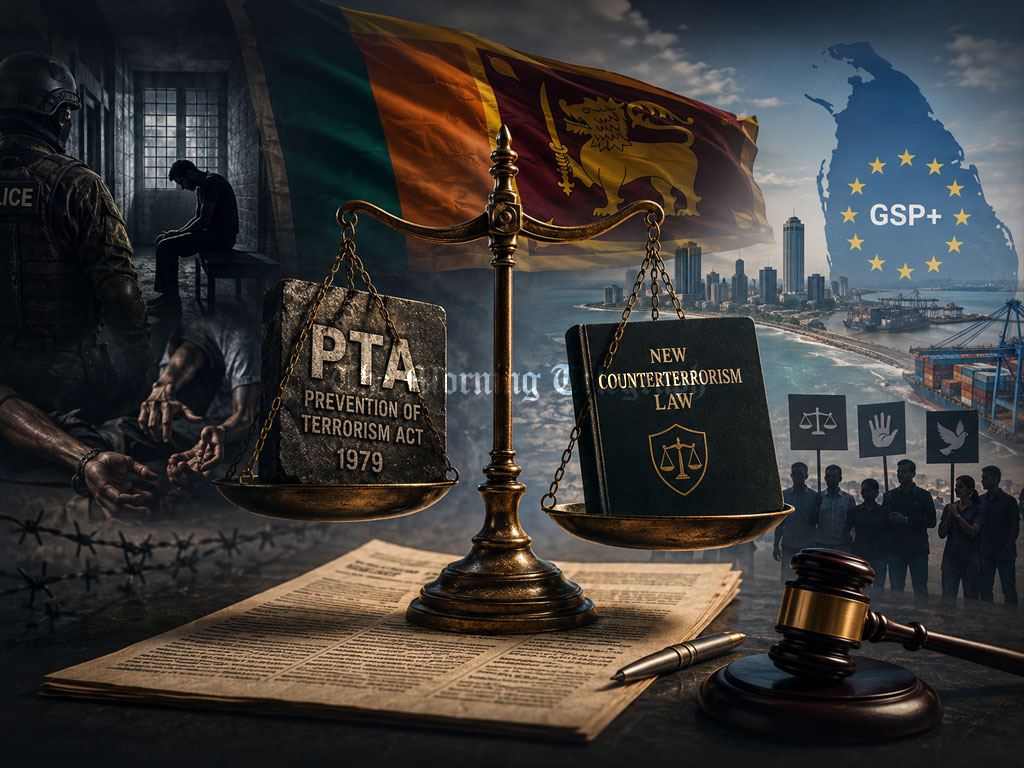
The PTA may finally be heading for the exit, but human rights groups fear Sri Lanka is simply changing the label while keeping the same machinery of fear. After decades of arbitrary arrests, torture allegations, political abuse, and threats to vital GSP+ trade benefits, the real question is whether the new counterterrorism law will protect citizens or quietly preserve the state’s sweeping powers under another name.
The highly controversial, draconian legislature, the Prevention of Terrorism Act (PTA), is finally to be scrapped, with an alternative legislature set to be introduced in its place.
However, prominent international and domestic human rights watchdogs fear that this legislative transition may turn out to be nothing more than another political facade.
There is deep skepticism that the new counterterrorism framework will merely repackage the old, toxic elements of the 1979 law under a fresh legal letterhead, allowing systemic state overreach to continue unchecked.

A Temporary Law That Became Permanent
Originally passed as a temporary three-year measure to curb internal unrest, the PTA instead became a permanent fixture of state machinery.
For nearly half a century, it has stood as a monument to executive overreach, systematically dismantling human rights, subverting due process, and fracturing the rule of law.
Over the decades, the PTA has been weaponized by successive administrations to stifle political dissent, target marginalized minorities, and silence journalists.
Since its inception, tens of thousands of individuals have been arbitrarily detained under its provisions, often held for months or even years without formal charges or trial.
Tragically, this unchecked authority led to numerous deaths in custody, as the defence establishments were effectively handed a free hand to operate within a legal vacuum.
Sweeping Powers and Torture Allegations
The structural flaws of the act were deeply entrenched, granting state authorities sweeping powers of arrest and allowing extended administrative detention without meaningful judicial review.
Most critically, it permitted confessions made to police officers to be admitted as evidence, a loophole that directly incentivized systemic torture to extract admissions of guilt.
Human rights organizations have extensively documented that the law functioned as an open door for horrific interrogation tactics.
Victims were routinely subjected to severe physical and psychological abuse, including blindfolding, waterboarding, and being hung upside down from ceiling fans while being beaten with plastic pipes, iron bars, or wooden batons.
Interrogators frequently resorted to falanga, beating the soles of the feet, as well as burning flesh with cigarettes, squeezing genitals, and rubbing chili powder into the eyes and open wounds of detainees.
Long after the civil war ended in 2009, these brutal practices persisted as a primary tool of state intimidation against peaceful protesters and civil society activists.
PTA’s Economic Cost and the GSP+ Threat
Beyond the immense human cost, the PTA has severely damaged Sri Lanka’s standing on the global stage, acting as a direct threat to the national economy.
The most tangible casualty has been the country’s relationship with the European Union regarding the Generalised Scheme of Preferences Plus (GSP+) trade concessions.
GSP+ grants duty-free access to EU markets for over 7,200 Sri Lankan products, injecting billions of euros into the domestic economy and acting as a critical lifeline for the nation’s massive apparel and rubber export industries.
However, this preferential access is strictly conditional on the ratification and meaningful implementation of international human rights and labor conventions.
Because of persistent rights abuses linked to the PTA, the EU previously revoked Sri Lanka’s GSP+ status in 2010, triggering a severe economic contraction.
While the concessions were reinstated in 2017, it came with an explicit, binding commitment from Colombo to repeal the PTA and replace it with human rights-compliant legislation.
For years, failure to meet this benchmark has left Sri Lanka on the precipice of losing these vital trade privileges once again.
A New Law Must Not Carry the Old Poison
Now, as the government moves to fulfill its promise, the introduction of an alternative counterterrorism bill brings a stark warning: true reform is not about changing a bill’s name.
Legal watchdogs are already sounding alarms that the proposed replacement preserves many of the old law’s most dangerous components, including overbroad definitions of terrorism and excessive executive powers of arbitrary detention.
If the replacement law merely masks old abuses under a new name, it will be a tragic missed opportunity.
To secure both international trade privileges and domestic stability, Sri Lanka must completely reject the repressive logic of 1979.
Real legislative progress requires precise definitions of offenses, strong judicial oversight, and an absolute commitment to constitutional freedoms.