
By Roy Denish
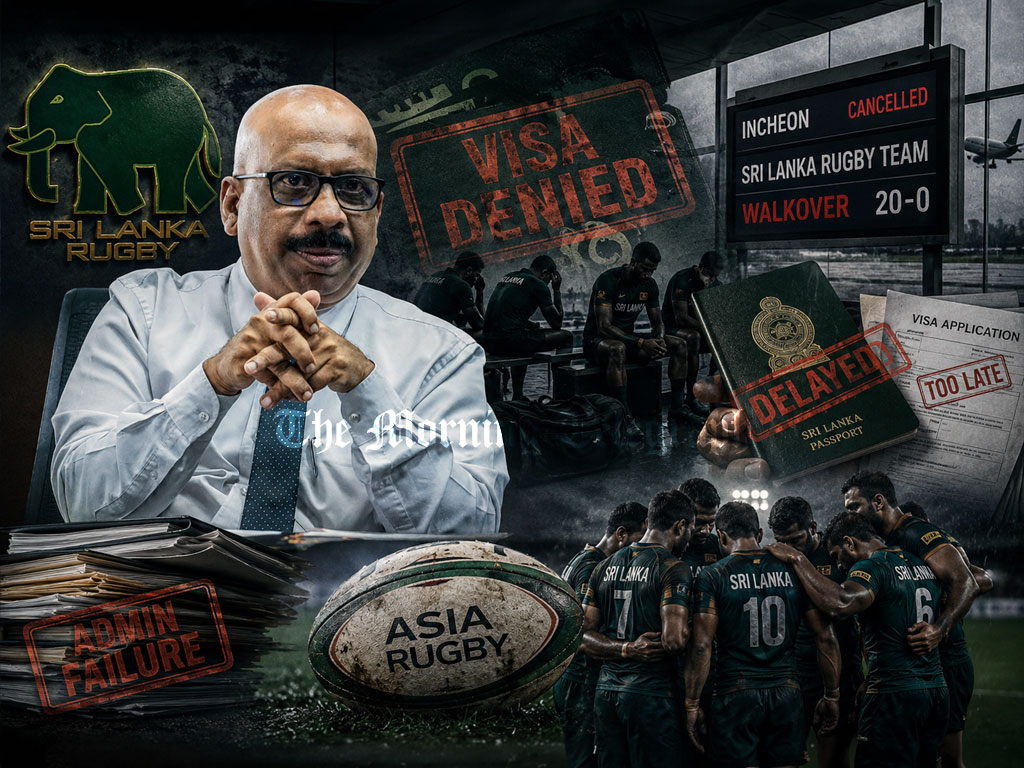
A 20-0 defeat without even taking the field has exposed the deepest cracks in Sri Lanka Rugby. While players trained, sacrificed, and prepared to fight for the country, officials failed at the one thing they had to get right, putting the national team on a plane.
COLOMBO — Sri Lanka’s rugby community has plunged into a fierce civil war following an administrative knock-on that forced the national team to concede a walkover in their final Asia Rugby Championship clash against South Korea, sparking a furious blame game between the sports ministry and union officials while players demand a complete tactical overhaul of the system.
SLRPA Calls for Independent Player Management
The Sri Lankan Rugby Players’ Association (SLRPA) has aggressively called for the immediate implementation of a structured, independent player management system to protect athletes from off-field errors.
The demand follows the cancellation of the June 13 fixture in Incheon, which saw South Korea awarded a 20-0 default victory after the Sri Lankan contingent failed to clear the visa scrum in time to cross the gainline.
The off-field debacle has drawn intense public criticism and reached the floor of Sri Lanka’s parliament, exposing the chronic administrative paralysis plaguing the island nation’s sporting bodies.

Documentation Submitted at the Eleventh Hour
While top sports officials have traditionally avoided the sin bin for operational fallouts, the sheer scale of the South Korean visa blunder has left the national squad completely isolated on the wing.
According to sources close to the diplomatic process, the documentation for the traveling squad was submitted at the absolute eleventh hour, leaving the South Korean Embassy in Colombo with zero time to complete standard clearance.
Sri Lanka Rugby Blames a Late Tactical Shift
Sri Lanka Rugby (SLR), currently overseen by Pavithra Fernando, issued a lengthy statement trying to spin the delay, attributing the handling error to a late tactical shift that separated the national Men’s Sevens and Fifteens programs.
The union claimed the subsequent shuffling of the squad list delayed essential ministry approvals.
However, critics point out that the international calendar had been set months in advance, and this massive handling error effectively stripped a crucial competitive opportunity from players, several of whom were slated to win their maiden international caps.
Sports Ministry Moves Into Defensive Alignment
Rather than taking ownership of the drop-kick, the Ministry of Sports, led by Minister Sunil Gamage, has moved swiftly into defensive alignment to deflect public anger.
Instead of addressing internal oversight failures within the ministry’s Department of Sports Development, which holds final veto power over national team deployments, officials have aggressively passed the ball back to the Sri Lanka Rugby Football Union (SLRFU) in a blatant attempt to avoid the penalty.
Parliament Tackles the State Apparatus
This finger-pointing has triggered intense blowback from former internationals and political figures who refuse to let the ministry kick to touch.
Opposition Leader Sajith Premadasa directly tackled the state apparatus in parliament, stating that it was known well in advance that the fixture was on the cards, and if the administration cannot execute basic passport and visa logistics, the government has completely dropped the ball while the players remain the ultimate casualties.
The Rs. 80 Million Contrast
Compounding the frustration is the stark contrast in how funding is distributed across the park.
Critics point out that SLR and the Ministry of Sports recently scrambled an estimated 80 million rupees (approx. $265,000 USD) to host a developmental tier six team from New Zealand for exhibition matches, a high-profile event where top politicians and sports officials were eager to join the post-match huddle and share the limelight.
Yet, the same administration completely missed its assignment when it came to securing basic consular paperwork for its own national athletes flying the state flag on the international stage.
A Long History of Institutional Instability
The current crisis is not an isolated handling error but the latest chapter in a long history of institutional instability within Sri Lankan sports governance.
For years, rugby on the island has been hamstrung by political interference, financial mismanagement, and bitter infighting that has disrupted any hope of continuous momentum.
Successive sports ministers have repeatedly used provisions of the country’s antiquated 1973 Sports Law to suspend, dissolve, or install temporary “interim committees” over governing bodies like SLR, effectively blowing the whistle on long-term player development programs.
Past Financial Yellow Cards Still Haunt Rugby
Furthermore, the sport is still struggling to recover from past financial yellow cards, including a heavy £50,000 fine imposed by World Rugby after previous administrators illegally facilitated local passports for foreign players to bypass strict eligibility rules.
Saddled with millions in legacy debts and ongoing governance disputes, the union has seen its international development grants routinely slashed or withheld by global governing bodies.
Incheon Walkover Jeopardizes Sri Lanka’s Standing
By failing to show up for the kickoff in Incheon, Sri Lanka has not only suffered a humiliating technical defeat but has also jeopardized its standing with Asia Rugby, which confirmed that no alternative window exists to reschedule the match within the 2026 competition cycle.
For the players, who unlike their heavily subsidized cricketing counterparts often balance full-time jobs with grueling training schedules, this visa fiasco represents a breaking point.
The players’ association warns that without a transparent, professional body to manage athlete logistics independently of erratic political appointees, the country’s rugby infrastructure faces an irreversible slide down the world rankings.


# SLR Governance Must Be Guided by the Constitution, Not Public Sentiment
The current debate surrounding the involvement of a Players’ Association in the administration of Sri Lanka Rugby raises a fundamental question:
What mandate does a Players’ Association have to oversee or administer Sri Lanka Rugby?
To the best of my knowledge, the original constitution of Sri Lanka Rugby does not provide any constitutional mandate for a Players’ Association to assume an oversight or administrative role over the elected body of SLR.
History provides a useful precedent.
During my tenure, then Sports Minister Hon. Namal Rajapaksa appointed an advisory committee headed by former SLR President Asanga Seneviratne. The SLR Council, however, rejected this appointment as it was not in keeping with the governance framework of the Union.
Subsequently, using powers under the Sports Act and Gazette provisions, the elected body of SLR was dissolved. The matter was challenged in court, and the courts ultimately overturned the dissolution, resulting in the reinstatement of the elected SLR office bearers.
This established an important principle:
The governance of Sri Lanka Rugby must remain within the framework of its constitution and the rule of law.
It was widely articulated at the time that the advisory committee proposal arose partly due to the requirements of the Asia Rugby constitution, which stipulates that a person seeking nomination for office within Asia Rugby must be an elected official of the member union making the nomination.
The historical record also shows that the former President had lost the SLR election in 2018, when Mr. Lasitha Gunaratne was elected President of Sri Lanka Rugby.
From 2020 to 2023, despite unprecedented challenges—including political pressure, suspensions imposed by World Rugby and Asia Rugby, and governance disputes—Sri Lanka Rugby continued to provide opportunities for national players to represent the country internationally.
During this period, Sri Lanka successfully toured and competed in:
– UK Commonwealth tournaments
– Asian Rugby Sevens events in Dubai
– South Korea
– China
Importantly, Sri Lanka competed under the Olympic Charter and the Olympic flag with the support of the National Olympic Committee and sponsors.
The Olympic ideal is clear:
> “The important thing is not to win, but to take part.”
The duty of any rugby administration is first and foremost to ensure that national players are given the opportunity to represent Sri Lanka on the international stage.
Against this backdrop, the recent failure to secure visas for an official international fixture is deeply regrettable. Such administrative lapses should be examined through proper governance mechanisms established under the SLR constitution and applicable law.
If reforms are required, they must come through constitutional processes—not through ad hoc structures lacking legal mandate.
Sri Lanka Rugby has survived for over 147 years because its governance has been rooted in institutions, constitutions, and the rule of law. Those principles must continue to prevail.