By Roy Denish
A towering supertanker carrying two million barrels of crude oil erupted into flames off Sri Lanka’s eastern coast, triggering a week-long international rescue operation that prevented one of the worst environmental disasters in Indian Ocean history.
Sequence of events is published below…
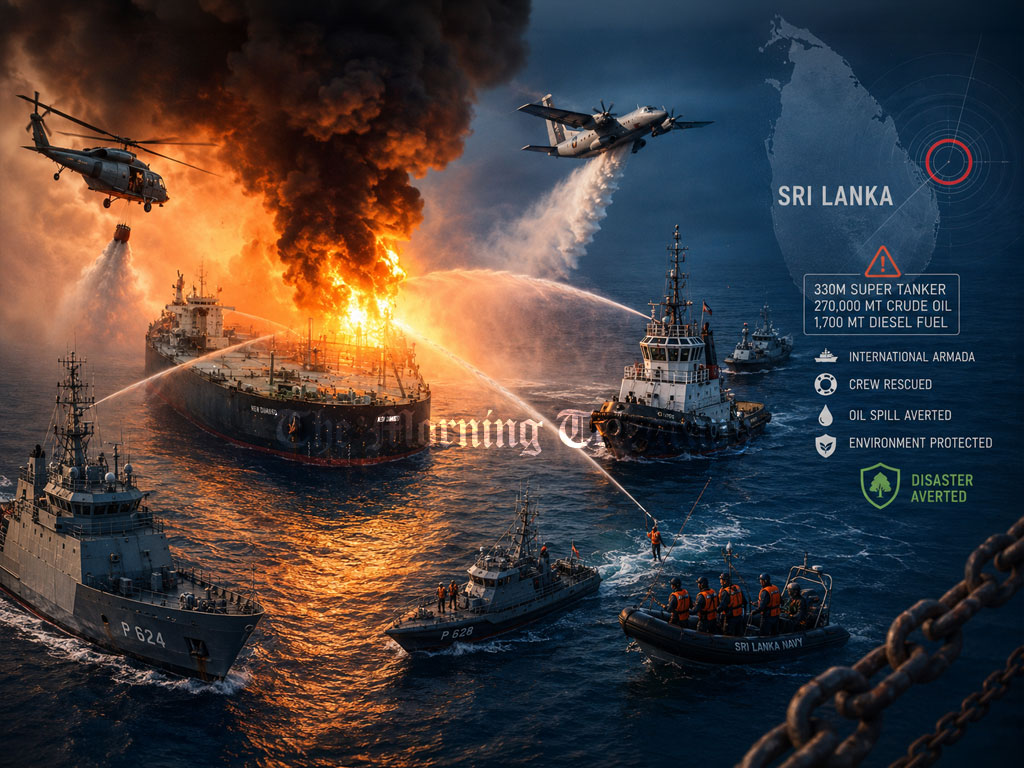
The steel deck plates of the MT New Diamond, broadcasting under the Panamanian flag with the call sign 3EWG, thrummed with the heavy, rhythmic heartbeat of a 330-meter supertanker as it cut through the deep waters of the Indian Ocean. The vessel was cruising 38 nautical miles off the eastern coast of Sri Lanka, having departed its last port of call at Mina al Ahmadi, Kuwait, on August 23, 2020. Deep in its belly, it carried 270,000 metric tons of Kuwaiti export crude oil along with 1,700 metric tons of heavy bunker diesel fuel bound for its final destination at the Port of Paradip in Odisha, India, to feed the Indian Oil Corporation’s refinery. Because the vessel was strictly a liquid bulk supertanker, it carried zero shipping containers. Instead, its massive holds were filled entirely with liquid energy. Managing this immense transit was a crew of twenty-three men, comprising five Greek nationals and eighteen Filipinos. Down in the towering, multi-story cavern of the main engine room, the air was thick with the scent of heated oil and high-pressure steam. A Filipino oiler stood near the auxiliary boiler conducting a routine inspection, entirely unaware that deep within the exhaust gas economizer, a hidden, catastrophic thermal buildup had just reached its ultimate breaking point.

Without warning, a massive pressure surge slammed backward into the auxiliary boiler’s steam-water drum, detonating it with a deafening metallic roar that shook the entire 300,000-ton hull from bow to stern. The shockwave was so violent it tore a multi-ton section of the main engine exhaust pipe clear off the funnel top, launching it across the open deck like artillery shrapnel, while the engine room skylights were blown out of their frames. In the lower decks, the lights instantly died as a total electrical blackout struck the vessel, and a blinding flash of thermal energy killed the oiler on duty instantly while severely burning a third engineer nearby. Ruptured internal pipes began vomiting heavy fuel oil and lubricants directly onto the white-hot machinery debris, sparking an inferno that turned the multi-tier engine room into a blazing furnace within minutes.
Up on the bridge, Captain Stereo Sterio Ilias felt the floor drop beneath his boots as the superstructure violently shuddered, and alarms began to wail across the dark, powerless console. Peering over the starboard side, he saw thick, acrid gray smoke and bright tongues of flame bursting through the ventilation frames, rising high into the morning sky and heading straight for the crew quarters. Beneath their feet sat two million barrels of highly volatile energy, a payload so immense that if the fire breached the cargo bulkheads, the resulting explosion would tear the ship apart and blanket the pristine marine ecosystems of Sri Lanka in suffocating black sludge. Realizing the ship was completely paralyzed, Captain Ilias immediately routed a desperate distress signal directly to the Maritime Rescue Coordination Centre (MRCC) Colombo, operated by the Sri Lanka Navy, reporting that the supertanker was disabled, ablaze, and drifting dangerously toward the eastern coastline.
By dawn the following day, an international military and salvage armada had converged on the smoking giant, transforming the open sea into a chaotic theater of war against chemical fire. The Sri Lanka Navy and Coast Guard quickly deployed an array of offshore patrol vessels, fast missile vessels, and support craft to the scene. The offshore patrol vessel SLNS Sayura braved the intense radiating heat alongside the advanced offshore patrol vessel SLNS Sindurala, which acted as a safe isolation and command node for the rescued crew. The crew of the fast missile vessel SLNS Ranarisi actively boarded the burning, unstable tanker to rescue the injured third engineer, while SLNS Samudura and Fast Attack Craft from the 4th Fast Attack Flotilla established a strict security cordon. They were soon joined by specialized Sri Lanka Ports Authority tugboats, including the Maha Wewa and Rawana, which rushed directly from the Hambantota port to initiate high-pressure water dousing.
Together, these vessels safely evacuated twenty-two terrified, smoke-blackened crew members. Overhead, Sri Lanka Air Force planes and helicopters flew continuous bombing runs, dropping over 440,000 liters of water and tons of dry chemical powder directly into the blazing superstructure. On the surface, Indian Coast Guard vessels flanked the crippled supertanker, training high-pressure foam cannons onto the glowing steel plates to keep the internal temperatures below the flashpoint of the crude oil. For a grueling week, the joint forces fought the blaze, pushing back fresh eruptions of fire each time a diesel tank ruptured, until the black smoke finally thinned into harmless steam and the cargo holds were declared safe and sealed.
In the wake of the fire, as the blackened, scarred hull wallowed in the water, a high-stakes legal and technical battle began on land regarding the fate of the vessel and the damage it left behind. While the primary crude oil payload remained miraculously untouched, the shattered engine room had leaked a localized bunker diesel slick extending several miles, prompting immediate demands for accountability from Sri Lanka’s Marine Environment Protection Authority. The ship’s registered Greek owner, Porto Emporios Shipping Inc., was quickly hit with an interim firefighting claim, forcing a settlement of 442 million rupees to fully reimburse the massive operational expenses incurred by the island’s defense forces. Meanwhile, Captain Ilias was detained and indicted in the Colombo High Court for maritime pollution and failing to report a hazardous spill under the Marine Pollution Prevention Act. He ultimately pleaded guilty to the charges, paying a criminal fine of 12 million rupees before the court lifted his overseas travel ban and allowed his departure.
The final phase of the crisis involved a critical geopolitical and environmental decision regarding where to move the unstable, unmanned supertanker, as bringing it into Sri Lankan territorial waters posed too great a risk. The island lacked the specialized deep-water terminals required to execute a high-stakes ship-to-ship transfer of two million barrels of oil, and the accompanying North-East Monsoon threatened to break the weakened hull apart if it ran aground. Salvage masters instead secured the ship with heavy emergency towlines and pulled it away from the coast, embarking on a long journey across the Arabian Sea to a safe anchorage in Khor Fakkan, near Dubai. There, in the early months of 2021, the massive cargo of crude oil was safely offloaded into a replacement tanker before the hollowed-out, ruined shell of the New Diamond was towed to a shipyard in Pakistan to be broken down for scrap metal.
In the historical record of South Asian maritime crises, the MT New Diamond often feels downplayed or missing from public memory, an illusion created because the narrative was completely eclipsed and retroactively overshadowed by the sheer, devastating scale of the MV X-Press Pearl catastrophe just nine months later in May 2021. During the first week of September 2020, the New Diamond dominated global front pages, but because the joint naval operation successfully prevented an environmental nightmare, the story faded from headlines the moment the immediate crisis was resolved. There were no blackened beaches or thousands of dead marine animals washing ashore to fuel sustained media coverage.
When the MV X-Press Pearl caught fire and subsequently sank off Colombo, it became a visible disaster in real-time, blanketing populated western coastlines in billions of toxic plastic pellets, chemicals, and heavy metals. That second incident immediately destroyed local fishing livelihoods, paralyzed tourism, and triggered multi-billion-dollar legal disputes and allegations of political corruption. Ultimately, the MT New Diamond was not intentionally suppressed by media or government authorities; rather, its legacy as a masterclass in successful disaster aversion was simply buried by the unfolding reality of the worst maritime chemical disaster in Sri Lankan history.
This dramatic confrontation ultimately stands as one of the most significant averted environmental disasters in modern maritime history. Through a high-stakes, coordinated international operation, the immediate threat of a two-million-barrel crude oil spill off Sri Lanka’s eastern coast was entirely neutralized. While the crisis cost a human life and caused localized diesel pollution, the structural containment of the main cargo averted what could have been a generation-defining ecological and economic death sentence for the island’s marine ecosystems.
The legacy of the disaster serves as a stark dual narrative. Legally and financially, it proved that coastal states can successfully enforce domestic pollution laws to hold foreign shipowners, managers, and officers accountable—resulting in swift multi-million rupee operational reimbursements and criminal convictions. Technologically and strategically, however, it exposed the critical vulnerabilities of littoral nations navigating the high-density shipping lanes of the Indian Ocean. The necessary decision to tow the structurally weakened hull to the United Arab Emirates highlighted Sri Lanka’s lack of specialized deep-water salvage infrastructure and ship-to-ship offloading capabilities at the time.
Ultimately, the reason the MT New Diamond faded from global headlines was not a deliberate media cover-up, but rather the bittersweet reality of a crisis managed too well to leave a visible scar. Because no black tides choked the beaches of Sangaman Kanda, public attention naturally drifted away, only to be violently pulled back months later by the catastrophic, hyper-visible destruction of the MV X-Press Pearl. In the historical record, the New Diamond endures as a vital case study: a triumph of emergency maritime diplomacy and regional military cooperation, and a lasting warning of the environmental tightrope walked daily by global shipping hubs.