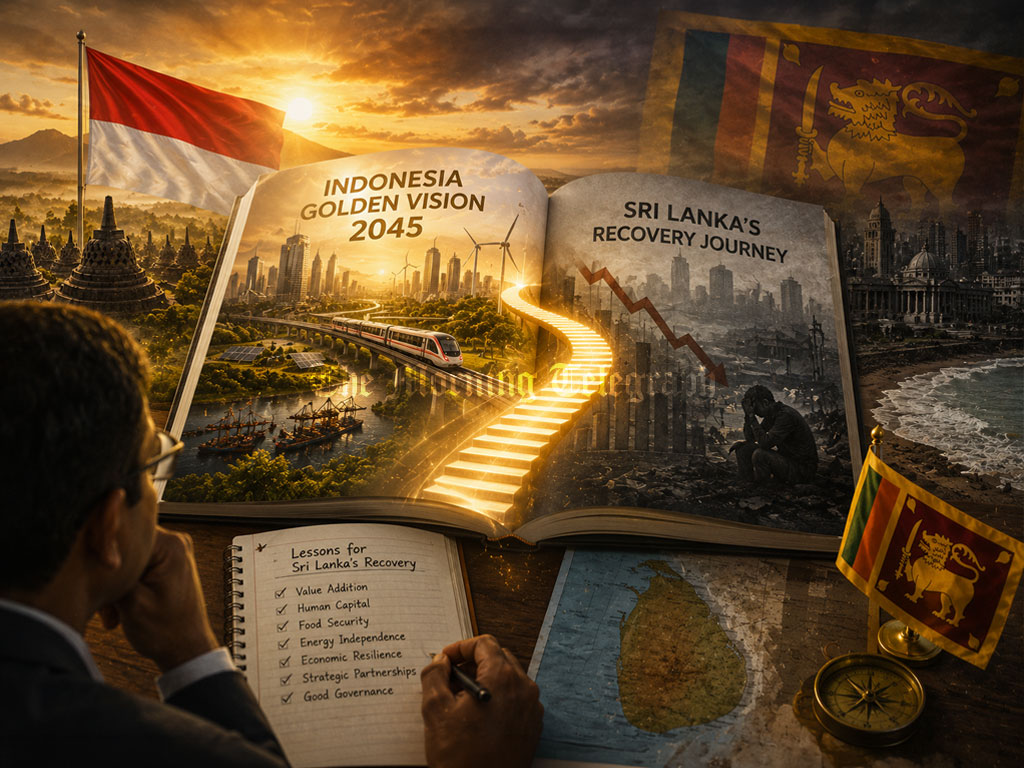
Indonesia Golden Vision 2045 shows how natural wealth, human capital and strategic partnerships can guide Sri Lanka’s recovery path.
Indonesia Golden Vision 2045 offers important lessons for Sri Lanka as Jakarta turns natural wealth, human capital and strategic partnerships into a national transformation roadmap.
At a recent Ambassadors’ Roundtable in Colombo, hosted as part of the Pathfinder Foundation’s premier diplomatic and policy dialogue series, Dewi Gustina Tobing, Indonesian Ambassador to Sri Lanka and accredited to the Maldives, presented Indonesia’s long-term development journey toward becoming a high-income, prosperous and globally influential nation by 2045.
Addressing diplomats, policymakers, academics, think tank representatives and members of the media, Ambassador Tobing outlined Indonesia’s transformation agenda while also highlighting opportunities for deeper cooperation between Indonesia and Sri Lanka as neighbouring Indian Ocean nations linked by history, geography and shared aspirations.

The Ambassador began by stressing why Sri Lanka should understand Indonesia’s future direction, noting that “it is important for Sri Lanka, as a good friend of Indonesia, to know about your neighbour, because we are neighbours connected by the sea.”
Her presentation focused on Indonesia’s “Golden Vision 2045”, a national ambition timed to coincide with the centenary of Indonesia’s independence, when the country hopes to become one of the world’s leading economies.
“Why do we call it the Golden Vision 2045?” she asked. “Because in this year, it is predicted that Indonesia is going to be the biggest economy in the world.”
She stressed, however, that such an ambition requires gradual and carefully planned transformation, supported by reforms implemented today.
Ambassador Tobing explained that Indonesia has entered a new phase of national development under President Prabowo Subianto, building on earlier development foundations while introducing new priorities to prepare the country for future challenges.
Indonesia today, she noted, is the largest economy in Southeast Asia, with a gross domestic product of about US$1.4 trillion and a population of more than 280 million people.
Despite uncertainty in the global economy, Indonesia has maintained resilience, recording growth of around 5 percent in recent years.
However, she warned that economic growth alone cannot secure long-term prosperity.
“Indonesia recognizes that sustaining growth alone is not enough,” she said. “The challenge is to transform growth into higher productivity, stronger competitiveness and greater prosperity for future generations.”
This transformation, she said, requires investment in people, technology, industrial capacity and national resilience.
A central theme of her address was Indonesia’s effort to move from a resource-based economy toward a value-added and innovation-driven economy.
Ambassador Tobing explained that although Indonesia possesses enormous natural resources, it has historically faced the challenge of exporting raw commodities without capturing enough economic value.
The current policy direction is therefore focused on “downstreaming” — processing resources domestically before export to create industries, generate employment and attract investment.
She highlighted nickel as one of the most successful examples of this shift.
“In the past Indonesia primarily exported raw nickel, and today Indonesia has developed a growing downstream ecosystem that includes smelters, stainless steel production, battery materials and electric vehicle supply chains,” she said.
Indonesia’s approach has positioned the country as an increasingly important player in the global electric vehicle industry.
The Ambassador drew attention to Indonesia’s resource advantages, noting that the country is the world’s largest producer of palm oil, accounting for around half of global production.
Indonesia also holds approximately 42 percent of the world’s nickel reserves and produces around 30 percent of global nickel output.
It also possesses significant reserves of gold, coal and other strategic resources.
But she explained that the objective is no longer simply to export these resources.
“What we are doing is not sending raw materials, but how to generate this raw material to be processed within the country and have value addition, which attracts more investment coming to Indonesia.”
Another important part of Indonesia’s transformation strategy is strengthening national control over natural resource revenues.
Ambassador Tobing explained that Indonesia has introduced policies requiring export earnings from strategic commodities to contribute more directly to the domestic economy.
“The export of Indonesian resources, including palm oil, nickel and ferroalloy, is obliged to bring the reserve to come to Indonesia and maintain it for one year in order to bring benefit to Indonesia,” she said.
Such measures, she argued, are designed to strengthen foreign exchange reserves, support currency stability and ensure that natural wealth benefits Indonesian society.
Human capital development was another major pillar of the presentation.
She stressed that Indonesia’s large population can become a demographic advantage only if citizens are healthy, educated and equipped with future-oriented skills.
“No country can become advanced if its people are not healthy, educated, productive and prepared for the future,” she stated.
In this context, Ambassador Tobing highlighted the government’s Free Nutritious Meal Programme, which provides nutritional support to students, pregnant women, breastfeeding mothers and young children.
She described nutrition as a foundation for future productivity, explaining that investment in children’s health and education is essential to building a competitive workforce capable of supporting Indonesia’s 2045 ambitions.
Food and energy security also hold a central place in Indonesia’s development planning.
The Ambassador explained that global disruptions, climate change and geopolitical tensions have made self-reliance in essential sectors increasingly important.
Indonesia has therefore strengthened agricultural productivity through improved irrigation, fertiliser access, food reserves and support for farmers.
She pointed to Indonesia’s achievements in rice production as evidence of this strategy.
In 2025, Indonesia recorded rice production of approximately 34.7 million tonnes and achieved a surplus of around 3.5 million tonnes, reducing its dependence on imports.
“Many years we imported rice to supply our domestic consumption,” she explained, adding that Indonesia had now reached a point where domestic production could meet national needs.
Energy independence is being pursued through similar measures.
Ambassador Tobing highlighted Indonesia’s biodiesel programme, explaining that the country is expanding palm-based biodiesel blending to reduce dependence on imported fuel.
“By 1st July this year, Indonesia will not import biodiesel. We can supply through our domestic production,” she said.
Indonesia is also exploring conversion from LPG to cleaner gas alternatives such as CNG and LNG, using domestic resources to strengthen energy security.
The Ambassador explained that Indonesia’s Golden Vision 2045 rests on four broad pillars: human development and mastery of science and technology; sustainable economic development; equitable development; and national resilience and governance.
These pillars reflect Indonesia’s ambition not merely to achieve higher economic growth, but to build an inclusive and sustainable society.
“Ultimately, Indonesia’s objective is not to achieve higher economic growth, but to ensure that development is inclusive, sustainable and beneficial for future generations,” she said.
By 2045, Indonesia aims to become a high-income country with a projected gross domestic product between US$9.1 trillion and US$9.8 trillion, while ranking among the world’s largest economies.
Turning to Indonesia-Sri Lanka relations, Ambassador Tobing said both countries share many similarities and opportunities for cooperation.
As fellow Indian Ocean nations, Indonesia and Sri Lanka have common interests in trade, investment, connectivity and regional stability.
Bilateral trade, she noted, continues to expand, with Sri Lankan imports from Indonesia reaching significant levels.
She rejected the idea that the two economies should be viewed mainly as competitors.
Instead, she described the relationship as complementary.
“I don’t really see it as competing each other. More to complementary, if I could say,” she explained.
She pointed to examples such as Sri Lanka importing Indonesian coconut oil for further processing and export, showing how supply chains between the two countries can create mutual benefits.
Ambassador Tobing also highlighted ongoing discussions on a preferential trade agreement between Indonesia and Sri Lanka, describing it as a mechanism that could further strengthen economic links.
“By having the preferential trade agreement, the industry will be more competitive in the future,” she said.
On Sri Lanka’s own economic challenges, particularly foreign exchange reserves and dependence on imports, the Ambassador shared lessons from Indonesia’s experience.
She explained that Indonesia improved its economic resilience by managing resources more effectively, increasing value addition and reducing unnecessary dependence on imports.
She encouraged Sri Lanka to maximise its own strengths, particularly agriculture.
“For me, the most easiest one is to manage what you have now, like agriculture,” she said. “How to increase productivity? How to manage well the plantation? So it will bring two things: you can supply yourself and you can reduce import.”
The Ambassador also discussed Indonesia’s role in ASEAN and its wider foreign policy approach.
She described ASEAN as “one of the most successful regional cooperation” mechanisms and emphasised Indonesia’s commitment to ASEAN centrality, openness and a rules-based regional order.
Indonesia’s foreign policy, she explained, remains based on independence and balance.
“Indonesia since the beginning of independence, we are a free and independent country,” she said. “We don’t go to any sides.”
She described Indonesia’s diplomatic philosophy through the phrase: “One enemy is too much, a thousand friends is too little.”
This approach, she argued, allows Indonesia to engage constructively with all countries while promoting peace and stability.
Addressing questions on social cohesion, Ambassador Tobing highlighted Indonesia’s diversity and the role of Pancasila, the country’s foundational philosophy, in maintaining unity.
With more than 600 dialects and multiple religious communities, Indonesia’s unity comes from shared national identity and common values.
“Even though we are very diverse in many things, what unites us is Indonesia,” she said.
For Sri Lanka, Ambassador Tobing’s message was clear: economic strength, social cohesion and strategic relevance must be built through domestic resilience.
Geography alone does not automatically create influence; countries must develop their internal capabilities.
As she observed, “a country has to be able to develop, to bring itself to be important.”
Indonesia’s Golden Vision 2045 is therefore not simply an economic plan.
It represents a broader national transformation built around human development, economic independence, resource management and international engagement.
For Sri Lanka, the Indonesian experience offers important lessons as the country seeks its own path toward recovery, resilience and sustainable growth.
As Ambassador Tobing concluded, Indonesia looks forward to working closely with Sri Lanka “to promote shared prosperity, strengthen regional cooperation and contribute to a more stable and resilient Indian Ocean region.”
The future of both nations, she suggested, lies not only in their individual ambitions, but also in their ability to work together as partners in a rapidly changing world.