
By Roshan Jayasinghe
A lifetime spent watching communication evolve from handwritten letters and telex messages to smartphones and artificial intelligence has left me with a simple observation. The tools keep changing. Human beings do not. This reflection began with a slogan seen during a FIFA World Cup match and became a journey through communication, connection, and the things that continue to matter regardless of the technology we use.
Every now and then I come across something very simple that stays with me for reasons I do not immediately understand. It might be a conversation, a moment during a ride, something I observe in nature, or sometimes just a few words that happen to catch my attention. A few days ago, while watching a FIFA World Cup match, I noticed a slogan that read, “The best reason to go online is to go offline.” It was only a brief message on a screen, yet I found myself thinking about it long after the match had ended. The more I reflected on those words, the more they seemed connected to many experiences throughout my own life.

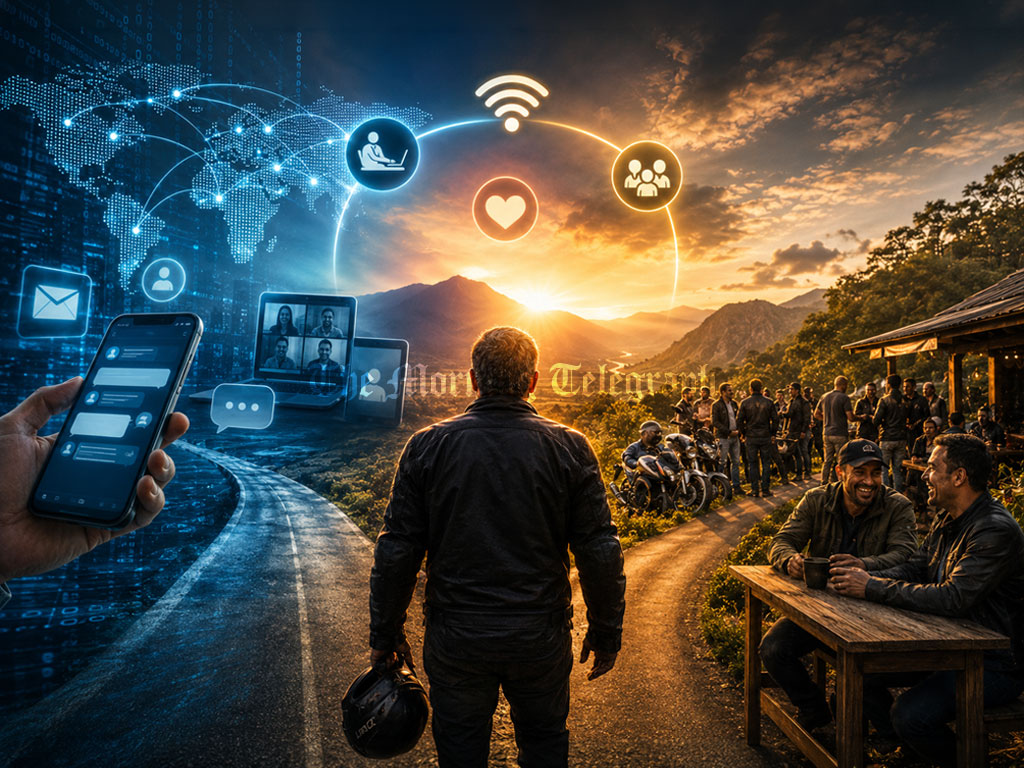
The first light I see on many mornings is often the glow of a phone screen. Like many people, one of the first things I do is check messages that may have arrived overnight and take a quick look at what is happening in the world around me. During the workweek, that might mean reviewing the day’s schedule, checking traffic conditions, and preparing for customer visits. On weekends, when a motorcycle ride may be part of the day ahead, I find myself checking the weather, looking at temperatures along different routes, and exploring roads and points of interest through the Rever app. A few messages may go back and forth between riding friends as plans begin to take shape. Within a matter of minutes, information that once required maps, phone calls, and local knowledge becomes readily available, helping turn an idea into a journey.
Whether I am driving to a customer location during the week or heading out on a motorcycle ride during the weekend, the phone comes with me. It serves as a GPS, traffic monitor, weather source, music player, and communication device. Messages arrive. Routes adjust. Traffic conditions change. Important calls occasionally need attention. The technology remains part of the day, and I appreciate what it makes possible.
Yet as the miles pass beneath the wheels, something interesting begins to happen. The technology quietly moves into the background while the experience itself moves into the foreground. The GPS can show me where I am, but it cannot feel the cool air flowing across an open road. The weather application may have predicted the temperature, but it cannot experience the changing scent of the landscape as the route winds through hills, valleys, neighborhoods, and open country. The music may accompany the journey, but it cannot replace the sensation of being fully present within it. The tools continue doing their jobs, but my attention increasingly belongs to the world unfolding around me.
One of the privileges of spending so much time on the road is the opportunity to observe people. During the workweek I visit businesses and speak with owners, managers, employees, and customers; on weekends I meet riders at roadside gathering spots, coffee shops, gas stations, and scenic overlooks. The settings are different, but I have come to expect the same thing from both. A conversation that was supposed to take a minute takes twenty, and neither of us is in any hurry to end it.
Along many of the roads frequented by riders there are familiar places where people naturally gather. What begins as a short stop often turns into conversations that last far longer than anyone intended. Riders compare motorcycles, discuss modifications, debate tire choices and suspension settings, share routes and destinations, and exchange stories from places they have traveled. One rider may have just returned from a multi-state journey while another is planning one. There is always something to learn because every rider arrives carrying a different experience and a different way of seeing the same road.
What has always struck me is how quickly a stranger in one of those roadside gatherings becomes something more. A shared passion creates common ground before a single name has been exchanged. Someone notices a mechanical issue you had overlooked. Another rider offers advice gained from years of experience. Phone numbers are exchanged. Future rides are planned. A rider who arrived alone can leave knowing there are people expecting to see him again next weekend. The motorcycles bring us together, but it is the human connection that brings us back.
As I reflected on the World Cup slogan, I found myself thinking about how much communication has changed during my lifetime. Long before mobile phones, computers, and the internet, people wrote letters by hand. Those letters were carried by postal services, ships, trains, and couriers. Sometimes weeks or months passed before a response arrived. Yet people wrote anyway, and waited, because the alternative was silence. The technology was simple, but what it carried was not.
When I entered the workforce, I witnessed another stage in that evolution. I still remember writing brief messages to overseas suppliers and handing them to a telex operator for transmission. Telex communication had its own language. Messages were kept short, direct, and economical. At times the operator would even adjust the wording I had written so it would be more effective in telex format. It was a very different way of communicating from what we know today. Then came the fax machine, and suddenly we could write complete sentences on a sheet of paper and watch that exact page arrive on the other side of the world. I still remember how remarkable that felt. The message no longer had to be translated into a special format. What you wrote was exactly what the recipient received. What once required careful abbreviation and interpretation could now be communicated much more naturally, and it felt like a significant step forward.
The years that followed brought computers, email, digital photographs, mobile phones, smartphones, social media, and now artificial intelligence, and looking back it astonishes me how much has changed inside a single lifetime, the speed of it, the collapse of distance, the sheer ease of reaching anyone anywhere, while the thing underneath never moved at all. I still wanted what I had wanted standing beside that telex operator, carefully choosing words that would eventually travel across the world: to reach a person on the other side of a distance, and to be reached in return.
Today I find myself using artificial intelligence to help organize and communicate thoughts that might otherwise remain trapped inside my own mind. I have never considered myself a writer in the traditional sense. I am simply a person who observes life, asks questions, reflects on experiences, and wonders about the human condition. Technology now allows those thoughts to be shaped into articles that can be shared with others. For me, that is not a replacement for human thought. It is an extension of it.
Looking back across those years, from handwritten letters to telex messages, from fax machines to email, from smartphones to artificial intelligence, I find myself arriving at a simple realization. The tools changed. The speed changed. The distance changed. Yet the reason we use them remains remarkably familiar. We are still trying to understand one another. We are still trying to share experiences, solve problems, offer guidance, express ideas, maintain relationships, and stay connected to the people who matter to us.
At sixty-two years of age, when I look back across the years, I realize that the moments I value most were never defined by the technology available at the time. They were defined by the people, by family and friends, by colleagues and riding partners, by mentors who took the time, by customers, and by complete strangers whose kindness arrived at exactly the moment it was needed. By the conversations that changed how I saw a thing, the lessons that only experience could teach, the chances to help someone, and the quiet gratitude of being helped in return. Technology often made those connections possible, but it was never the connection itself.
The more I watch, the more I think we are fed by something deeper than information. Information can travel instantly around the world. Connection still happens one person at a time, at a roadside, over a cup of coffee, in the twenty minutes neither of us meant to spend.
That is why the slogan stayed with me. The point was never to remain online. It was to use these remarkable tools to find our way back to one another, and then to go and live the life they had helped us arrange.
The tools will keep evolving. Artificial intelligence will improve, and communication will grow faster and more seamless than anything I can presently imagine. Yet I suspect that whatever matters most will stay roughly where it has always been, that I will still ride out on a Saturday morning to stand around with people I am glad to see, and still be grateful when a stranger points out the thing I missed.
Tomorrow morning I will probably do what I often do. I will check my messages, look at the weather, review the route ahead, and send a note to a friend. Then I will head into the day, whether that day leads me toward customers, conversations, mountains, coastlines, or somewhere entirely unexpected. The technology will have done its job. It will have helped me find my way back to the people, the places, and the moments that make a life worth living.
And that, for me, is the best reason to go online.
Author’s Note
When I was younger, I often found myself fascinated by the tools. The motorcycle. The fax machine. The computer. The mobile phone. Every new development seemed to represent progress, and in many ways it did. As the years have passed, however, I find myself becoming increasingly interested in something else. The people using them.
The longer I observe life, the more I realize that every generation believes it is living through extraordinary change, and every generation is right. Yet beneath all that change, I keep arriving at the same small handful of wants, the ones that have not aged at all: to understand and be understood, and to feel I have given something that mattered to someone.
This reflection began with a slogan during a football match, but it ended somewhere entirely different. It reminded me that while our tools may become faster, smarter, and more capable, the responsibility for using them wisely remains with us. Technology can help us communicate. Only human beings can create understanding.
The thoughts shared here are not conclusions. They are simply observations gathered over time, from conversations, motorcycle rides, workplaces, friendships, family life, and the everyday experiences that quietly shape us. If they encourage even a brief moment of reflection about our own relationship with technology, humanity, and one another, then they have served their purpose.
About the Author
Roshan Jayasinghe is a writer and observer of human systems. His work explores the gap between man made constructs and lived humanity, with a focus on how economics, trade and everyday choices intersect with questions of fairness, responsibility and inner alignment. Through essays for publications in The Morning Telegraph, he aims to remind readers that they are not passengers in a fixed machine, but active custodians of a shared world.



Yeah, after working in IT for over 30 years, tools come and go. Life at large still remains the same. Hopefully people use the tools to make life easier and better and not the opposite.