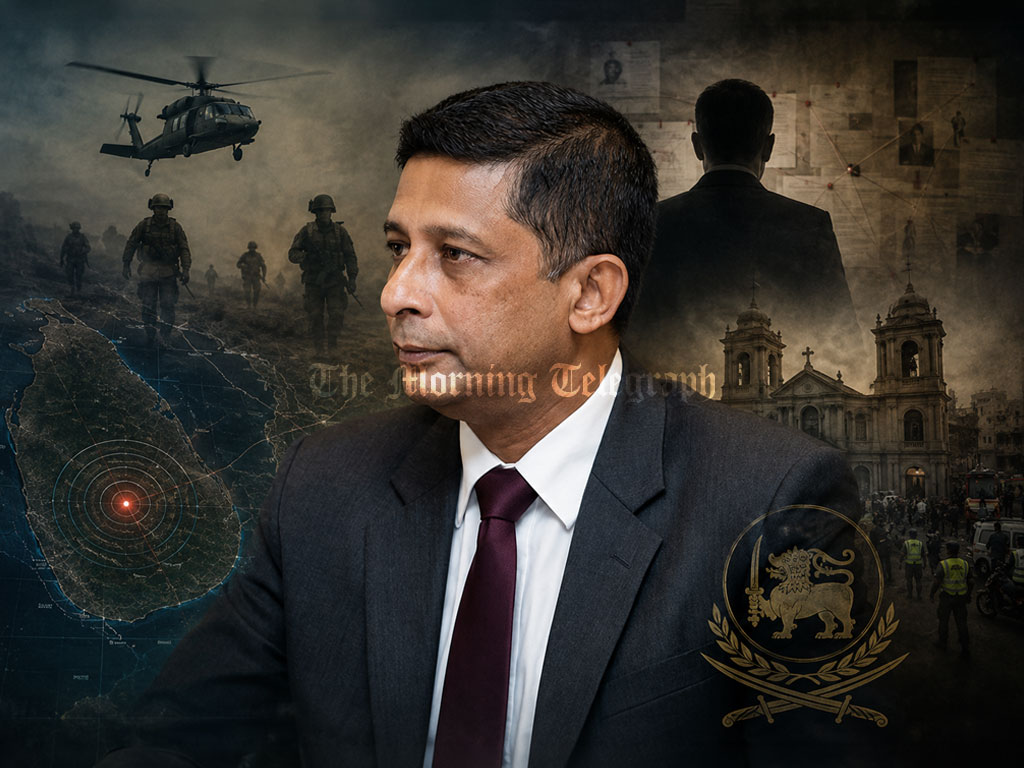
Major General Suresh Sallay’s journey from cadet to intelligence chief is marked by secrecy, sacrifice, controversy, and unanswered questions about the Easter attacks.
The untold story of Major General Suresh Sallay traces his journey from a quiet cadet officer to Sri Lanka’s intelligence chief, a path defined by secrecy, sacrifice, controversy, and unanswered questions that continue to surround his career and his connection to the Easter Sunday attacks.
The following essay is based on the original article published in the Colombo-based newspaper Aruna. The article was originally written in Sinhala by journalist Nirosha Wasala and was based on an interview conducted with retired Major General Upali Rajapaksa, a senior officer of the Sri Lanka Army and a longtime colleague of Major General Suresh Sallay.

Major General Suresh Sallay’s journey in the Sri Lanka Army is a story shaped by dedication, intelligence, discipline, and sacrifice. For a military officer, the uniform represents the highest symbol of honour, duty, and identity. However, there was a period in Major General Suresh Sallay’s career when he was unable to wear that most valuable uniform for a long time. This was not because he was separated from his military responsibilities, but because he was entrusted with a duty considered even more valuable than wearing the uniform itself. Those who serve in intelligence roles often work in civilian clothing rather than in military dress, carrying out responsibilities that remain hidden from public view. Sallay had to put aside the visible symbol of his profession because he became an intelligence officer, working in an area where secrecy, analysis, and strategic thinking were more important than public recognition.
When Suresh Sallay received his commission as a Second Lieutenant 38 years ago, he did not join as an armed intelligence officer because such a dedicated armed intelligence unit did not exist within the Sri Lanka Army at that time. The Army’s armed intelligence structure was established later, during the early part of the decade, under the leadership of Colonel Lionel Balagalla, who would eventually rise to become the Commander of the Sri Lanka Army. Sallay joined the Army through the regular officer recruitment system and entered military life as part of Cadet Officer Recruitment Course No. 27. On March 16, 1987, Suresh Sallay and his colleague Major General Upali Rajapaksa joined the Sri Lanka Army together. Their intake consisted of 76 cadet officers who began their training journey with dreams of serving the country.
Among those 76 young cadets, Suresh Sallay stood out as an exceptionally quiet, innocent, talented, and disciplined individual. According to retired Major General Upali Rajapaksa, Sallay possessed excellent physical fitness and strong mental ability. His name was consistently included among the top ten officers in the course. When Upali Rajapaksa was commissioned as the tenth officer in the course, Suresh Sallay was commissioned as the ninth, which is why he remained a memorable figure among his fellow officers from those early days. The 27th Cadet Officer Recruitment Group, which entered training on March 16, 1987, completed its commissioning on December 10, 1988, officially entering the Sri Lanka Army as commissioned officers. Of the original 76 cadets, approximately 56 successfully received their commissions.
This group later became one of the most respected batches in the history of the Sri Lanka Army. Retired Major General Upali Rajapaksa, speaking about his fellow officer and friend, referred to them as the “Sallay and Upali batch” within Army circles. Many officers from this intake went on to achieve senior ranks and leave lasting marks on the history of the Army. Among them were Major Generals Nishantha Herath, Sujeewa Senarath Yapala, Sanjaya Wanasinghe, Vandika Mahinkanda, Sumith Premalal, Priyantha Gamaghe, Upul Pilapitiya, Ashoka Peiris, Sarada Samarakoon, Champaka Ranasinghe, and Samantha de Silva. Brigadiers Kumara Iswaran and Priyantha Kaldera were also among the notable officers from this group.
One of the most remarkable achievements from this batch belonged to Major General Sanjaya Wanasinghe, who rose to become the second-highest-ranking officer in the Sri Lanka Army as Chief of Staff and later served as Army Commander. His career created a unique historical possibility because his father, General Hamilton Wanasinghe, had also served as a former Commander of the Sri Lanka Army. If considered internationally, such a father-and-son achievement reaching the position of Army Commander would be an extremely rare accomplishment.
The person sharing these memories, retired Major General Upali Rajapaksa, also had an impressive military career of his own. He was an officer of the Commando Regiment and served as the Commander of the 15th Regiment of the Commando Regiment. He later held important positions including the 68th General Officer Commanding of the Directorate of Military Operations and Commander of the Mullaitivu Security Forces. His own experiences in the military gave him a close understanding of Suresh Sallay’s character, abilities, and professional development.
Interestingly, Upali Rajapaksa had originally dreamed of joining the Signal Corps of the Sri Lanka Army. However, he was commissioned as a Second Lieutenant in the Gemunu Watch. At that time, the regiment was commanded by Brigadier Halangoda. After serving approximately one year in the Gemunu Watch under Brigadier Halangoda’s leadership, Sallay received the opportunity to transfer to the Sri Lanka Army Signal Corps, which had been his long-standing ambition. This move became a turning point in his career because it placed him in a field that matched his natural abilities in communication, technology, intelligence, and analysis.
According to Upali Rajapaksa, Suresh Sallay was always more interested in intellectual activities than direct battlefield confrontation. This did not mean that Sallay lacked courage or battlefield ability. During military training, he participated enthusiastically in all activities and never avoided difficult tasks. He was hardworking, committed, and physically capable. However, his greatest strengths were his intelligence, strategic thinking, and ability to analyse situations. Upali explained that while he himself often achieved first place in training activities, there was one area where he could never defeat Sallay: the one-mile run. Whenever they wore sports uniforms and competed in running, Sallay would always overtake him. Although Sallay had a smaller physical appearance, his stamina and physical strength were exceptional.
Upali Rajapaksa described Sallay as a person who was not aggressive or harsh by nature. He was gentle, friendly, and innocent. When conflicts arose, Sallay was not the type of person who immediately sought confrontation. Instead, he believed that defeating an enemy through intelligence, planning, and strategy was more effective than relying only on weapons. This quality reflected the mindset of a leader and strategist, which eventually guided him toward the Signal Corps and later into intelligence service.
During their training period at the Army Academy in Diyatalawa, Upali Rajapaksa also remembered meeting Sallay’s parents. He described them as similarly humble and innocent people. Over the years, various claims and discussions about Sallay’s family background appeared on social media, but Upali strongly criticized attempts to use personal family details to attack Sallay. He explained that such actions were unfair and reflected a low level of public discussion.
Suresh Sallay’s family background is diverse and represents the multicultural nature of Sri Lanka. His father, Tuan Harish Sallay, is of Malay origin, while his mother is Catholic. The Sallay family includes people connected to Muslim, Catholic, and Buddhist traditions. There is a ten-year age difference between his father and mother, and Upali Rajapaksa stated that some individuals had attempted to misuse even this personal information to create criticism against the family.
Suresh Sallay was one of four brothers. He was the second oldest in the family. His elder brother is Tyrone Sallay, the third brother is Selvin Sallay, and the youngest is Ramesh Sallay. According to Upali Rajapaksa, all four brothers were talented, disciplined, and humble individuals. Like his brothers, Suresh Sallay received his education at Mahanama College, Colombo, a Sinhala-medium school. The educational background of the brothers reflected their connection to Sri Lanka’s diverse society.
The Sallay family also had a strong connection with national security services. While many families may choose different professional paths, it was notable that several Sallay brothers selected careers connected to the defence forces. Tyrone Sallay is currently living abroad, while the other brothers also pursued significant careers. Selvin Sallay became a respected officer of the Commando Regiment and contributed to numerous military operations. He was among the survivors of one of the most difficult battles faced by the Commando Regiment. During Operation Jayasikuru, he suffered injuries that eventually led to his retirement from military service on medical grounds. He later documented his experiences by writing the book “The Battle of Mankakulam Through the Eyes of a Commando,” providing insight into the realities of combat from the perspective of a Commando officer.
The youngest brother, Ramesh Sallay, continued his own military career and currently serves as a Major General in the Sri Lanka Army’s Military Police. While one brother selected the Commando Regiment and another joined the Military Police, Suresh Sallay moved from the Gemunu Watch to the Signal Corps and later made another important career decision by entering the Armed Intelligence Corps. His exceptional abilities, including his knowledge of several languages such as Tamil, were considered important factors that contributed to his selection for intelligence duties.
Suresh Sallay’s transition into intelligence work marked a significant stage in his military career. His ability to understand complex situations, communicate effectively, and analyse information made him well suited for a role where patience, observation, and strategic thinking were essential. His professional path moved beyond conventional military duties and into an area where success often depended on actions that could not be publicly acknowledged. Intelligence officers frequently work behind the scenes, and many of their contributions remain unknown because revealing operational details could compromise national security.
Retired Major General Upali Rajapaksa recalled several important stages in Sallay’s career development. According to him, Sallay became a Major around June 1996 and remained in that rank for approximately ten years. Upali Rajapaksa himself also spent around fourteen years as a Major, allowing him to understand the professional challenges and experiences that come with that stage of an officer’s career. He strongly rejected claims made by some individuals that Sallay did not contribute to military operations during the war period. According to Upali, such statements were completely false.
He explained that Suresh Sallay was an intelligence officer, and because of the confidential nature of intelligence operations, details of his work could not be publicly revealed. However, Upali emphasized that Sallay contributed to national security efforts during the conflict period. Intelligence officers play a different role from frontline soldiers, and their contributions are often invisible to the public. Their work involves gathering information, analysing threats, supporting operational decisions, and preventing attacks before they happen.
Major General Suresh Sallay also played a role in efforts to defeat LTTE terrorism through his intelligence responsibilities. His contribution was not limited to battlefield operations but extended into strategic intelligence activities that supported military success. After the end of the war in 2009, Upali Rajapaksa stated that Sallay played an important role in preventing attempts by the LTTE network to rebuild itself in the Vanni region. However, because such activities involved sensitive intelligence matters, he said he could not reveal further information about those operations.
Following his military service and intelligence responsibilities during the war, Sallay participated in several overseas training programmes that further developed his professional knowledge. His career gradually expanded into international security and diplomatic responsibilities. From 2006 to 2009, he served in the diplomatic field as the First Secretary at the Sri Lankan Embassy in Paris, France. This assignment allowed him to gain international exposure and understand global security networks from a diplomatic perspective.
Later, from 2012 to 2016, Suresh Sallay served as the Head of the Army Intelligence Division and Director of the Army Intelligence Directorate. This was a major responsibility that placed him at the centre of intelligence coordination within the Sri Lanka Army. His experience, knowledge, and ability to handle complex security issues strengthened his reputation as an intelligence professional.
From 2016 to 2018, Sallay again served in a diplomatic capacity, this time as a Ministerial Advisor at the Sri Lankan High Commission in Malaysia. During this period, he continued to develop international connections and gain knowledge about security issues beyond Sri Lanka’s borders. According to Upali Rajapaksa, these experiences were valuable because modern security threats often extend beyond national boundaries and require international cooperation.
In late 2018, Suresh Sallay received an opportunity to attend the National Defence College course in New Delhi, India. According to Upali Rajapaksa, Army Commander Mahesh Senanayake was appointed as the new Chief of Defence Staff during this period, and Sallay became aware that he had an opportunity to participate in the prestigious course based on his qualifications and professional background. Sallay returned to Sri Lanka at the end of 2018, completed the necessary arrangements, and travelled to India within approximately two weeks. Two other Sri Lankan officers also attended the course with him.
The National Defence College course included around 130 students, and Suresh Sallay achieved an outstanding result by being selected among the five best students. His research work prepared during the course received recognition and won the award for the best research thesis submitted by a student. This achievement reflected his intellectual ability, research skills, and understanding of national and international security issues.
Sallay successfully completed the advanced security studies programme from January to November 2019 and returned to Sri Lanka in late 2019. By that time, the Easter Sunday attacks had already taken place. Discussions later emerged claiming that Sallay had been seen in Mannar in March 2019. However, according to Upali Rajapaksa, this claim was impossible because Sallay was attending the course in India during that period. He stated that anyone could verify Sallay’s movements and confirm when he travelled to Sri Lanka while attending the programme.
When Sallay returned to Sri Lanka, Gotabaya Rajapaksa had become President. Due to Sallay’s qualifications, his success at the National Defence College, and his previous experience as Director of Army Intelligence, President Gotabaya Rajapaksa appointed him as the Chief of State Intelligence Service. This appointment was historically significant because, according to the information provided by Upali Rajapaksa, it was the first time a military intelligence officer had been appointed to lead an institution that had traditionally been headed by senior police officers.
By the time of this appointment, the Easter attacks had already occurred. Sallay’s responsibilities included addressing national security concerns and dealing with international terrorist networks. According to Upali Rajapaksa, Sallay worked extensively to weaken terrorist financial networks operating internationally, including efforts connected to countries such as France and Malaysia. He described Sallay’s approach as careful, systematic, and highly professional.
Major General Suresh Sallay’s career has therefore included many different forms of service: battlefield intelligence, military communication, diplomatic assignments, international training, and leadership in national intelligence. His supporters argue that his contributions to national security were significant, even though many details remain confidential because of the nature of intelligence work.
However, in 2024, following political changes in Sri Lanka, Major General Suresh Sallay was removed from his position as Director General of State Intelligence Service. After retiring from intelligence service in late 2024, he briefly served as a senior member of a leading policymaking body in Sri Lanka.
Retired Major General Upali Rajapaksa also addressed allegations and public discussions surrounding Sallay’s connection to the Easter Sunday attacks. He stated that Sallay was not in Sri Lanka during the period when the attacks occurred and that this fact could be verified through proper investigation. He emphasized that he had no objection to investigations being conducted to identify the masterminds behind the Easter attacks or to legal action being taken against anyone proven guilty.
However, Upali Rajapaksa stressed that Suresh Sallay had not been convicted of any crime and therefore deserved to be treated fairly and humanely. He stated that investigations and legal procedures must continue according to the law, but society should not declare someone guilty before evidence and legal judgment establish responsibility.
He emphasized that if any individual has committed a crime, the law must apply equally to that person. There should be no interference with legal proceedings. At the same time, he argued that protecting human dignity during investigations is a fundamental responsibility of any civilized society. According to him, destroying a person’s reputation and character before guilt is proven is itself an act of injustice.
Upali Rajapaksa expressed sadness that someone who had dedicated decades of service to the country was being publicly condemned before a legal conclusion had been reached. He described Suresh Sallay as a close friend and a colleague who had sacrificed much while serving Sri Lanka. He stated that Sallay’s intelligence capabilities had contributed to national security efforts during difficult periods of the country’s history.
Upali Rajapaksa further explained that during the long years when Sri Lanka faced the threat of terrorism, officers like Suresh Sallay worked under extremely difficult conditions. Their responsibilities often required personal sacrifice, secrecy, and dedication without expecting public recognition. Intelligence officers rarely receive the same visibility as soldiers who fight openly on the battlefield, but their work is equally important because their information and analysis often determine the success or failure of military and national security operations.
He stated that while the country had experienced the suffering caused by the Easter Sunday attacks and the devastating consequences of the thirty-year war, it was important not to allow anger and grief to replace justice and fairness. The pain caused by terrorism affected all communities, and those responsible for such crimes must be identified and punished according to the law. However, according to Upali Rajapaksa, accusing individuals without confirmed evidence and treating them as criminals before a legal decision damages the principles of justice.
He strongly rejected the idea that Suresh Sallay could have contributed to a crime such as the Easter attacks. Upali said that, based on his personal knowledge of Sallay’s character, discipline, and professional conduct over many decades, he found it extremely difficult to believe that Sallay would participate in such an act even through a single word or instruction. He emphasized that his belief was not based simply on friendship but on years of observing Sallay as a fellow officer, colleague, and member of the same military intake.
According to Upali Rajapaksa, Suresh Sallay had always served the country rather than any individual or political group. He believed that Sallay performed his duties for the Republic of Sri Lanka and for whichever government leadership was officially in power at the time. In his view, a professional military officer’s responsibility is to the state, not to personal interests or political personalities. He expressed confidence that Sallay would have carried out his responsibilities regardless of who governed the country.
Upali also criticized the manner in which some members of society had attacked Sallay personally. He said that discussions about Sallay’s family background, including details about the ages of his parents and wife, were unnecessary and cruel. He argued that such personal attacks had nothing to do with determining whether someone was guilty or innocent of a serious allegation. According to him, investigations should focus on evidence, facts, and legal procedures rather than emotional attacks against an individual and his family.
He described Suresh Sallay as a highly intelligent person who reached the position of Chief of State Intelligence because of his abilities, professional experience, and dedication. According to Upali, Sallay’s achievements were not the result of personal influence but the outcome of years of training, service, and commitment. His career progression from a young officer in the Gemunu Watch, to the Signal Corps, to intelligence leadership demonstrated his adaptability and professional excellence.
Upali Rajapaksa repeatedly emphasized that he was not asking for special treatment for Sallay. He stated clearly that if any person, including a military officer, commits a crime, that individual must face the consequences under the law. No position, rank, or past service should provide protection from justice. However, he believed that justice must be based on evidence and that every person has the right to be considered innocent until proven guilty.
He said that society must maintain humanity during investigations and legal proceedings. According to him, there is a moral responsibility to treat every individual with dignity and respect while allegations are being examined. A person’s reputation and life should not be destroyed by public judgment before the legal process is complete. He described this as an important principle that separates justice from revenge.
Upali Rajapaksa also reflected on the sacrifices made by members of the Sri Lanka security forces during the thirty-year conflict. Thousands of military personnel lost their lives while fighting to protect the country, and many others suffered injuries and lifelong consequences. He expressed sadness that after such sacrifices, some members of the security forces faced accusations and criticism related to wartime conduct. He believed that those who served the country deserved fair treatment and recognition for their contributions.
He stated that he was deeply troubled by what he considered unfair treatment of Suresh Sallay. In his opinion, Sallay had dedicated his life to national service and had made significant contributions during a period when Sri Lanka faced serious security challenges. He questioned how society could label someone as guilty before the completion of a proper legal process.
According to Upali Rajapaksa, the same society that suffered because of terrorism and war should also understand the importance of justice and fairness. He expressed concern that some people appeared to show intense hatred toward Sallay, even greater than the anger directed at former LTTE leader Velupillai Prabhakaran, who led a violent separatist movement responsible for thousands of deaths. Upali said he could not understand such hostility toward Sallay without proven evidence of wrongdoing.
He explained that if Sallay had committed any offence, there was a proper way to determine the truth. Investigations should be carried out, evidence should be examined, and courts should make decisions. Until then, he believed that public condemnation was unfair and harmful. He repeated that the legal system must decide guilt or innocence, not public opinion.
Major General Suresh Sallay’s career represents a different kind of military service, one that depended not only on physical courage but also on intelligence, patience, and strategic thinking. From his early days as a quiet and talented cadet officer, he developed into a senior intelligence professional who served in important national and international positions. His career included military operations, intelligence leadership, diplomatic responsibilities, and advanced security studies.
His journey also reflects the diversity of Sri Lanka itself. Coming from a multicultural family background and receiving education in a Sinhala school, Sallay represented the ability of individuals from different communities to contribute to national institutions. His brothers’ own careers in the security forces further demonstrate the family’s connection to military service and national duty.
Despite the controversy surrounding him in later years, his supporters, including Major General Upali Rajapaksa, continue to highlight his professional achievements and personal character. They believe that his long years of service, dedication, and intelligence contributions should be considered alongside any allegations made against him. At the same time, they acknowledge that the law must determine the truth through proper investigation.
The relationship between Suresh Sallay and his fellow officers from Cadet Officer Recruitment Course No. 27 has remained strong despite the passage of decades. Every year, military groups traditionally gather to remember their shared experiences and strengthen their bonds. The 27th Cadet Officer Recruitment Group meets annually on March 16, the date they first joined the Army. However, according to Upali Rajapaksa, there were occasions when Sallay did not attend these gatherings. He believed that Sallay may have sensed potential risks and therefore became more cautious about appearing publicly.
As the group approached its 40th anniversary, Upali Rajapaksa expressed his hope that Suresh Sallay would be able to attend the celebration scheduled for March 16 of the following year. For him, such a gathering would represent not only a reunion of former cadets but also an opportunity to recognize the bond created through decades of shared military service.
Upali stated that he considered Suresh Sallay a person of exceptional value and often said that Sallay was a more valuable individual than himself. He repeated that he did not oppose justice or legal action against anyone who committed a crime. His concern was only that justice should be based on facts and that individuals should not be condemned without proof.
He expressed hope that if Sallay was innocent, the legal process would eventually establish that truth. However, he also questioned who would compensate for the personal suffering, emotional pain, and damage to reputation caused during a period of accusation if it was later proven that no crime had been committed. For this reason, he appealed for humanity and fairness throughout the process.
According to Upali Rajapaksa, the last time he met Suresh Sallay was approximately five years earlier. Over time, Sallay had even missed several informal gatherings with his former colleagues. Despite this distance, the respect and friendship among members of the 27th Cadet Officer Recruitment Group remained strong.
Retired Major General Upali Rajapaksa’s final hope was that Major General Suresh Sallay would be cleared of all allegations through proper legal procedures and would once again be able to stand alongside his fellow officers at the 40th anniversary celebration of their cadet intake. For those who served with him, Suresh Sallay remains not only a former intelligence chief or a senior military officer, but also a friend, colleague, and fellow soldier whose life has been closely connected with the history of the Sri Lanka Army.
SOURCE :- SRI LANKA GUARDIAN