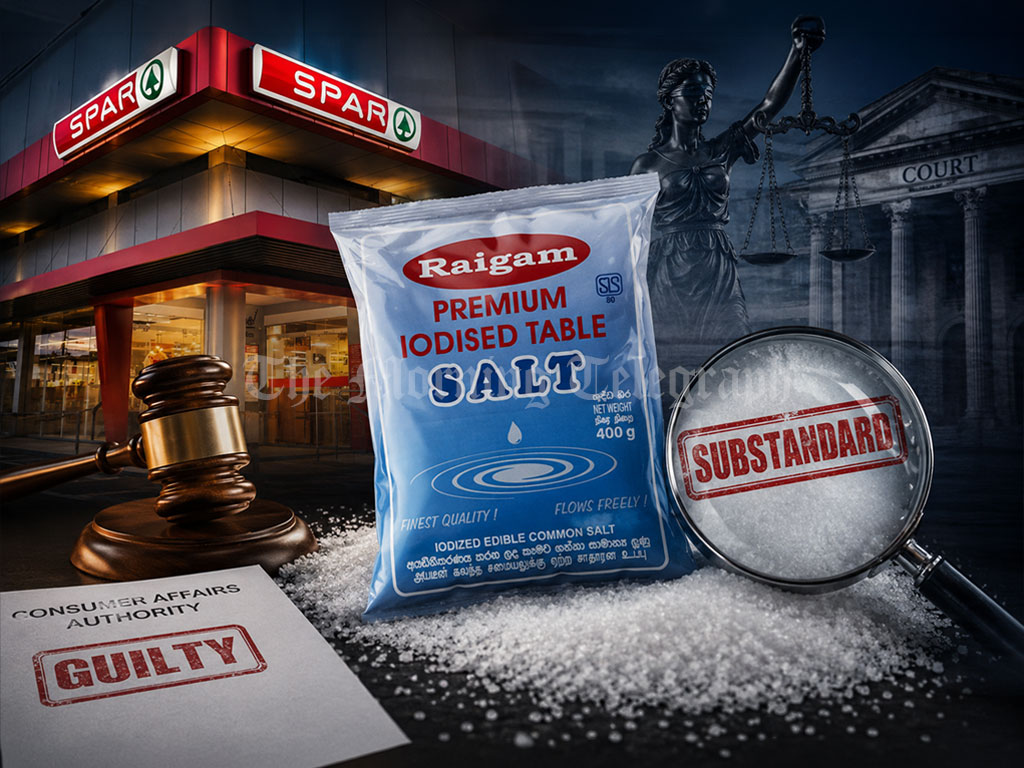
Raigam SPAR salt scam exposes substandard salt sales, court fines, brand deception, and urgent consumer warnings in Sri Lanka.
Raigam SPAR salt scam has exposed how consumer trust in major brands and supermarket chains can be damaged when product quality is sacrificed for profit.
When purchasing a product, Sri Lankan consumers often place their confidence in the brand name and the reputation of the store selling it. This trust becomes even stronger when the product is sold through an international supermarket chain and manufactured by a local company that has been familiar to Sri Lankan households for decades.
However, a recent ruling by the Colombo Chief Magistrate’s Court has clearly shown that such trust can be exploited when money and profit are placed above consumer health, safety, and financial protection.
The matter came to light after “SPAR Sri Lanka Private Company,” better known as SPAR Supermarket, and “Raigama Wayamba Salterns Private Company,” a leading local salt manufacturer, were found guilty and fined Rs. 200,000 each for manufacturing and selling substandard salt.

How The Fraud Was Caught
This serious consumer fraud was uncovered after the Sri Lanka Consumer Affairs Authority carried out a sudden raid at the SPAR supermarket located in Union Place, Colombo 02.
Samples of powdered salt were taken and sent to the Government Analyst for testing. According to the analyst’s reports, the salt samples failed to meet the SLSI 80:2019 national standards required for products supplied to consumers, confirming that the salt was substandard.
Accordingly, both the manufacturer and the distributor were produced before court. They pleaded guilty to charges of deceiving and misleading consumers, in violation of Sections 30 and 31 of the Consumer Affairs Authority Act.
Profit Over Quality
This incident cannot be treated as just another isolated court case. It reflects a worrying reality within Sri Lanka’s present corporate sector.
Even companies that have gained strong brand recognition in the market and become deeply connected to the daily lives of people are now gradually compromising product quality in order to increase profit margins.
Rising raw material costs or the wider economic crisis cannot be used as excuses for such conduct. When a consumer walks into a supermarket and pays a higher price for a branded product instead of buying from a regular shop, that decision is based on trust in quality and safety.
If that trust is betrayed even through an essential food item like salt, which people consume every day, it represents a serious collapse in corporate ethics.
Awards Cannot Replace Public Trust
Today, many companies spend millions of rupees each year on lavish award ceremonies held at star-class hotels. Others obtain awards such as “Brand of the Year” or “Most Trusted Brand” from different organizations and proudly display them on television screens, newspapers, and advertisements.
These awards are then used to create a powerful illusion around the brand, further drawing consumers into believing that the product is unquestionably reliable.
However, the greatest lesson from this case is that no amount of advertising, public relations campaigns, or grand award ceremonies can replace genuine product quality.
The real “public award” is not bought on a stage. It is earned and protected only through proper standards, honesty, and consistent quality.
Companies that mislead the public with substandard products may eventually face court fines, legal costs, and public humiliation.
A Warning For Consumers
The Consumer Affairs Authority deserves public appreciation for taking legal action against major companies such as Raigam and SPAR.
This case confirms that the law applies equally to all, regardless of brand power, market position, or public image.
Still, consumers also carry a responsibility to remain alert. It has now been proven that products sold by a well-known company or a reputed supermarket cannot be blindly trusted as 100% correct.
Therefore, if you notice poor quality, misleading claims, or any form of consumer deception in the products you purchase, do not hesitate to immediately inform the Consumer Affairs Authority through the shortcode 1977 during office hours.
Only through public vigilance can consumers protect both their money and their health from those who exploit trust for profit.