Vijay Eswaran’s Asia Capital stake raises fresh questions over QNet claims, corporate veils, UBO gaps, and Sri Lanka’s regulators.
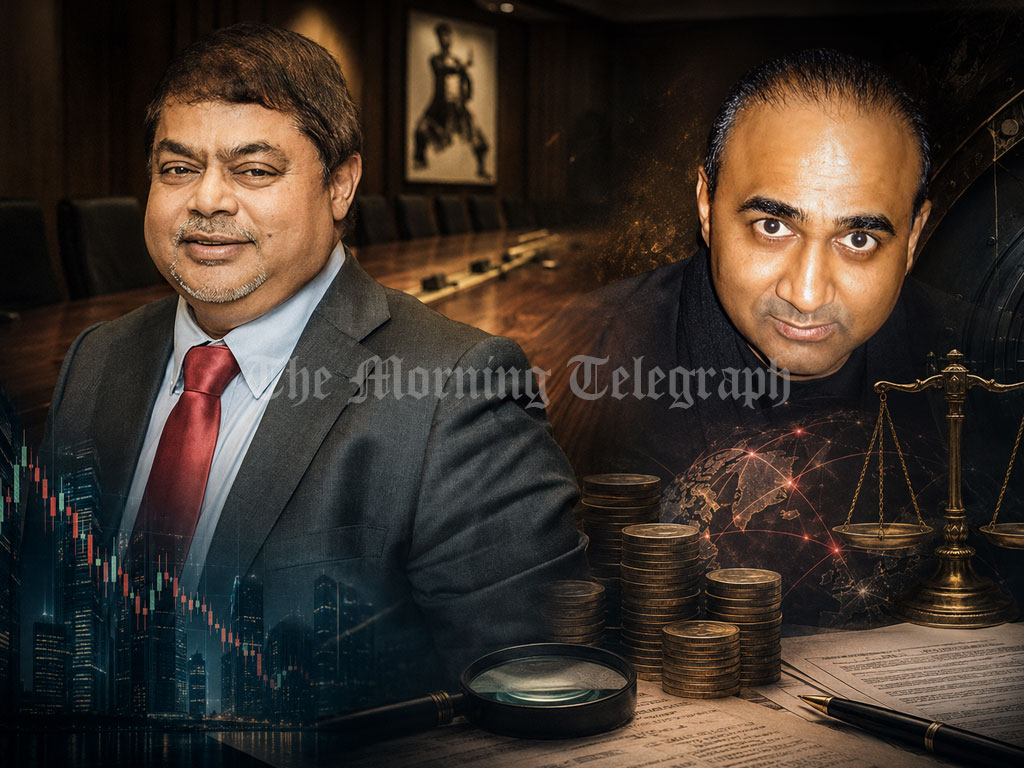
Vijay Eswaran and his assets in Sri Lanka’s capital market have raised serious questions over regulation, corporate ownership, and whether the law is strong enough to stop internationally accused businessmen from earning profits inside the country.
A Legal Loophole Or The Corporate Veil?
When examining certain corporate transactions operating inside Sri Lanka’s capital market and financial regulatory structure, the law often appears like a spider’s web. Small insects get trapped and perish, while large-scale fraudsters break through and move on.
The legal and financial complexities surrounding Asia Capital PLC, a prominent company listed on the Colombo Stock Exchange, and its majority shareholder, Malaysian national Vijeyeswaran S. Vijeyaratnam, also known as Vijay Eswaran, appear to perfectly illustrate this theory.
How is Vijay Eswaran, against whom international pyramid scheme and money laundering allegations have been made, and against whom arrest warrants have reportedly been issued in several countries including India, still able to hold 71.6% majority ownership of a legally listed company in Sri Lanka and earn profits?
Is this a loophole in Sri Lankan law? Or is it a highly subtle and ruthless exploitation of the “Corporate Veil” in company law?

Pyramid Money And The International Hunt
Vijay Eswaran is the founder of QNet, formerly known as QuestNet and GoldQuest, which economists have described as a massive pyramid network spanning more than 100 countries worldwide.
Law enforcement agencies in India, the Philippines, Indonesia, and several African countries have taken strict action against him and entities linked to the network. The Economic Offences Wing of the Mumbai Police in India has even issued lookout circulars against him in connection with an alleged Rs. 425 crore fraud.
Yet, despite the Central Bank of Sri Lanka officially designating QNet as a banned pyramid scheme under the Banking Act No. 30 of 1988, Vijay Eswaran has still been able to dominate a section of the country’s capital market through Asia Capital.
Has the Central Bank of Sri Lanka and the Financial Intelligence Unit been dormant? The truth is that even when regulators enforce the law, modern financial fraudsters are often several steps ahead of domestic legal systems.
The Hidden Face Behind The Corporate Veil
Vijay Eswaran appears to evade Sri Lankan legal exposure through a highly technical legal maneuver.
He is alleged to have routed money into Asia Capital not directly in his personal name, but through a network of companies registered in Malaysia or other offshore jurisdictions, including entities such as Fast Gain International Limited.
Here, the “Corporate Veil” in modern company law becomes a powerful shield.
To confiscate an asset as proceeds of money laundering under criminal law, it must be proven in court beyond reasonable doubt that the asset was obtained from a predicate offence.
Although Vijay Eswaran faces allegations and cases in several countries, he has not yet been convicted by a Sri Lankan court.
Moreover, the capital brought into Sri Lanka has arrived through official banking channels as foreign remittances.
As a result, he continues to function as the owner of a listed company by using the legal protection of the corporate veil and the major gaps in disclosure relating to Ultimate Beneficial Owners, or UBOs, under local law.
Raju Radha: Puppet Or Strategic Operator?
Amid this controversial ownership structure, Asia Capital’s current Managing Director, Raju Radha, has been accused of acting as a proxy for Vijay Eswaran.
However, a deeper analysis of the company’s internal data and financial reports presents a more complex picture.
The biggest crisis faced by the company in recent history was the US$ 6 million dispute with a group of Japanese investors, CC Trust Pte Ltd of Singapore.
After this criminal breach of trust case, filed in the Colombo Fort Magistrate’s Court, became invalid on two occasions, Raju Radha managed to bring the crisis to a historic amicable settlement in early 2026.
By resolving the dispute through the transfer of only the shares of the River House hotel, instead of handing over the entire hotel chain to the Japanese investors, he demonstrated a successful corporate restructuring strategy.
Amid liquidity pressures, he has also managed to reduce the company’s net loss gap by 2026 by selling loss-making assets.
Therefore, it appears that Raju Radha is more of a practical crisis manager who took charge of a sinking ship than merely a puppet of the majority shareholder.
Why Are Vijay Eswaran’s Assets Not Confiscated?
The story of Asia Capital and Vijay Eswaran is not merely the crisis of one company. It is a massive question mark over the regulatory structure of Sri Lanka’s capital market.
As long as the Securities and Exchange Commission relies only on technical compliance, there may be no effective legal barrier preventing internationally accused businessmen from building financial empires inside Sri Lanka under the protection of the corporate veil.
To stop black money allegedly earned through pyramid schemes from being laundered and hidden inside Sri Lanka’s legitimate economy, a strong integrated mechanism involving the SEC, the Central Bank’s Financial Intelligence Unit, and the Criminal Investigation Department is essential.
Most importantly, if the disclosure of Ultimate Beneficial Owners is not made mandatory for listed companies, no one can prevent Sri Lanka from continuously becoming a “safe haven” for international economic criminals.
When will the authorities act to close these gaps? That answer may determine the future credibility of the country’s entire economy.
Editors note: Courtesy
This story was first published by Sri Lankan Leader: https://slleader.lk/life-style/14044-shielded-by-the-veil-how-fugitive-wealth-thrives-in-sri-lanka-s-capital-markets