By Roy Denish
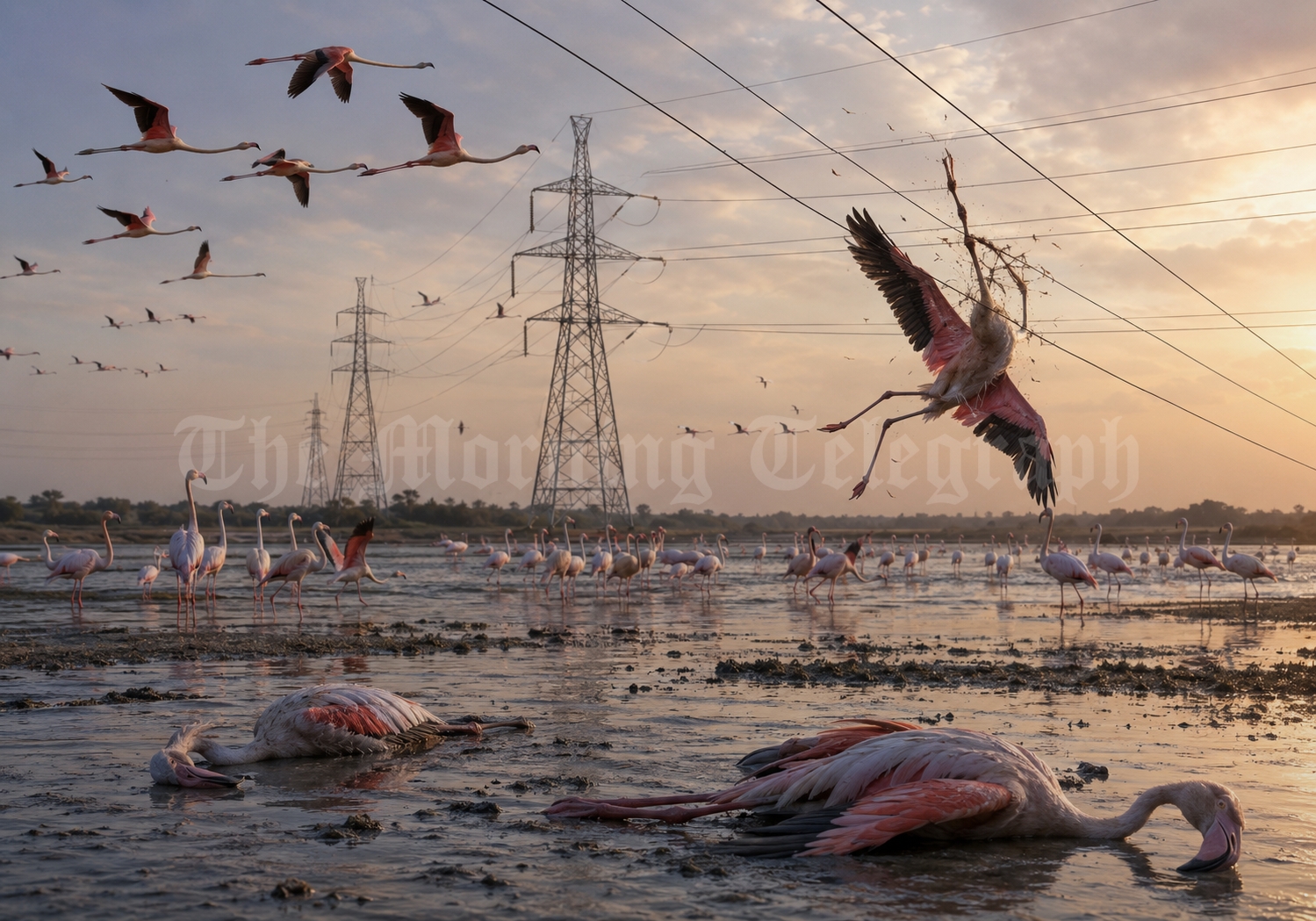
The recent discovery of dead greater flamingos within the ecologically sensitive Vankalai Sanctuary has ignited an intense debate over the rapid expansion of power infrastructure along Sri Lanka’s premier avian migration routes.

Wildlife officials and local conservationists confirmed that multiple migratory flamingos were recovered with severe, fatal injuries. While initial community reports suspected electrocution from the high-tension cables traversing the sanctuary, subsequent post-mortem examinations conducted by the Department of Wildlife Conservation revealed a more graphic reality. The necropsies, led by DWC veterinary surgeon Balachandran Giritharan, determined that the birds’ trademark elongated necks were cleanly slashed mid-flight upon striking the low-visibility transmission lines.
Ornithologists emphasize that the physical anatomy and flight behaviors of the greater flamingo make them exceptionally vulnerable to human infrastructure. Traveling in large, tightly packed flocks during low-light hours—primarily dawn, dusk, and late into the night—these large waterbirds possess a wide wingspan but remarkably poor maneuverability once airborne. When power grids bisect established flyways, the results are frequently catastrophic.
The incident unfolds at a delicate political and environmental juncture for the region. The Mannar Peninsula, recognized globally as a critical stopover wetland complex within the Central Asian Flyway, has increasingly become a geographic battleground balancing the nation’s renewable energy goals against biodiversity preservation.
Local environmental groups, including the Centre for Environmental Justice, have expressed profound concern that these infrastructure casualties are materializing precisely where activists had warned. Activists note that large-scale development projects, including controversial wind energy grids, must implement rigorous ecological safeguards to prevent transforming vital marine sanctuaries into lethal corridors.
“These migratory birds rely on ancient, unchanging flight paths,” noted leading ornithologists monitoring the region. “When infrastructure is placed directly in their paths without underground cabling or high-visibility bird diverters, we are compromising a fragile natural heritage.” Original story appeared on Mongabay website.