By Roy Denish
A buried murder theory, billions in disputed funds, missing CCTV footage and a forensic reversal have reignited one of Sri Lanka’s most explosive unsolved cases.
A Death That Continues to Haunt Sri Lanka
It is a ghost that has long haunted the upper echelons of Sri Lankan politics and finance.
For over three years, the violent death of high-profile tycoon Dinesh Schafter was systematically buried under a narrative of self-harm.
However, newly uncovered dossiers, highly classified communication logs, and a damning consensus from a panel of the country’s leading forensic experts have blown the case wide open, sending shockwaves through a prominent political dynasty.
At the heart of the unfolding scandal is a lethal mix of billions in unaccounted capital, deep-seated institutional corruption, and a meticulously executed killing inside one of Colombo’s most public spaces.
The Final Journey to Borella Cemetery
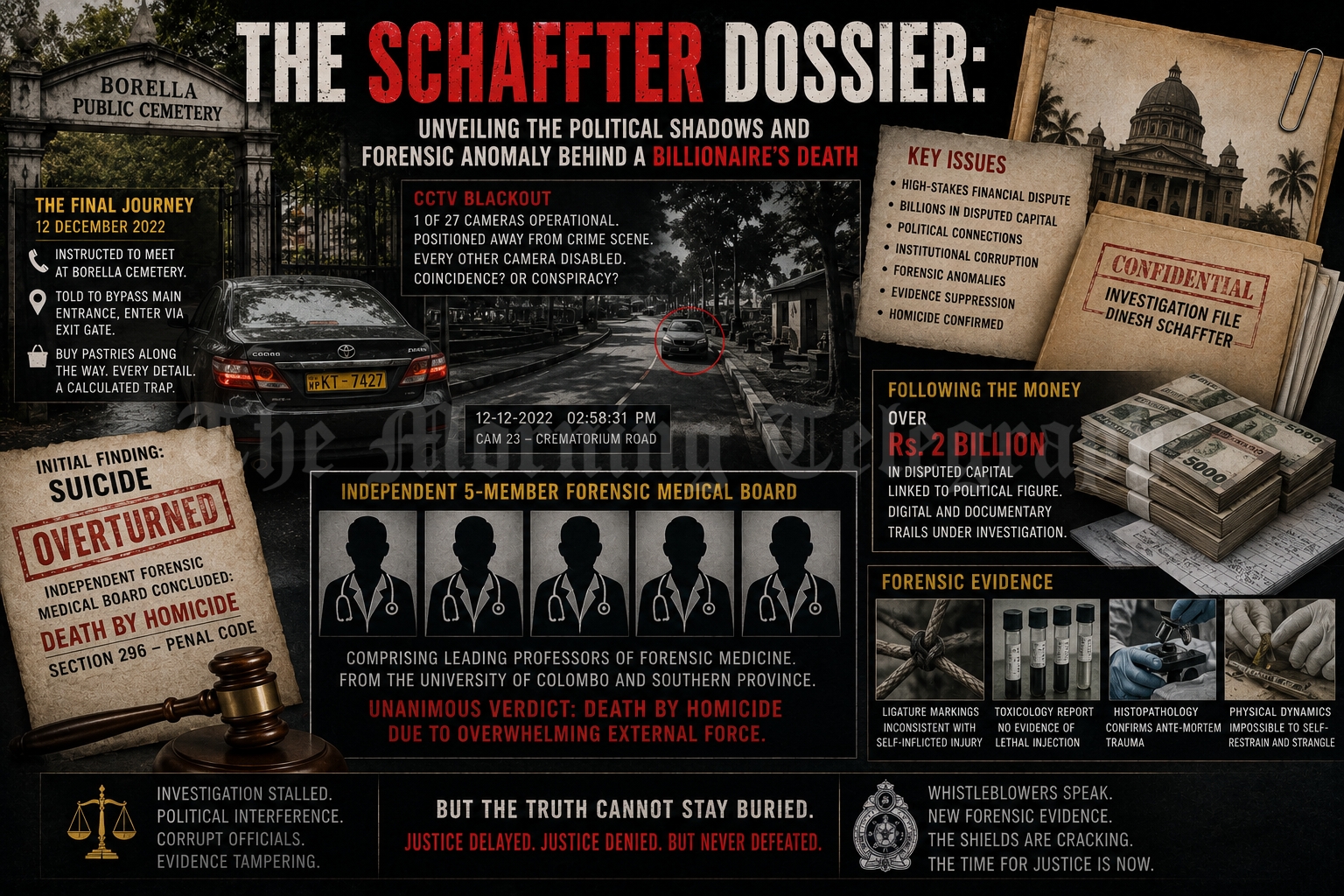
On the afternoon of December 12, 2022, Dinesh Schafter, the Managing Director of Janashakthi PLC and a member of one of the island’s most powerful yet intensely private business families, left his home for what he believed was a conflict-resolution meeting.
Investigative evidence now indicates that Schafter had been locked in a high-stakes financial dispute involving a prominent member of the Rajapaksa family over a massive capital investment and disputed commission percentages running into billions of rupees.
Acting as the intermediary in these volatile transactions was a well-known local spin doctor whose communications are currently under strict police scrutiny.
According to precise geolocation and call-data records now held by investigators, Schafter was instructed during a telephone call to meet his contacts at the Borella Public Cemetery.
Detailed Instructions Allegedly Designed to Avoid Detection
The instructions were highly specific and appeared designed to evade notice.
Shafter was allegedly told to purchase dishes from a particular pastry shop along his route, bypass the cemetery’s main entrance entirely, and enter against the flow of traffic through the designated exit gate.
Schafter complied.
Minutes later, his vehicle was parked near the crematorium, where the alleged trap was sprung.
CCTV Blackout Raises Serious Questions
What followed the discovery of Schafter’s bound body inside his vehicle bears what independent investigators describe as the hallmarks of state-sponsored evidentiary erasure.
They note that similar patterns have characterised several high-profile homicides during previous political eras.
When officers from the Borella Crime Department arrived, they encountered a digital blackout.
Of the extensive closed-circuit television network managed by the Colombo Municipal Council inside the cemetery, only one camera was reportedly operational.
That camera was positioned at a sharp angle towards the crematorium and captured nothing more than the arrival of Shafter’s vehicle.
Every other internal camera had allegedly been rendered inactive.
Investigation Transferred Following Political Intervention
The initial rapid inquiry conducted by Borella investigators was then abruptly halted under top-down directives reportedly influenced by a powerful minister.
The case file was removed from the local police and transferred to the Criminal Investigation Department.
During this period, the CID unit handling the case was led by controversial figures, including Deputy Inspector Prasad Ranasinghe.
Ranasinghe was subsequently accused of having financial links to alleged transnational drug kingpins such as Undugoda Salindu and Kudu Anju.
Under his command, the investigation visibly stalled.
State Initially Promoted Suicide Theory
The State’s initial medical and investigative narrative definitively asserted that Schafter had died by suicide.
Senior officials publicly claimed that Schafter had somehow managed to bind his own hands intricately, wrap heavy electrical wire around his own neck, secure himself to the driver’s seat, and cause his own strangulation.
The theory was later amended to suggest that he had injected himself with an undocumented cocktail of lethal chemicals.
Media Narrative Focused on Debt and Domestic Discord
The mainstream press and State-aligned social media networks quickly appeared to synchronise their reporting.
The public sphere was flooded with stories of crippling business debts and domestic discord in what was described as a textbook campaign to influence public perception and close the case.
Refusing to accept the State-approved medical findings, the Schafter family launched an aggressive legal counteroffensive before the Colombo Magistrate’s Court.
Family Demanded Independent Forensic Review
The family was represented by President’s Counsel Anuja Premaratne.
Its legal team successfully demanded that the findings of the original Judicial Medical Officer be bypassed and fought for the appointment of an independent and unimpeachable panel.
The court agreed and appointed a five-member special medical board comprising some of the country’s most respected forensic pathologists.
The panel included senior professors from the University of Colombo and leading forensic specialists from the Southern Province.
Medical Board Rejects Suicide Finding
The panel conducted a detailed, multi-month review of tissue samples, scientific evidence, and the physical dynamics of the ligatures.
Its findings completely dismantled the State’s original narrative by concluding that the death of Dinesh Schafter was not a suicide.
The board officially stated that the scientific evidence demonstrated the application of overwhelming external force.
It declared the death a homicide under Section 296 of the Penal Code.
Historic Reversal of Earlier Autopsy Findings
For the first time in modern Sri Lankan judicial history, a supreme medical board formally invalidated a previous State-vetted autopsy report.
The ruling legally transformed what had been treated as a closed suicide case into an active murder investigation.
With the forensic findings legally established, the direction of the investigation has shifted firmly towards the alleged political nexus.
Billions of Rupees at the Centre of the Investigation
The suspected financial motive remains staggering.
Documents reportedly indicate that the political figure in question was holding more than two billion rupees in capital directly linked to Schafter.
Investigators are now tracing the digital and documentary trails connected to this money to establish its exact chain of custody in the period leading up to the killing.
Pressure Mounts as Police Insiders Begin to Speak
New forensic evidence, permanent telecommunications backups, and alleged whistleblowers within the Police Department are beginning to reshape the investigation.
The legal shields that once protected those suspected of involvement appear to be weakening.
The State now faces an ultimatum to enforce the rule of law against one of the country’s most feared political entities.