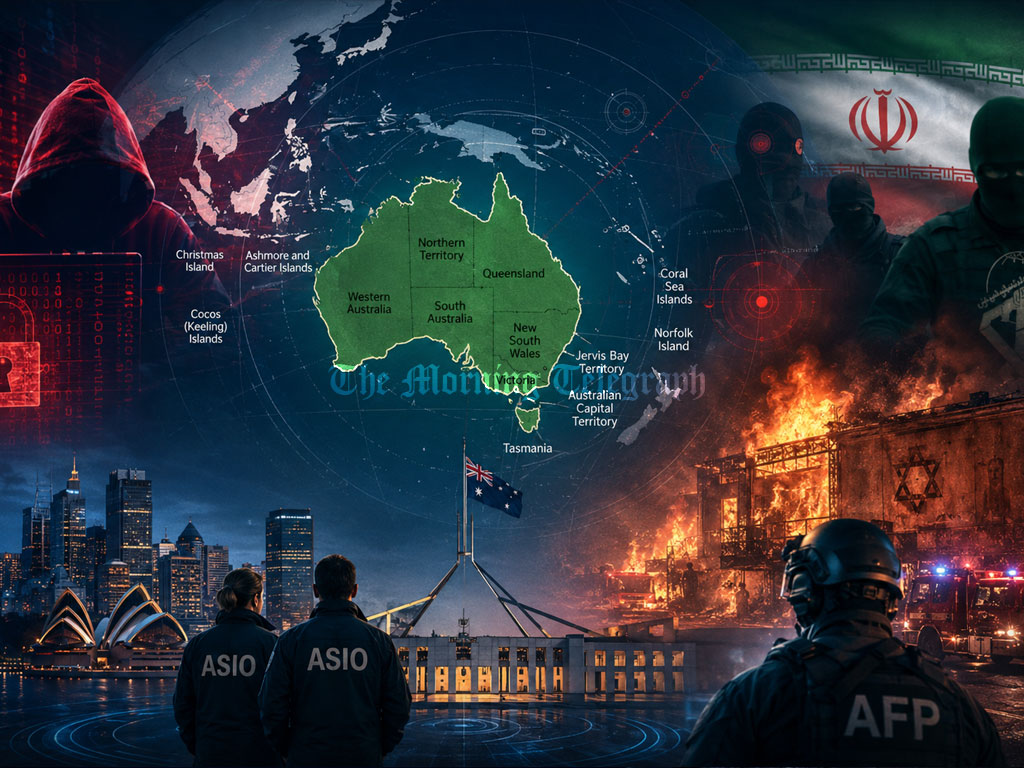
Australia threat landscape is worsening as ASIO warns of terrorism, Iran-linked plots, espionage, sabotage and online radicalisation.
Australia threat landscape has entered a more dangerous phase, with ASIO warning that terrorism, espionage, foreign interference, cyber sabotage and state-backed violence are now converging at unprecedented levels.
In its 2026 annual threat assessment, Australian Security Intelligence Organisation Director-General Mike Burgess revealed that Australia has foiled 31 major terrorism plots since 2014.
He also said 14 “significant terror-related cases” had been resolved since the Bondi terror attack in December 2025.
ASIO, one of the world’s leading security services, uncovered that Iran’s Islamic Revolutionary Guard Corps recruited Australian-Iraqi national Kadhim Malik Hamad Rabah al-Hajami, also known as Kazam Hamad, to mount attacks against a Jewish restaurant in Sydney and a synagogue in Melbourne.

Hamad has been described as a cigarette, tobacco and drug smuggler.
The Australian case is one of the most significant examples of the Iranian regime allegedly using criminal networks to carry out terrorist attacks overseas.
In response, Canberra expelled its Iranian ambassador.
Security officials believe this method of operation by the IRGC is likely to continue in the months and years ahead.
ASIO did not identify Kazam Hamad by name, but his profile was provided by the Iraqi government, which detained him in January 2026.
The National Center for International Judicial Cooperation in Iraq announced the arrest of a drug trafficker and other criminals wanted by Iraqi and international courts following an official request from Australia.
In a statement, the Iraqi government said Kadhim Malik Hamad Rabah al-Hajami was arrested in coordination with the General Directorate of Narcotics and Psychotropic Substances Affairs at the Ministry of Interior after obtaining approvals from the Supreme Judicial Council.
The proceedings were initiated by the First Karkh Investigation Court, which specialises in drug cases.
According to the details released, the suspect’s name was listed as Kadhim Malik Hamad Riyah Al-Hajali, with the alias Abu Samer.
He was identified as an Iraqi and Australian national, born on March 26, 1984, in Nasiriyah.
His case number was listed as No. 2564, with Australia named as the requesting country.
The offence type was recorded as drug-related offences under Article 28 of narcotics law.
His legal status was listed as arrested, with the date and place of detention recorded as January 21, 2026, by the Narcotics Directorate in Al-Karkh.
Iraqi authorities described Kazam as “one of the most dangerous wanted men in the world.”
They said he was responsible for importing large quantities of drugs into Iraq and Australia, as well as smuggling heroin.
They also alleged he was involved with major organised crime gangs in Sydney responsible for shootings, murders, kidnappings, violent assaults, extortion and drug imports.
Authorities further alleged he had links with outlaw gangs that held extensive influence in Australia and the Middle East and were involved in murders, shootings, money laundering, fraud, assaults, arson and global drug trafficking.
A Turning Point for Australia
The firebombing of the Adass Israel synagogue in Melbourne and the arson attack on Lewis Continental Kitchen, a Jewish business in Sydney’s east, allegedly by IRGC-linked networks, followed by the Bondi massacre by Islamic State, marked a turning point in Australia’s fight against terrorism.
In response to the sustained terrorism threat, Canberra is now discussing how to build stronger capability to confront both state and non-state terrorist threats.
Alongside the threat posed by hostile states such as Iran, exclusivism, extremism and their violent expressions remain enduring national security challenges.
The growing web of interconnected threats shows the complexity of Australia’s changing security environment and the urgent need to address it.
Hamad, also known as Kadhim Malik Hamad Rabah al-Hajami, was alleged to be one of the key figures in Melbourne’s tobacco wars.
He was deported from Australia in 2023 and is currently being held at a secret location in Iraq.
The Australian Federal Police said his arrest had triggered infighting within the syndicate he allegedly led.
“The firebombing of a synagogue can simultaneously be criminal arson, foreign interference, the promotion of communal violence and politically motivated violence,” Burgess said.
He added that “when Iran directs the arson, it’s an act of state-sponsored terrorism.”
Major Terror Attacks Since 2014
Australia’s terrorism threat has been reflected in a series of attacks over the past decade.
The most significant incidents since 2014 include the Bondi Beach shooting in 2025.
On December 14, 2025, an Islamic State-inspired and antisemitic attack took place at a “Chanukah by the Sea” community celebration on Bondi Beach in Sydney.
Two gunmen opened fire and used explosives, killing 15 people and injuring more than 40 others.
The Adass Israel Synagogue firebombing took place on December 6, 2024.
Masked attackers broke into the synagogue in the Melbourne suburb of Ripponlea, poured accelerant and set it on fire.
The attack was later classified as terrorism with links to Iranian state actors.
The Wakeley Church stabbing occurred on April 15, 2024.
A 16-year-old inspired by Islamism attacked a bishop and parishioners with a knife at Christ The Good Shepherd Church in Wakeley, Sydney.
The bishop was permanently blinded in one eye.
The Melbourne stabbing attack took place on November 9, 2018.
An Islamic State-inspired attacker set a pickup truck on fire and stabbed three pedestrians in Bourke Street, Melbourne, killing one person before being shot and killed by police.
The Brighton siege occurred on June 5, 2017.
A gunman linked to Al-Qaeda and ISIS stormed an apartment complex in Brighton, Melbourne, killed a man, held a woman hostage and shot three police officers before being killed by authorities.
The Lindt Cafe siege took place on December 15 and 16, 2014.
A lone gunman with a history of radicalisation and extremist views held 18 people hostage inside the Lindt Chocolate Cafe in Sydney’s Martin Place.
The 16-hour siege ended when police stormed the building, resulting in the deaths of two hostages and the perpetrator.
The Parramatta shooting occurred on October 2, 2015.
A 15-year-old radicalised youth shot and killed a civilian police accountant outside police headquarters in Parramatta, Sydney, before being killed in an exchange of gunfire with police.
The Endeavour Hills stabbing took place on September 23, 2014.
An 18-year-old radicalised male stabbed two police officers outside the Endeavour Hills police station in Melbourne before being fatally shot.
Current and Emerging Threats
Australia now faces multiple threats, ranging from foreign interference and espionage from China to terrorism linked to Iran, as well as cyber threats from several actors.
Explaining the complexity facing ASIO, Burgess said a security service cannot simply pivot from one threat to another.
Instead, it must counter multiple threats at the same time.
He said resourcing decisions are not based on mathematical formulas or obscure budget rules, but are constantly adjusted in response to a dynamic security environment.
“Even when surging espionage and foreign interference demanded more attention, countering terrorism remained a priority,” he said, referring to ASIO’s 2022 Annual Threat Assessment.
He said ASIO increased counter-terrorism resources when the threat level was raised in 2024, and that growth continued in the months before Bondi.
“Resourcing followed the threat,” he said.
Burgess added that the number of ASIO officers working on counter-terrorism in 2025 was almost double the number in 2005.
ASIO’s 2026 Threat Assessment
The full speech by Mike Burgess, AM, Director-General’s Annual Threat Assessment 2026, was delivered on June 24, 2026.
He began by acknowledging the pain and grief of the families, friends and community of those killed and injured in the Bondi terror attack.
Although the Royal Commission and court case limited what he could say, Burgess placed the attack within the wider context of a deteriorating global and domestic security environment.
He said a small group of extremists moving to violence with little or no warning was shocking, but sadly not surprising.
In the previous year’s threat assessment, ASIO had declassified part of its outlook to 2030.
Burgess said he had warned that Australia was entering a period of strategic surprise and security fragility.
He had predicted that the threat environment would become more dynamic, diverse and degraded before the end of the decade.
“Unfortunately, we are already there,” he said.
Dynamic Security Environment
Burgess described the environment as dynamic because great power competition is having a deep and ongoing impact on global stability and strategy.
Alliances and norms once considered unbreakable are now being questioned.
He said many assumptions once taken for granted are being tested, including social cohesion, economic stability and supply chain certainty.
Global tensions, conflicts and technological advances continue to affect Australia’s security environment directly.
A More Diverse Threat Picture
The ASIO chief said the environment is also diverse because Australia no longer faces isolated risks.
Instead, it faces multifaceted instability where state-sponsored aggression and domestic volatility intersect.
At the centre of this convergence are espionage, foreign interference and politically motivated violence.
However, Burgess warned that the perimeter is expanding.
Australia is already seeing surges in communal violence and preparation for sabotage.
He said this diversity creates a systemic challenge for national security.
Antisemitism, he said, is a clear example.
Burgess said antisemitism is often viewed through a narrow lens, but in reality it can originate from multiple sources at once.
Neo-Nazis are antisemitic.
Islamic extremists are antisemitic.
Issue-motivated extremists can be antisemitic, especially when they adopt conspiracy theories and stereotypes about Jewish communities.
Nation states can also be antisemitic, as shown by the arson attacks against Jewish communities in Melbourne and Sydney allegedly carried out by criminals directed by Iran’s Islamic Revolutionary Guard Corps.
Anarchists and revolutionary groups can also be antisemitic.
Burgess noted that Australian companies with perceived links to Israel had been subjected to repeated acts of vandalism and arson by far-left activists, though this received relatively little media coverage.
He stressed that criticism of the Israeli government is not automatically antisemitic.
However, he said some threatening statements by perpetrators went far beyond political protest or commentary.
These groups have different ideologies, do not associate with each other and often despise each other.
Their tactics, techniques and operating methods differ.
Yet they are united by a common hatred.
Burgess said violent antisemitism is not a single or simple intelligence problem.
ASIO must identify and address threats from all these directions.
The firebombing of a synagogue may simultaneously be criminal arson, foreign interference, the promotion of communal violence and politically motivated violence.
When Iran directs that arson, Burgess said, it becomes state-sponsored terrorism.
ASIO’s investigation into the arson attacks was among the most difficult and detailed in its recent history.
It was led by a counter-intelligence team, with support from counter-terrorism officers.
Burgess said it is now common for initial leads to be handled by counter-terrorism officers before shifting to counter-intelligence teams, and vice versa.
This shows how traditional definitions and distinctions are breaking down.
A Degraded Security Environment
Burgess said Australia’s security environment has also degraded.
Great power competition is driving an insatiable appetite for strategic advantage.
As a result, espionage and foreign interference are at extreme levels, while preparation for sabotage is growing in scale and sophistication.
At the same time, politically motivated violence, including terrorism, remains an acute concern.
Burgess said he was gravely concerned by the temperature and trajectory of the terrorism threat.
Grievance is rising, social cohesion is strained and the likelihood of violence has increased.
Conflict in the Middle East is fuelling frustration and anger, and the effects could become even more severe if further economic shocks or shortages occur.
Social media is amplifying grievance narratives, eroding trust in institutions, promoting discord and inflammatory rhetoric, deepening polarisation and creating an environment more permissive of violence.
Burgess warned that when intolerance is tolerated, and violent language and violent acts are left unchecked, they become normalised.
That creates the impression they are acceptable and increases the likelihood of further violence.
At the same time, global terrorism threats are re-emerging.
Traditional groups such as Islamic State, Al-Qaeda and their affiliates are growing their ability to conduct and inspire attacks.
They are enabled by permissive physical and online spaces.
These groups continue to see Western interests as legitimate targets.
Burgess said an Iran-aligned group had orchestrated a wave of attacks across Europe earlier in the year.
Most were low-capability attacks involving arson or rudimentary incendiary devices.
Most targeted Jewish interests.
All were designed to spread fear as part of Iran’s anti-American, anti-Israel and antisemitic agenda.
Iran continues to view Australia as a legitimate target for covertly directed acts of violence.
ASIO assesses there is a realistic possibility that the Iran-linked group active in Europe will expand its networks toward Australia.
It could conduct or inspire arson, vandalism or even assassinations on Australian soil.
The New Terrorism Challenge
Australia’s terrorism threat level remains at “probable.”
However, Burgess said he does not believe the current system fully captures the situation Australia now faces.
The next threat level is “expected,” which applies when authorities have intelligence about a specific attack.
ASIO does not currently have such intelligence.
But Burgess said the environment is worsening and acts of politically motivated violence are becoming more likely than the word “probable” suggests.
He compared the situation to climate change.
Just as climate change increases the likelihood of extreme weather without forecasting a specific storm, politically motivated violence is becoming more likely even without a specific attack being predicted.
Burgess said it is too simplistic to assume there is one terrorism threat or one most likely terrorism threat.
After Bondi, there were calls for greater focus on Sunni violent extremism.
That approach made sense when ISIS and Al-Qaeda were the principal security threats.
But contemporary terrorism is now far more complex.
The Bondi attack occurred in December and is now subject to a court case.
In January, a West Australian man allegedly threw a homemade bomb into an Indigenous rally.
Had the device exploded, it could have caused another mass-casualty event.
That case was allegedly inspired by neo-Nazi ideology.
In February, police charged another West Australian man with allegedly planning a mass-casualty attack targeting Western Australia’s Parliament House, police headquarters and mosques.
That case was also allegedly motivated by extreme right-wing ideology.
ASIO’s covert online operations team played a key role in discovering and identifying that individual.
Since then, ASIO has dealt with extremists across the ideological spectrum.
These included one who allegedly combined ideological and extreme Christian beliefs, and another individual allegedly inspired by extreme left-wing ideology.
The cases demonstrate the diversity and complexity of the modern terrorism environment.
Burgess said many of its drivers are relatively new.
Instead of fixed ideologies, radicalised individuals are increasingly embracing mixed ideologies.
Instead of being radicalised by real-world associates, they are often radicalised by strangers online.
Instead of being radicalised in groups, they are often radicalised alone.
Instead of being radicalised over months or years, they are increasingly radicalised in weeks.
Instead of being radicalised as adults, they are often radicalised as minors.
Instead of gathering in prayer halls or backyards, they gather in encrypted chat rooms.
Instead of planning sophisticated attacks over long periods, they move toward low-capability attacks with little or no warning.
These dynamics make the current terrorism environment different and, in some ways, harder to manage than the Al-Qaeda and ISIL period.
ASIO has sharpened its responses, adjusted operational thresholds and continues to evolve its capabilities.
Burgess welcomed the government’s recent investment in the ASIO and AFP counter-terrorism online centre.
Working with law enforcement partners, ASIO has foiled 31 major terrorism plots since 2014.
Burgess said that means many lives were saved.
But he also said the 31 figure refers only to major plots.
In the same period, ASIO and law enforcement partners resolved many less advanced, but still potentially deadly, terror-related cases.
He cautioned that ASIO is not all-seeing or all-knowing.
It cannot stop every terrorist, just as it cannot catch every spy.
But it continues to work around the clock to keep Australians safe.
Concurrent, Cascading and Compounding Threats
Terrorism is not the only danger Australia faces.
Burgess described the degraded environment as one marked by concurrent, cascading and compounding threats.
ASIO categorises these into “threats to life” and “threats to our way of life.”
But in the current environment, the agency cannot focus on one category at the expense of the other.
Both are important and both must be countered at the same time.
To illustrate the point, Burgess reviewed notes from one randomly selected week in his working record.
It was not an exceptional week.
Yet ASIO dealt with more than 40 priority counter-terrorism cases.
Working with law enforcement and intelligence partners, ASIO investigated a 20-year-old with nationalist racist ideology who had a detailed written plan for attack.
It also investigated a 17-year-old with a bomb-making instruction manual who was searching for places to conduct politically motivated violence in support of ISIL.
Another case involved a 15-year-old with mixed nationalist, racist and Christian violent extremist ideology who wanted to blow up a school.
At the same time, ASIO was also countering major threats to Australia’s way of life.
These included coerced repatriation, Iranian state-linked terrorism, cyber threats to critical infrastructure and espionage targeting AUKUS.
Coerced Repatriation
Burgess described how ASIO officers spent many hours over several days assisting an individual subjected to a long campaign of intimidation.
For 10 years, a foreign regime had demanded the man return to his place of birth to answer unspecified corruption allegations.
Officials from that regime made repeated late-night phone calls to his home in Australia, pressuring him to travel.
At one point, an official visited Australia under the guise of tourism to escort him to the foreign country.
That attempt failed, but the pressure continued.
Relatives overseas were told to persuade the individual to cooperate and were threatened with retaliation if he refused.
When he still refused, the regime acted on those threats.
Relatives were detained, interrogated and subjected to travel bans.
A family member in Australia then travelled to the foreign country to try to resolve the matter.
Officials interrogated that person for hours and said the traveller would only be allowed to return to Australia if they agreed to maintain phone contact with the regime and file reports on the target.
ASIO describes such campaigns as coerced repatriation, where a foreign government applies relentless pressure on someone living in Australia.
Victims almost certainly face punishment, persecution or prosecution if they return.
In many cases, they are critics of a foreign regime.
In other cases, even where criminality is alleged, coerced repatriation still violates individual rights and Australian sovereignty because it bypasses legal cooperation systems.
Sometimes pressure is applied directly by foreign government agents.
ASIO recently caught two officers trying to coerce their target at a Victorian fast-food restaurant.
Sometimes pressure is applied indirectly.
Foreign services may hire Australian private investigators, lawyers or other professionals to locate victims, monitor their movements and pass on threatening messages.
ASIO is aware of at least five regimes using these tactics against Australians.
One country is especially active.
In 2023 alone, that country coerced at least eight individuals to leave Australia for their place of birth.
Five were Australian citizens or permanent residents.
Three never returned.
ASIO fears this is only a fraction of the real number because victims are often too afraid to report the coercion.
Burgess warned that even subtle pressure is cumulative and brutal in its impact.
It undermines a person’s agency and decision-making, chills diaspora communities, encourages self-censorship, restricts free speech and weakens participation in political debate.
He warned those conducting coerced repatriations that ASIO is watching and has zero tolerance.
He also warned private investigators and lawyers that ignorance is no excuse if an overseas client asks them to locate or monitor someone in Australia.
They could be aiding foreign interference.
Iran’s Onshore Threat
While some regimes try to silence Australians by luring them overseas, others are more brazen and cause harm inside Australia.
During the same period, another counter-intelligence team achieved a breakthrough in ASIO’s investigation into Iran’s involvement in antisemitic arson attacks.
ASIO identified direct links between Iran’s Islamic Revolutionary Guard Corps and two individuals living offshore who maintained strong ties to Australia.
ASIO assessed they knew they were being directed by the Iranian regime.
They allegedly orchestrated attacks on buildings linked to Jewish Australians using a complex chain of proxies, including Australian-based criminals.
An Iran-based Australian citizen allegedly orchestrated the firebombing of Lewis Continental Kitchen in Bondi, the first major attack in what Burgess called the summer of antisemitism.
This person was described as a senior agent of the IRGC Qods Force operating global networks.
Burgess said ASIO knows more about him than he realises, including the name of his superior in Iran and the department he works for.
That department was identified as Department 11000, a covert unit within the IRGC Qods Force responsible for coordinating operations in the West.
Burgess also confirmed that a former Australian resident living in Iraq directed the attack on the Adass Israel Synagogue in Melbourne.
Iran allegedly recruited him through a complex web of Iraqi-based militia groups.
The IRGC valued his wealth and criminal connections, protected him and supported his illegal enterprises.
That changed after ASIO publicly named Iran’s involvement in the antisemitic arsons.
After further pressure from Australian and local law enforcement, his Iranian backers reportedly abandoned him and he was imprisoned.
Burgess said he could not name the two individuals to protect ongoing investigations and prosecutions.
But he warned them that ASIO knows who they are, what they have done and who they work for.
Although no one died in the arson attacks, Burgess said he worries that one day an Australian could be killed by a foreign government on Australian soil.
That concern is heightened by the possibility that Iran-backed groups operating in Europe may expand to Australia.
In March, ASIO conducted multiple warranted activities targeting Australians in direct contact with the IRGC.
ASIO assessed those individuals were seeking to covertly promote hatred, foster antisemitism and encourage violence against Iran’s perceived enemies.
Critical Infrastructure at Risk
The third major threat described by Burgess involved critical infrastructure.
ASIO discovered nation-state hackers had compromised the network of an Australian critical infrastructure provider.
The agency assessed the hackers were preparing for sabotage.
They were not planting “digital dynamite,” but were mapping the network and maintaining access so they could cripple it at a time of their choosing.
Cyber sabotage is an evolving threat.
Burgess said he has established dedicated teams to counter it.
As ASIO’s understanding grows, so does its concern.
The scale of this activity, led by one nation state in particular, was described as difficult to overstate.
Critical infrastructure in the energy and communications sectors, along with infrastructure supporting the military, are top targets.
In this case, a state-sponsored group not only gained access to an Australian critical infrastructure provider, but also acquired credentials, including login details and passwords for active users and IT professionals protecting the network.
ASIO identified, tracked and attributed the hack, then worked with the victim company and security partners to remediate the compromise.
That work is ongoing.
AUKUS Under Espionage Pressure
Australia’s defence capabilities and AUKUS remain priority targets for foreign intelligence services.
For some nations, even some Australia considers friendly, AUKUS is their top priority target.
Burgess described how a spy from a foreign intelligence service approached an Australian security clearance holder online, pretending to be from a consulting company.
The spy paid the official to write two reports on Australia’s relationship with Pacific neighbours.
Then, believing the target had been recruited, the spy offered money for inside information on AUKUS.
The foreign intelligence service wanted details on Pillar 1 progress, Pillar 2 technologies, investment levels, Australia’s geostrategic ambitions, relations between the three AUKUS governments and the likely direction of Australian public opinion.
The clearance holder became suspicious and reported the contact.
When ASIO officers interviewed the person, they gained valuable insight into the foreign service’s information gaps and tradecraft.
The clearance holder even handed over the money received from the spies for the earlier reports.
ASIO disrupted the operation and made the foreign service pay for it.
Officers then borrowed the official’s phone and called the supposed consultant in her home country.
Thinking it was her target, the spy answered, only to discover she was speaking to ASIO.
ASIO identified her, demanded that she stop targeting Australians, explained Australia’s espionage laws and warned that the Director-General reserves the right to speak publicly about such matters.
The spy hung up.
Burgess said the message was received.
Professional networking sites remain a low-cost and low-risk recruitment tool for foreign intelligence services.
ASIO expects such targeting to grow as AUKUS matures and the attack surface expands.
A Security Service Under Pressure
Burgess concluded that coerced repatriation, state-based terrorism, preparation for sabotage and espionage targeting AUKUS were only four threats that overlapped in one typical week.
Many other operations could not be discussed publicly, including attempts to manipulate democracy and undermine the economy.
There were also details of more than 40 priority counter-terrorism investigations that could not be revealed.
At ASIO, he said, every week is “one of those weeks.”
Each threat represented a significant challenge.
In every case, ASIO was countering a sophisticated, capable and highly resourced nation state.
But the greatest challenge is cumulative.
In a degraded security environment marked by concurrent, cascading and compounding threats, ASIO must decide how to prioritise when resources are limited.
Burgess said he does not believe major threats can be ranked against each other.
The liberty of individuals, countering antisemitism, protecting critical infrastructure and defending AUKUS all matter.
Australia does not have the luxury of simply observing threats.
It must confront them.
ASIO’s resources must go where the threat takes them.
Its actions, Burgess stressed, are enabled and constrained by law and must always be proportionate.
ASIO lowered the terrorism threat level in 2022 because there were fewer extremists with the capability and intent to conduct attacks.
Even as espionage and foreign interference surged, counter-terrorism remained a priority.
When the threat level rose in 2024, counter-terrorism resources increased, and they continued growing before Bondi.
The number of ASIO officers on counter-terrorism in 2025 was almost double the number in 2005.
But staffing alone does not tell the full story.
Twice as many staff does not necessarily mean twice as much intelligence, twice as many investigations or twice as many disruptions.
In the new terrorism environment, even a vast army of case officers and surveillance officers may not find an individual radicalised online using encrypted communications.
Burgess said the terror alert system will never include a level of “impossible” or “unthinkable.”
That is why ASIO must continue evolving.
He said the assessment was not cheerful reading, but the agency must be frank to prevent complacency from becoming Australia’s greatest threat.
When autocratic regimes seek to silence dissidents and perceived enemies, Australia may be shocked, but should not be surprised.
When hackers exploit known vulnerabilities, Australia may be shocked, but should not be surprised.
When antisemitism grows after being tolerated, Australia may be shocked, but should not be surprised.
When inflammatory rhetoric and provocative protest lead to violence, Australia may be shocked, but should not be surprised.
When a radicalised individual or small group uses an easily available weapon while the threat level is probable, Australia may be shocked, but should not be surprised.
When critical infrastructure is disrupted, Australia will be shocked, but should not be surprised.
And if an Australian is killed by a foreign government on Australian soil, Australia will be shocked, but should not be surprised.
Burgess said these threats should not be tolerated or treated as normal.
They must be recognised and confronted.
He urged anyone facing an immediate threat to call police, and anyone seeing something concerning to contact the National Security Hotline on 1800 123 400.
One call, he said, can make a difference.
By addressing known vulnerabilities and managing known risks, Australia can become a harder and more resilient target.
ASIO is also aggressively adopting new tools and techniques, including artificial intelligence, to navigate the security environment.
Burgess said ASIO is recruiting across the organisation, including intelligence development, finance graduates, human resources graduates, technologists and executive assistants.
Every ASIO officer, he said, contributes to the mission.
Security is a shared responsibility, and many dynamics shaping the threat environment cannot be solved by ASIO alone.
The tolerance of intolerance, growth of grievance, radicalisation of minors and spread of conspiracy theories require a whole-of-community response.
People applying for Australian visas are required to acknowledge Australian values, including the idea of a “fair go” for all, mutual respect and tolerance.
Burgess said that principle could help reduce the temperature of Australia’s security environment.
Australians can disagree, protest, report the news and condemn governments or political parties, but must consider how they do so and avoid condemning entire communities.
Despite the scale of the challenge, Burgess said Australia remains well placed to meet it.
Its parliaments are sovereign, its communities are resilient, its economy is growing and its security and law enforcement agencies are world class.
Australia should not be insecure about its security.
But in a dynamic, diverse and degraded environment, that confidence is being tested.