Thirukkovil mineral sands project faces backlash as residents question Capital Metals, environmental risks and who benefits from mining.
When Communities Say No, Why Push Ahead?
Thirukkovil mineral sands project has become a test of power, consent and environmental justice, as Capital Metals PLC targets Sri Lanka’s eastern coast.
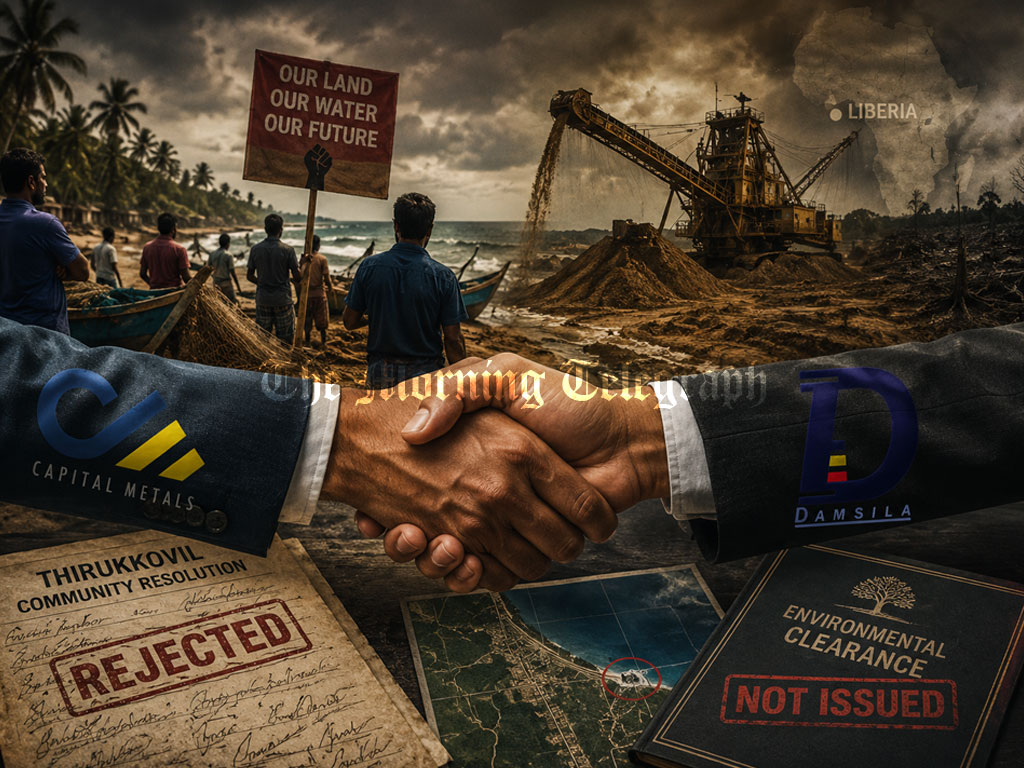
A company once linked to destroyed farmland and threatened protesters in Liberia is now seeking to mine the coastline of eastern Sri Lanka. It has not changed its method, only its name. That is the central fact behind the Thirukkovil dispute, and it deserves far more attention than the soft language of “stakeholder consultation” and “community engagement” usually permits.

Capital Metals PLC, backed by UK investors and now working with local firms including Damsila, was previously known as Equatorial Palm Oil. Under that name, it was directly implicated in a 2013 land-grabbing scandal in Liberia involving the forced seizure of villagers’ ancestral land, deforestation and intimidation of protesters, documented by Global Witness, before the venture collapsed under public pressure and financial failure.
The company did not learn from that collapse. It rebranded, moved from palm oil to mineral sands, and went looking for a new coastline. It found Ampara District.
The people of Thirukkovil are not unaware of what is being proposed. Divisional Council chairman S. Sasikumar says the company attempted this once before in 2021 and was rejected outright.
“Our people know exactly what happened to the Pulmoddai area,” he said, citing fears that large-scale extraction could permanently damage the landscape and water table.
He insists no council approval has been granted and that final environmental clearance has still not been issued, regardless of what the company claims publicly.
He also makes a point that should trouble anyone defending the project: those speaking in favour of it are, according to him, largely not people who actually live there.
“If the people who live here don’t want it, how can a project like this move forward?”
That is not rhetorical. It is the whole question.
Local council member Prabhakaran Yogarasa explains what is geographically at stake. Three waterways, Chinna Muhattuvaram, Periya Muhattuvaram and Korale lagoon, meet along this coastline, feeding an estuary that directly supports around 3,000 fishing families.
This is not an empty beach being measured against a corporate balance sheet. It is a lagoon system, a mangrove habitat and the economic foundation of thousands of households.
All of it is being weighed against extraction projects that have a documented habit of leaving damaged land behind once the resource is gone.
Yogarasa’s alternative vision, built around eco-tourism, lagoon tours, birdwatching and Pottuvil’s existing tourist traffic, is not fantasy. It is a real economic option that those promoting the mining project do not appear interested in properly costing.
Fishermen’s association chairman Parasuraman Madhan describes a company that has worked the community for years, not with bulldozers, but through persistence.
Company representatives reportedly met his association more than fifteen times, asking for signatures from 100 residents in support of the project and offering boats, nets, roads and water infrastructure in return.
“We rejected all of it,” he said. “Our association has held that same position from that day to this.”
That is not a community surrendering to pressure. It is a community recognizing a pattern and refusing to participate.
That makes it even more notable that Capital Metals has also reportedly attempted to repurpose a locally approved pawning-centre building for another use, prompting the Divisional Council to issue a notice declaring it unlawful.
If a company is already cutting corners over a small office building, what confidence should anyone have in its handling of a mining operation?
The most powerful testimony comes from a 66-year-old fisherman named Parasuraman, who lives near the Koraikalappu estuary.
He remembers a 1997 visit to shrimp farming operations near Chilaw, arranged through an NGO. What stayed with him was not aquaculture technique. It was that local people no longer had drinking water, after years of industrial activity contaminated groundwater so badly that water had to be brought in from distant provinces.
“What we learned is that short-term profit can create long-term problems,” he said. “We still have clean groundwater in our villages today. We are not willing to risk that.”
That is not an abstract environmental slogan. It is a man describing a warning he saw in another village and using it, reasonably, to reject the same fate for his own.
The contradictions at national level are impossible to ignore.
While environmentalists held a public teach-out at Galle Face Green on the 17th to warn people about destructive mineral sand extraction, a Mineral Sands Technical Conference was taking place at the Galadari Hotel at the same time.
That conference was sponsored by Capital Metals and other extraction firms, with Industry Minister Sunil Handunnetti attending as chief guest.
One government simultaneously watching a citizen warning event and an industry-sponsored conference involving the company those citizens are protesting is not balance.
It is either a government that has not decided which side it is on, or one that has decided and hopes nobody notices the optics.
In Parliament, MPs Shanakiyan Rasamanickam and Kaveendiran Kodeeswaran have raised the same uncomfortable question: who really benefits from these mineral resources, and is that benefit remotely proportional to the environmental cost carried by people who may never see the export revenue?
None of this means Sri Lanka should ignore mineral sand deposits that could generate export income and foreign investment. That is a legitimate national interest, and pretending otherwise would be dishonest.
But the fact that a resource has value is not an argument for handing it to a specific company with a documented record of land seizure and environmental destruction elsewhere in the world.
That is especially true when the affected community has rejected the project twice, organized testimony from people who have seen this kind of story unfold before, and placed a viable alternative economic model on the table.
The real failure is not that Sri Lanka is weighing development against the environment. It is that the decision appears to be made in Colombo by people who will not live with the consequences, about land that, in every practical sense, belongs to the people of Thirukkovil who will.
SOURCE :- SRI LANKA GUARDIAN