
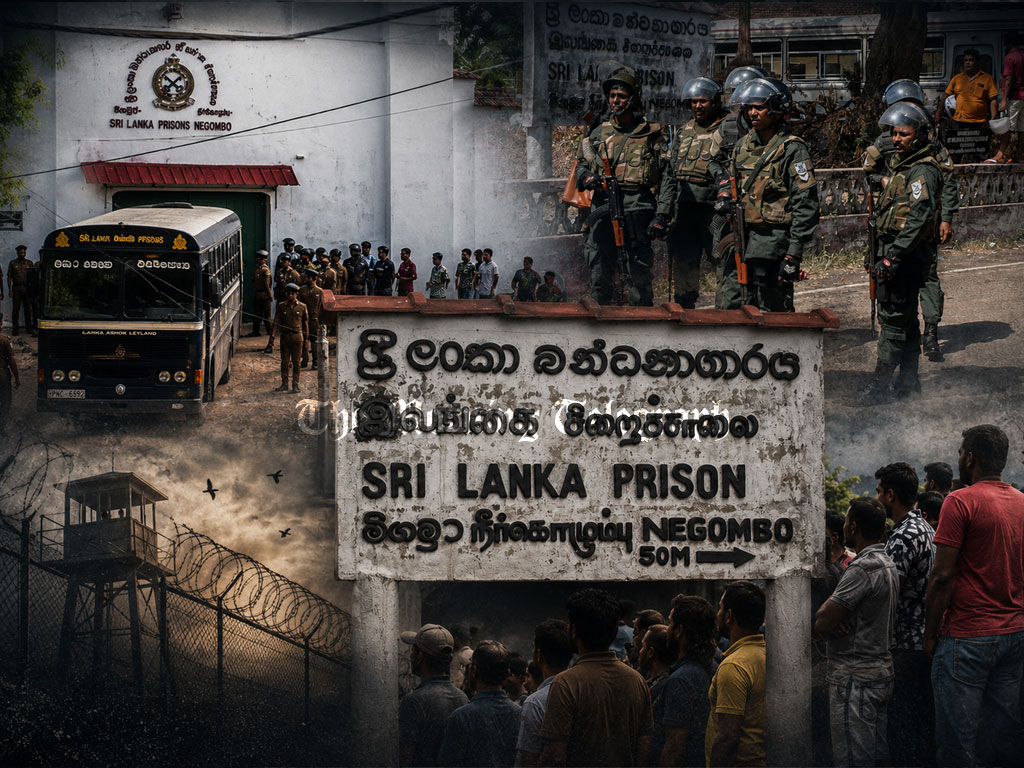
The Negombo Prison unrest left 27 dead and 104 injured. Here are answers to 10 key questions about the violence, gunfire and aftermath.
The Negombo Prison unrest on July 5 and July 6 left 27 people dead and 104 injured, raising urgent questions about what happened, why the violence erupted and how authorities responded.
The unrest unfolded across two days and involved inmates, prison officers, police and the Police Special Task Force. Authorities have offered explanations about the alleged cause of the violence, the use of firearms, prison overcrowding and allegations involving drugs and dengue.
Based on statements from prison authorities, government officials and observations from the scene, here are answers to 10 major questions surrounding the deadly incident.

1. What Happened During the Negombo Prison Unrest?
The first outbreak of unrest at Negombo Prison occurred on Sunday, July 5.
Prisons Commissioner and Prison Media Spokesman A.C. Gajanayake said a clash between two groups of inmates caused the initial violence.
According to Negombo District Hospital, authorities hospitalized 35 injured inmates that day. Two inmates later died from their injuries.
Justice Minister Harshana Nanayakkara told BBC Sinhala that night that authorities had brought the clash under control.
Prisons Commissioner General Prasad Hemantha Kumara later explained the response at the Cabinet media briefing on Tuesday, July 7.
“By the evening of July 5, this situation had been completely brought under control. The inmates were sent back to their wards and locked in, food and drink were provided, and all those activities had been completed,” he said.
However, the crisis was not over.
On Monday, July 6, a large number of relatives gathered near Negombo Prison. They had come to seek information about the condition of inmates.
A BBC reporter at the scene said that, after some time, a sound resembling gunfire came from inside the prison. The crowd outside became agitated, prompting police officers to control the situation.
At the Cabinet media briefing, Prasad Hemantha Kumara described what authorities said happened that morning.
“The next morning, which was Monday, is a day when court proceedings take place. Officers had approached to begin those activities after providing food,” he said.
“By that time, it has now been revealed to us that these inmates had consumed drugs and were in a state of delirium.”
He said another clash then broke out among the inmates.
“A clash occurred among those inmates. While the officers were working to resolve it, they had approached that location.”
The Commissioner General said security arrangements were in place. He alleged that inmates had consumed narcotic pills and were in a delirious state.
“Because these inmates had used narcotic pills, they were in a delirious state. Women had also used them. After consuming them, they had raised various allegations,” he said.
Police Special Task Force officers and riot control personnel later arrived near the prison’s main gate. Inmates had also gathered close to the gate.
An officer was later seen firing a weapon through a small window in the main gate.
Security personnel then entered through the gate. Inmates who had gathered nearby were seen running back into the prison.
After some time, people who appeared injured were brought out of the facility. Ambulances then transported the injured to hospital.
2. How Many People Died and How Many Were Injured?
By Tuesday morning, July 7, the death toll from the Negombo Prison unrest had risen to 27.
The Police Media Spokesperson’s Office confirmed the figure to BBC Sinhala.
According to the office, 20 of those killed were inmates, while seven were prison officers.
Authorities also reported that 104 people suffered injuries during the unrest.
The injured were receiving treatment at Negombo District Hospital and Colombo National Hospital, according to the Police Media Spokesperson’s Office.
3. What Do Authorities Say Caused the Violence?
BBC Sinhala asked Prison Media Spokesman and Prisons Commissioner A.C. Gajanayake about the primary cause of the unrest.
He said a clash between two groups of inmates held on drug-related charges triggered the violence.
“There was some control over drugs at Negombo Prison. So there was strong opposition from these people to that. It was with that that the clash occurred. And that’s why another clash occurred the following day,” he said.
BBC Sinhala also asked whether some inmates had provided information about drug trafficking to prison authorities. Some media reports had suggested that such information may have contributed to the unrest.
Gajanayake said that possibility could not be ruled out.
“It’s possible. They may have provided some information to the authorities. That would be a problem for drug traffickers. There may also be a component of attacks due to that.”
However, he maintained that the primary incident involved two groups of inmates facing drug-related charges.
The spokesman said investigations must establish the full circumstances of the incident.
Meanwhile, Samagi Jana Balawegaya Parliamentarian Harshana Rajakaruna told Parliament on Tuesday, July 7, that authorities had received intelligence about possible unrest but failed to act.
Journalists questioned Prisons Commissioner General Prasad Hemantha Kumara about the allegation during the Cabinet media briefing.
One journalist asked whether authorities had received an intelligence report three or four days earlier warning that an incident could occur.
“Such reports are generally received. The institution had made the necessary arrangements in response. Officers had been deployed to take the necessary remedial measures to prevent unrest among inmates. It is precisely because officers were deployed that the damage that occurred was minimized,” the Commissioner General replied.
However, another journalist later raised a similar question during the same briefing. This time, the Commissioner General said authorities had not received such intelligence.
Asked whether prison intelligence units had received information warning about an attack or clash, he replied:
“No, no such intelligence information had been received. As prison officers, we actually first think about the needs of the inmates. We know that on Monday, their relatives will definitely come. We need to provide them that opportunity.”
He said relatives bring food from home and inmates need opportunities to speak with friends and family members.
“If we don’t provide solutions for those, these inmates will become more restless. That’s why we carried out those regular duties and processes in the prison,” he added.
4. What Have Authorities Said About Dengue Allegations?
On the first day of the unrest, several female inmates climbed onto the prison roof to protest.
They alleged that dengue patients inside the prison were not receiving proper treatment. They also claimed that some inmates had died after contracting dengue.
BBC Sinhala questioned the Prison Media Spokesman about the allegations.
A.C. Gajanayake acknowledged that there were dengue patients inside the prison. However, he said none of them had died from the illness.
“To my knowledge, none of the dengue patients had died. If so, the Commissioner General would have reported it, right?”
He said authorities had hospitalized inmates who contracted dengue.
“There were dengue patients. But they had been hospitalized. They had recovered and returned to the prison. I have not received reports that any dengue patients had died,” he said.
Prisons Commissioner General Prasad Hemantha Kumara also addressed the issue at the Cabinet media briefing on Tuesday.
“There are doctors in the treatment unit for dengue, and they have been carrying out those procedures in the usual manner,” he said.
Cabinet Spokesman Nalinda Jayatissa also rejected claims that dozens of inmates had died from dengue.
“If 40 had died from dengue, there would need to be bodies, right? That is a completely false statement. Nothing like that has happened,” he said.
Jayatissa said patients had access to treatment and medical personnel.
“Every patient is provided with the necessary treatment. The required doctors and staff are available for that. Some fever patients had been reported. The previous day, only one person had been reported there. They were also treated.”
“Therefore, no complaint of any kind had been received regarding that,” the Cabinet Spokesman said.
5. Did Prison Overcrowding Contribute to the Crisis?
Prison capacity has emerged as another major concern following the Negombo Prison unrest.
During an inquiry conducted by BBC Sinhala in 2025, the then Prisons Commissioner General said Sri Lanka’s 36 prisons had a maximum capacity of 10,500 inmates and suspects.
However, the Prisons Department’s official website reported that the country’s prison population had reached 41,257 by July 5, 2026.
BBC Sinhala asked A.C. Gajanayake about conditions at Negombo Prison.
The Prisons Media Spokesman said approximately 2,400 inmates were being held there when the unrest occurred.
“There were about 2,400 inmates at Negombo Prison. I don’t have the data right now to say exactly how many inmates that prison can hold,” he said.
Cabinet Spokesman Nalinda Jayatissa also acknowledged overcrowding during Tuesday’s media briefing.
“There is congestion in prisons. That is a fact known to all of us. This is not something that arose yesterday or today. In prisons that can hold 11,000, by around September 2024, there were around 28,000 to 29,000.”
He said the number had since risen further.
“Now, due to the ‘Country United Together’ drug eradication program being implemented through law enforcement, the number has further increased to 41,000,” Jayatissa said.
The Cabinet Spokesman identified both the rising prison population and the shortage of officers as major problems facing the system.
6. Why Did Security Forces Use Firearms?
The use of firearms on the second day of the unrest generated significant public debate.
Prisons Commissioner General Prasad Hemantha Kumara addressed the issue at the Cabinet decision announcement media briefing on Tuesday, July 7.
He said inmates had broken through the first iron door inside the prison and reached a wooden door.
According to the Commissioner General, an uncontrollable situation could have developed if inmates had broken through the second door and escaped.
He also said inmates who broke through the iron door attacked prison officers nearby.
Authorities resorted to firing as the only available measure to protect the officers and prevent inmates from escaping into society, he said.
“According to prison premises, there are two main gates in prisons. First, there is the iron door, and then the wooden door.”
“These inmates had broken through the iron door and come to the wooden door side. Between the wooden door and the iron door, there are valuable equipment.”
He warned about the possible consequences if the inmates had breached the wooden door.
“If these inmates had broken through the iron door and also broken through this wooden door and come out, I cannot assess the destruction that would have occurred. If they had broken through that wooden door and come out, everyone would have escaped. Everyone would come to society. The destruction that would have caused cannot be described.”
The Commissioner General defended the actions of prison officers.
“Therefore, if prison officers had not put their lives at risk and acted in this manner, this would have turned into a much greater disaster.”
He said several officers were trapped among the inmates and faced attacks.
“By that time, a large number of our prison officers had been trapped among the inmates inside, and they were being attacked. They had approached that premises to prevent the clash among those inmates and rescue them. Those officers were also trapped inside.”
“It was at that time that the inmates had broken through the iron door and come out. It was to control this situation that the officer fired through that wooden door,” he said.
7. Could Authorities Have Controlled the Clash Differently?
Prison Media Spokesman A.C. Gajanayake said security forces had to make a major effort to control the violence.
He said inmates damaged security equipment installed at the prison.
“They had destroyed CCTV cameras and body scanners that were installed at the prison gates. Finally, when they came near the main gate, prison officers, police, and Police Special Task Force officers together prevented the inmates from going beyond that point,” he said.
Justice Minister Attorney Harshana Nanayakkara also addressed the violence in Parliament on Tuesday, July 7.
He said inmates identified as primarily responsible for the unrest had obtained weapons.
“The attack was on two unarmed officers. When they were attacked, others came. The majority of officers died after being subjected to inhumane attacks.”
The Minister said inmates then broke through the iron door.
“They break through the iron door and come out. According to available information, they had obtained one or two weapons. How that happened will be investigated. At that point, officers fired in self-defense,” Nanayakkara said.
8. How Many Inmates Were Moved to Other Prisons?
Authorities transferred approximately 1,000 inmates from Negombo Prison to other prisons for security reasons.
Prisons Media Spokesman and Prisons Commissioner A.C. Gajanayake confirmed the transfers.
According to the spokesman, authorities transferred inmates to Agunakolapelessa, Boossa, Dumbara, Anuradhapura, Polonnaruwa and Kuruwita prisons.
The transfers formed part of the authorities’ security response following the violence.
9. How Can Families Find Information About Inmates?
Relatives of those killed and injured in the Negombo Prison unrest have been given several ways to seek information.
BBC inquiries found that authorities had already started informing families about inmates who died or suffered injuries.
Police made arrangements at Negombo District Hospital to identify the deceased inmates.
Authorities also displayed a list of hospitalized inmates in front of Negombo Hospital.
BBC observed that officials had issued permission slips allowing relatives to inquire about injured inmates. The slips carried the signature of the Chief Jailer of Negombo Prison.
The Prisons Department also displayed lists of inmates transferred from Negombo Prison to other facilities. Relatives could view those lists to find information about transferred inmates.
10. What Will the Justice Ministry Do Next?
Justice Minister Harshana Nanayakkara told Parliament on Tuesday, July 7, that the government was taking steps to address prison congestion by increasing available space.
He also said authorities had appointed a committee to examine the House Arrest Act.
According to the Minister, the proposed approach could allow some remanded suspects to remain under house arrest while authorities monitor them electronically. This would provide an alternative to holding them in prison.
Nanayakkara also addressed staffing problems within the Prisons Department.
“Recruitments are also being made for the Prisons Department. But the public service is no longer an attractive place. People from good schools no longer apply to prisons, because it’s not attractive. Job applications have decreased significantly,” he said.
The Justice Minister said the government had already started taking steps to resolve problems within the prison system.
However, Nanayakkara cautioned that the reforms would require time before their results became visible.
The deadly Negombo Prison unrest has placed renewed attention on security, overcrowding, staffing shortages and conditions within Sri Lanka’s prison system. Investigations are expected to determine the full circumstances behind the violence and the events that led to the deaths and injuries.
SOURCE:- BBC SINHALA


Karma for killing of Tamil imates in welikanda at the inception of the Tamil war of liberation