Cardinal Ranjith conscience remarks raise questions about moral authority, justice, due process and Sri Lanka’s crisis of responsibility.
The Cardinal Ranjith conscience message after his Vatican visit has opened a deeper national debate about morality, justice and responsibility.
After returning to Colombo, Cardinal Malcolm Ranjith told Sri Lankans they must follow their conscience. He spoke about a country that has often chosen shortcuts over principles, political convenience over proper procedure, and temporary fixes over difficult truths.
His statement was simple and powerful. It was also deeply political.
However, it raised a question older than any government, constitution or election: what is conscience, and who has the moral authority to question the conscience of others?
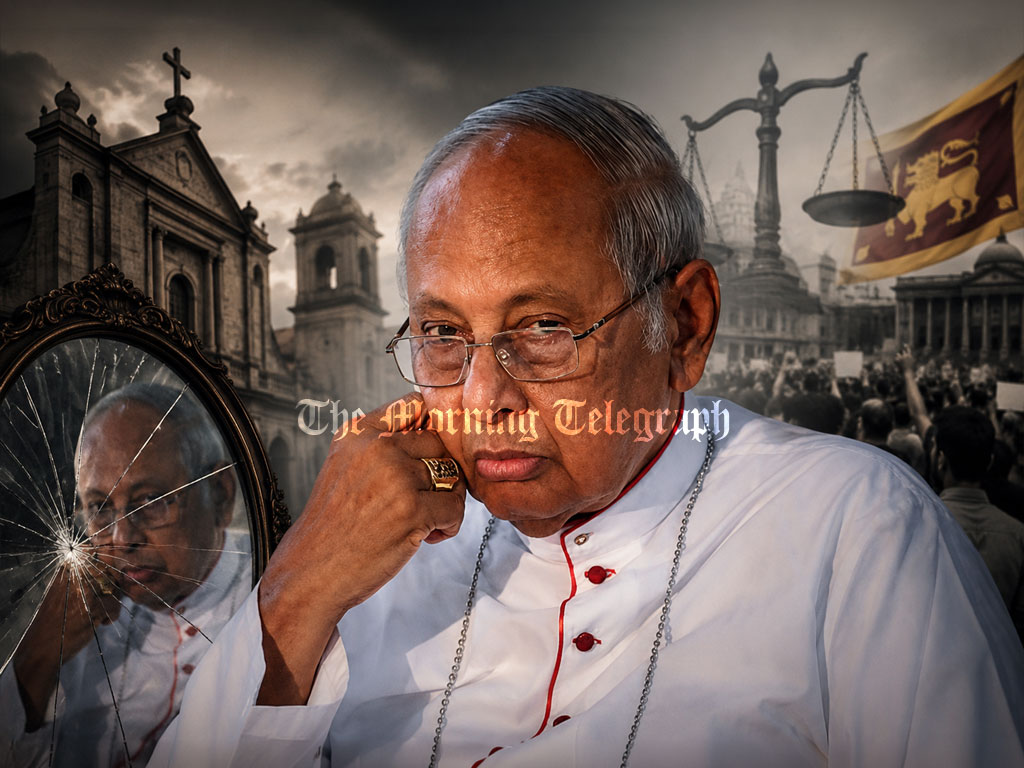
One cannot speak repeatedly in the name of conscience without eventually standing before the same mirror. Many Sri Lankans may wonder what the late Father Tissa Balasuriya, a great Catholic intellectual, would have said if he heard Sri Lanka’s second Cardinal speak about national morality, justice and responsibility today.

Cardinal Ranjith Conscience Message and Moral Burden
A person who speaks in the name of conscience must also examine his own.
Conscience is not a weapon to use against opponents. It is not a political slogan. It is not a convenient argument.
It is a burden carried by every human being, especially those who claim spiritual authority.
In Catholic theology, conscience is not simply personal opinion or political instinct. It is the deepest place where a person encounters moral truth.
The Second Vatican Council, in Gaudium et Spes, declared that “in the depths of his conscience, man detects a law which he does not impose upon himself, but which holds him to obedience.”
That teaching challenges every religious leader. The question is not whether leaders may speak about conscience. They may. The question is whether they are ready to apply that same moral examination to themselves.
The Gospel of Matthew records Christ’s warning: “First take the plank out of your own eye, and then you will see clearly to remove the speck from your brother’s eye.”
That remains one of the most uncomfortable teachings for anyone in authority. It demands self-reflection before public judgment.
It is easy to expose the failures of governments, politicians and opponents. It is far harder to question one’s own actions, decisions and silence.
Justice, Easter Attacks and Due Process
Cardinal Ranjith has often spoken about corruption, injustice, national decline and the suffering of ordinary people.
These are legitimate concerns. A Church that ignores injustice abandons its mission.
Catholic tradition has long insisted that faith cannot be separated from human dignity and social responsibility. From early Christian thought to modern Catholic social teaching, the message remains clear: power must serve truth, not protect itself.
However, moral authority weakens when leaders apply standards to others but not to themselves.
Sri Lanka’s history is filled with difficult questions about identity, nationalism and exclusion.
Since 1956, the country has faced the consequences of political choices built around language, ethnicity and majoritarian identity. Many critics argue that these developments deepened Sinhala-Buddhist political dominance and created wounds still felt today.
Any serious discussion about Sri Lanka’s future must confront these realities. It cannot focus only on present mistakes.
A conscience that condemns today’s injustice but ignores yesterday’s suffering remains incomplete.
The Catholic Church’s demand for truth and justice over national tragedies, including the Easter Sunday attacks, is legitimate. Victims and families deserve answers.
Those responsible for crimes must face accountability.
But justice cannot become vengeance. Public pain cannot replace proper legal process.
Catholic tradition has always separated justice from punishment driven by anger. Even those accused of serious crimes must face judgment through evidence and due process.
Human dignity does not disappear when someone becomes unpopular.
A Mirror for Moral Authority
When calls for extreme punishment become louder than calls for complete truth, another question of conscience emerges.
Is justice truly being served? Or is public anger becoming political pressure?
The Church has a moral duty to demand accountability from governments. But it must also defend the principles that protect every person from arbitrary power.
A Church that demands justice must defend fairness. A Church that speaks about dignity must defend dignity even when doing so is inconvenient.
There is also another unanswered question around leadership itself.
Cardinal Ranjith has remained a central public figure years after reaching the usual retirement age for bishops. A bishop’s resignation requires acceptance by the Pope. Still, public figures with moral influence naturally face questions about transparency, responsibility and the purpose of continued leadership.
Religious authority is not only about holding a position. It is also about showing humility and knowing when authority itself must be questioned.
The ancient Christian tradition teaches that leadership is service. Christ washed the feet of his disciples. He did not seek power as privilege. He showed sacrifice as duty.
Sri Lanka is not looking for a perfect cardinal, a perfect politician or a perfect institution. Such things do not exist.
The country needs a conscience that applies the same standard everywhere: to governments, communities, opponents, supporters and itself.
Including the Cardinal.
A nation does not move forward because one group claims moral superiority over another. It moves forward when those with influence ask the hardest question of all: have I truly followed my conscience, or have I only used conscience to judge others?